
Discover how aligners for teens can effectively address crowding and bite concerns. Learn key insights before your first appointment!
Aligners for Teens: A Parent’s Complete Guide

Clear aligners are a genuinely good option for many teenagers, and for the right candidate, they can be just as effective as traditional braces. The key phrase is “right candidate.” Most teens with mild to moderate crowding, spacing, or bite concerns can do very well with clear aligner treatment, provided they are willing to wear the trays consistently. Here is what you need to know before booking that first appointment:
- Effectiveness: Aligners treat mild to moderate cases effectively; severe jaw or skeletal issues may still require traditional braces.
- Teen-specific design: Modern teen aligner systems include eruption tabs for still-developing teeth and compliance indicators that show whether trays are actually being worn.
- Wear time is non-negotiable: Treatment depends on extensive daily wear each day. Compliance is the single biggest factor in whether aligners succeed.
- A clinical assessment is required: Digital X-rays and a 3D intraoral scan are necessary to confirm your teen is a suitable candidate. No online quiz or photo submission replaces that exam.
Your best immediate next step: schedule an in-office evaluation with a dentist or orthodontist who offers 3D scanning and can review your teen’s full dental development before recommending a path forward.
Table of Contents
- How does teen clear aligner treatment work, step by step?
- Is your 12, 13, or 14-year-old a candidate for aligners?
- What teen-specific aligner systems include and why supervision matters
- Braces vs. clear aligners for teens: how do you choose?
- How much do teen aligners cost, and how do families pay?
- What does the treatment timeline actually look like?
- Practical tips to help your teen succeed with aligners
- Keeping the new smile: retainers and long-term follow-up
- What Dr. Navneet Kamboj wants parents to know before the consult
- Key Takeaways
- A note from Claytondentalstudio on how we approach teen aligner care
- Clear aligner services at Claytondentalstudio in Humble, TX
- Useful sources and further reading
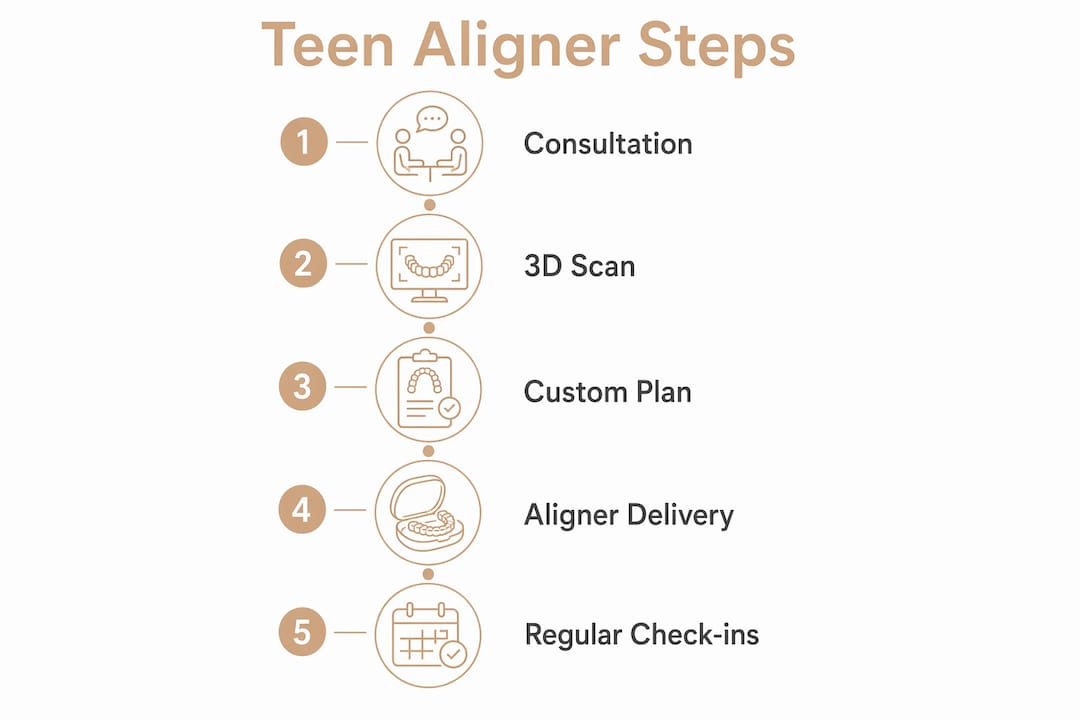
How does teen clear aligner treatment work, step by step?
Understanding the process from start to finish makes the whole experience feel much less daunting. Clear aligner therapy, sometimes called teen Invisalign or simply clear braces for teens, follows a predictable clinical sequence.
- Clinical evaluation. The first visit includes a full dental exam, digital X-rays to assess root and bone health, and a 3D intraoral scan that creates a precise digital model of your teen’s teeth. No messy impressions needed.
- Custom treatment plan. Using 3D planning software, the clinician maps out the exact sequence of tooth movements. You can often see a virtual preview of the expected final result before a single tray is made.
- Aligner fabrication and delivery. Custom-made trays arrive at the office. Each set is designed to move teeth a small, controlled amount. Your teen switches to the next set in the series every one to two weeks.
- Progress check-ins. Many practices schedule in-office visits every 8–12 weeks while some offer remote monitoring between appointments. Fewer visits does not mean less oversight; the supervision model simply shifts to longer intervals with digital check-ins.
- Refinements. If teeth need additional fine-tuning near the end of treatment, a new series of trays is made. This is common and is often included in the original treatment fee.
- Retention phase. Once active treatment ends, retainers hold the new position. This phase is permanent in the sense that some form of retention is always recommended long-term.
Pro Tip: Bring your teen’s most recent dental X-rays, your insurance card, and a written list of questions to the first consult. It saves time and helps the clinician give you a more accurate treatment estimate on the spot.
Is your 12, 13, or 14-year-old a candidate for aligners?
Age alone does not determine candidacy. Dental development and behavioral readiness matter far more than a birth year.
Clinical criteria a dentist will assess:
- Most permanent teeth should be erupted, or the case should be in late mixed dentition where eruption tabs can manage the remaining baby teeth.
- Mild to moderate crowding, spacing, overbite, underbite, or crossbite are all treatable with aligners.
- Severe skeletal discrepancies, such as significant jaw misalignment, often still require traditional fixed braces or even surgical intervention.
Behavioral criteria parents should honestly evaluate:
- Can your teen reliably wear something for 20–22 hours a day without being reminded constantly?
- Do they have a track record of keeping track of their belongings?
- Are their oral hygiene habits solid enough to brush after every meal before reinserting trays?
A quick at-home checklist before the consult:
- Most adult teeth visible in the mouth (check with a flashlight if needed)
- No history of repeatedly losing retainers or small items
- Willingness to follow through on daily routines without significant parental enforcement
- No active gum disease or untreated cavities (these need to be resolved first)
The in-office assessment will confirm everything with digital X-rays and a 3D scan. Think of your home checklist as a way to walk into that appointment with realistic expectations, not as a substitute for the clinical exam.
What teen-specific aligner systems include and why supervision matters
Not all aligner systems are built the same. Products designed specifically for adolescents include features that generic or direct-to-consumer trays simply do not have.
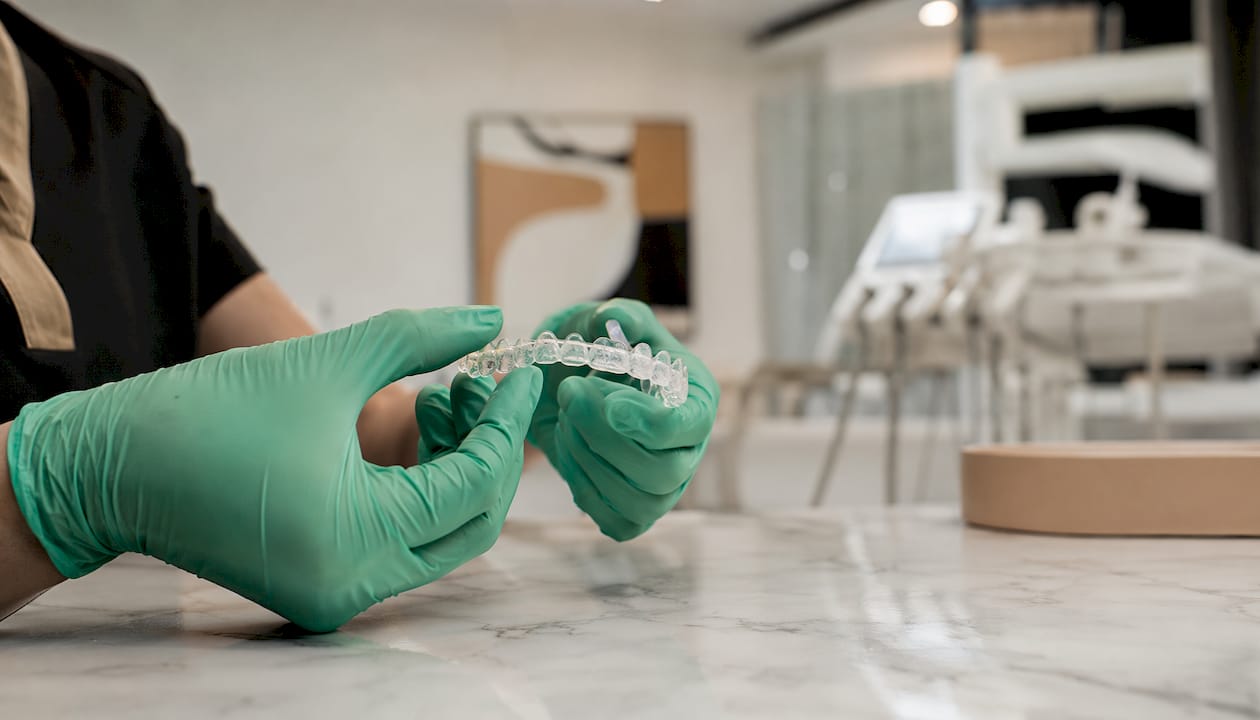
Eruption tabs are built into teen aligner trays to preserve space for permanent teeth that have not yet come in. Without them, a tray could press against a partially erupted tooth and cause unwanted movement or discomfort. This design detail is especially important for younger teens still in late mixed dentition.
Compliance indicators are small blue dots on each tray that fade to clear as wear time accumulates. Parents can check the dots at a glance to see whether the trays are actually being worn. It is a built-in accountability tool that removes the need for constant questioning.
Teen-specific packages also typically include extra replacement trays, because lost or damaged trays are common. Having replacements on hand prevents treatment delays.
Clinical oversight is not optional for growing patients. A teen’s jaw and bite are still developing, which means tooth movement needs to be monitored by a clinician who can catch unwanted changes early. Remote or mail-order aligner models skip the digital X-rays, bite analysis, and in-person checks that make treatment safe. For a teenager whose mouth is still changing, that gap in oversight carries real clinical risk.
Pro Tip: Ask your provider specifically whether the teen-specific version of their aligner system is being used, not the standard adult product. The features are meaningfully different for a developing smile.
Braces vs. clear aligners for teens: how do you choose?
The honest answer is that both can work well. The decision usually comes down to case complexity, your teen’s maturity, and their lifestyle.

| Factor | Clear Aligners | Traditional Braces |
|---|---|---|
| Appearance | Nearly invisible | Visible metal or ceramic brackets |
| Compliance required | Yes, 20–22 hrs/day | No, fixed in place |
| Diet restrictions | None (remove to eat) | Avoid hard, sticky foods |
| Oral hygiene | Normal brushing and flossing | Requires extra tools and care |
| Case complexity | Best for mild to moderate | Handles complex cases effectively |
| Emergency visits | Fewer (no broken brackets) | More common |
| Supervision model | In-office plus remote check-ins | Regular in-office adjustments |
When braces are usually the better call:
- Severe skeletal discrepancies or significant jaw repositioning is needed.
- Complex bite corrections requiring very precise, three-dimensional tooth control.
- Your teen frequently loses belongings or struggles with daily follow-through. Fixed braces remove the compliance variable entirely, which is a genuine clinical advantage for less organized patients.
When aligners tend to be the right fit:
- Mild to moderate crowding, gaps, or bite concerns.
- Your teen is image-conscious and motivated. The near-invisible appearance often boosts confidence during treatment.
- Sports or musical instrument involvement makes brackets and wires impractical.
- Your teen has strong hygiene habits and a reliable daily routine.
The most useful questions to ask at the consult: “Based on the complexity of my teen’s case, which option gives us the most predictable outcome?” and “What would make you recommend switching from aligners to braces mid-treatment?” Those two questions reveal more than any comparison chart.
How much do teen aligners cost, and how do families pay?
Cost is one of the first things parents want to know, and the range can be quite variable depending on case complexity, number of trays needed, and included services.
| Cost Factor | Lower End | Higher End |
|---|---|---|
| Case complexity | Mild crowding or spacing | Moderate bite correction |
| Refinements | Included in fee | Billed separately |
| Retainers | Included | Additional cost |
| Geographic location | Smaller markets | Major metro areas |
How families typically pay:
- Dental insurance: Many plans that include orthodontic coverage apply the same benefit to clear aligners as to braces. Check your plan’s orthodontic lifetime maximum (commonly $1,000–$2,000) and whether it covers any licensed provider or only in-network ones.
- HSA/FSA: Out-of-pocket orthodontic expenses are generally eligible for Health Savings Account and Flexible Spending Account reimbursement. Keep all receipts and the treatment plan documentation.
- In-office financing: Most practices offer payment plans with a down payment and monthly installments. Ask specifically whether the quoted fee includes refinements and retainers, or whether those are billed separately.
Checklist to bring to the cost conversation at your consult:
- Your insurance card and the orthodontic benefit summary from your plan
- A question about what is and is not included in the quoted fee
- A question about the policy for lost or broken trays (replacement cost or included?)
- A question about whether the retention phase retainers are part of the package
What does the treatment timeline actually look like?
Active treatment typically takes several months to over a year, depending on case complexity and compliance. The single biggest variable is compliance.
What to expect at each stage:
- Month 1: Trays are delivered, attachments (small tooth-colored bumps that help aligners grip) may be placed, and your teen adjusts to wearing them. Mild pressure when switching to a new set is normal and usually fades within a day or two.
- Months 2–6: Visible changes often begin around this point, particularly with spacing or mild crowding. Check-ins confirm the teeth are tracking as planned.
- Mid-treatment: The clinician reviews progress against the digital plan. If teeth are not tracking correctly, adjustments to the plan or additional attachments may be made.
- Refinement phase: Near the end of active treatment, a new short series of trays may be made to fine-tune final positions. This is routine, not a sign that something went wrong.
- Retention: Active treatment ends, retainers begin. This transition is immediate.
Poor compliance is the most common reason timelines extend. A teen who regularly skips wear time may need additional trays or, in some cases, a switch to fixed braces. The compliance indicator dots give you an early warning before a small habit problem becomes a significant delay.
Practical tips to help your teen succeed with aligners
Good habits established in the first two weeks tend to stick for the rest of treatment. The reverse is also true.
Daily habits that keep treatment on track:
- Aligners go back in immediately after eating, not after the next activity. A phone alarm set for meal times helps.
- Always store trays in their case when out of the mouth. Trays left on lunch trays or napkins disappear regularly.
- Rinse trays with cool water before reinserting and brush them gently with a soft toothbrush. Hot water warps the plastic.
- Brush teeth after every meal before reinserting trays. Food trapped under a tray accelerates decay.
School and sports guidance:
- Teachers do not need to know about the aligners. Your teen can remove them discreetly before eating and reinsert after.
- For contact sports, remove the aligners and wear a standard mouthguard during practice and games. Put the aligners back in as soon as the activity ends.
- For performances or photos, aligners are nearly invisible and can stay in. If your teen prefers to remove them briefly, that is fine as long as the daily wear total stays at 20–22 hours.
Pro Tip: Rather than asking “Did you wear your aligners today?” every evening, agree on a weekly check-in where your teen shows you the compliance indicator dots. It shifts the dynamic from interrogation to shared accountability, and it gives you real information instead of a yes/no answer.
Keeping the new smile: retainers and long-term follow-up
Finishing active treatment is not the finish line. Teeth have a natural tendency to drift back toward their original positions, and that tendency does not disappear once the aligners come off.
Retainer types your teen’s provider may recommend:
- Clear removable retainers: The most common choice after aligner treatment. They look similar to aligners and are worn nightly. Retainer wear schedules typically start full-time (20–22 hours/day) for the first few months, then transition to nights only.
- Hawley retainers: A wire-and-acrylic design that is durable and adjustable. Less common after aligner treatment but still used in some cases.
- Fixed bonded retainers: A thin wire bonded to the back of the front teeth. Requires no daily compliance but needs professional removal if it breaks.
Understanding the types of dental retainers available helps you have a more informed conversation with your provider about which option fits your teen’s habits and lifestyle.
Life events that can destabilize results:
- Wisdom tooth eruption can shift front teeth. Monitor with periodic X-rays.
- Growth spurts in younger teens can alter jaw relationships.
- Prolonged gaps in retainer wear, even years after treatment, can lead to noticeable relapse.
A simple annual check-in with the dentist or orthodontist is usually enough to catch any early shifting before it becomes a problem that requires retreatment.
What Dr. Navneet Kamboj wants parents to know before the consult
At Claytondentalstudio, we see parents come in with a lot of questions and sometimes a lot of anxiety about whether they are making the right call. That is completely understandable. Here is the perspective Dr. Kamboj shares with families considering clear aligners for their teen:
Questions to ask at your teen’s first consult:
- Is my teen’s case mild, moderate, or complex, and does that change which treatment is best?
- How will you monitor the eruption of any teeth that have not come in yet?
- What happens if my teen loses or damages a tray?
- Are refinements and retainers included in the quoted fee?
- How often will we need in-office visits, and do you offer remote check-in options?
- What are the signs that we should switch to braces instead?
- How do you track compliance, and what happens if wear time is consistently low?
Claytondentalstudio’s workflow includes in-office 3D scanning, a personalized digital treatment plan, and scheduled progress checks to make sure teeth are moving as planned. Dr. Kamboj’s approach combines clinical precision with the kind of honest, straightforward communication that helps families make confident decisions.
Key Takeaways
Clear aligners work well for teens with mild to moderate orthodontic issues when daily wear of 20–22 hours is maintained and a licensed clinician provides ongoing oversight throughout treatment.
| Point | Details |
|---|---|
| Compliance is the deciding factor | Teens must wear aligners 20–22 hours daily; consistent noncompliance makes braces the more reliable choice. |
| Clinical assessment is required | Digital X-rays and a 3D scan confirm suitability; no online evaluation replaces an in-office exam. |
| Cost ranges from $3,000 to $8,000 | Insurance, HSA/FSA, and in-office financing can all reduce out-of-pocket costs significantly. |
| Retention is permanent | Retainers are needed long-term after treatment ends; skipping them leads to relapse. |
| Claytondentalstudio offers in-office evaluation | Dr. Kamboj provides 3D scanning and personalized treatment planning for teen patients in the Humble, TX area. |
A note from Claytondentalstudio on how we approach teen aligner care
I’m Dr. Kamboj, and I want to be straightforward with you: not every teen is a clear aligner candidate, and I will tell you that honestly at the first visit. What I have found over nearly a decade of practice in the greater Houston area is that the families who do best are the ones who come in informed, ask good questions, and leave with a realistic picture of what treatment involves.
At Claytondentalstudio, we offer invisible braces and clear aligner services right here in Humble, TX, serving families across the Atascocita and surrounding communities. Every teen evaluation starts with a 3D digital scan and a thorough clinical exam. We review the results together, walk through the options, and make a recommendation based on your teen’s actual dental development, not a one-size-fits-all protocol.
If you are ready to find out whether your teen is a good candidate, the next step is simple: book a consultation. We will handle the rest.
Clear aligner services at Claytondentalstudio in Humble, TX
Families in the Humble and Atascocita area have a local option for in-office teen aligner care that does not require driving into the city.
At Claytondentalstudio, the clear aligner program includes 3D digital scanning at the initial evaluation, a custom treatment plan reviewed with parents and teens together, in-office progress checks, and guidance on retention after treatment. Dr. Kamboj accepts many dental insurance plans with orthodontic benefits, and the office works with patients on financing options to make treatment manageable. HSA and FSA payments are accepted for eligible out-of-pocket costs.
Ready to take the first step toward your teen’s healthier smile? Book a consultation at Claytondentalstudio and let us give you a clear, honest picture of what treatment would look like for your teen specifically.
Useful sources and further reading
- American Association of Orthodontists: Orthodontics for Teens
- Koch Orthodontics: Invisalign for Teens — What Parents and Teens Actually Need to Know
- Braces World Orthodontics: Are Teen-Friendly Clear Aligners Right for Your Teen?
- Feller Orthodontics: Clear Aligners for Teens
- ARIA Dental Care: Things You Should Know About Invisalign Teens
- ClearRetain: How Long Do You Have to Wear a Retainer?
- Claytondentalstudio: Clear Aligners Service Page
- Claytondentalstudio: Invisalign Provider in Atascocita
This article is for general informational purposes only and does not constitute professional dental or orthodontic advice. Please consult a licensed dental provider to evaluate your teen’s specific situation and confirm current treatment options.
Recommended
Ready to Schedule Your Appointment?
Dr. Kamboj and the Clayton Dental Studio team are here to help. Call us or book online today.