
Understand the three peel depths—superficial, medium, deep—and which acids treat acne, pigment, or texture. Find skin-type-aware matching and realistic...
3 Chemical Peel Types That Match Your Skin Type and Goal
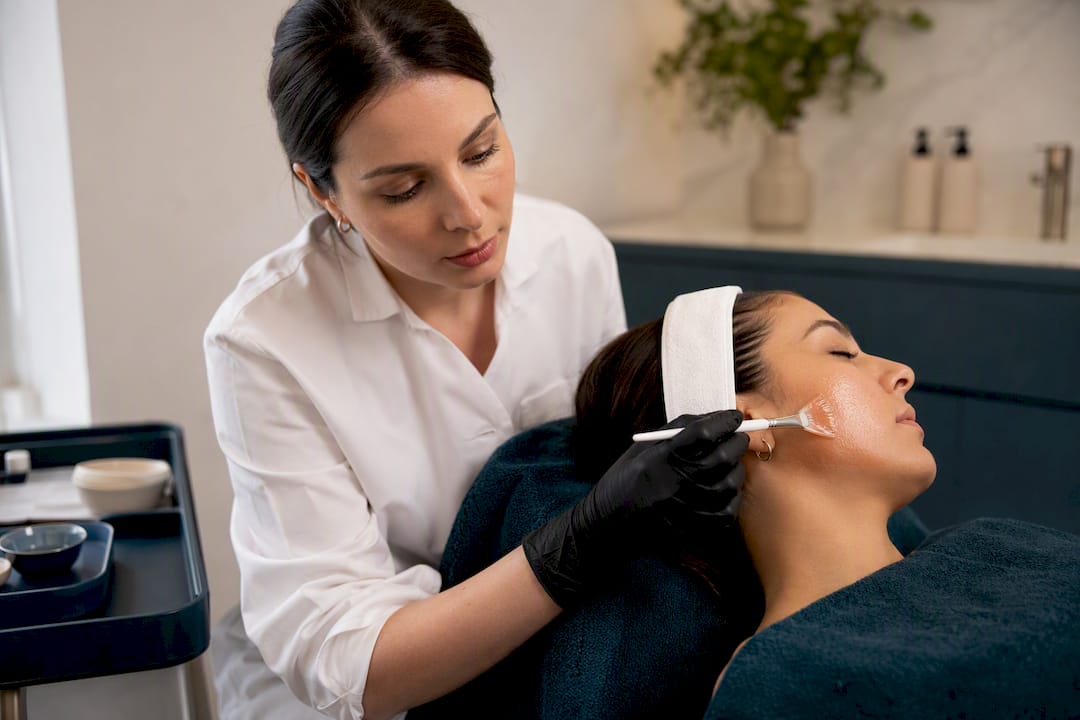
Chemical peels fall into three depth categories: superficial, medium, and deep. Superficial peels smooth texture and brighten dullness with almost no downtime, medium peels tackle pigment and fine lines with about a week of recovery per common clinical experience, and deep peels address significant scarring or wrinkling with a longer, higher-risk recovery. The right choice depends on your skin concern, your skin tone, and how much downtime you can actually afford. Talk with a provider before deciding.
TL;DR:
- Superficial peels target only the outer epidermis and usually require only a few hours to three days of redness and flaking.
- Medium-depth peels penetrate into the papillary dermis, typically necessitating about a week of visible peeling and social downtime.
- Deep peels reach into the mid-reticular dermis, involving longer recovery times of multiple weeks and carrying rare but serious systemic risks.
- Agent selection and technique significantly influence peel depth and results, making provider expertise essential for safety and effectiveness.
- Skin type, medical history, and specific concerns like hyperpigmentation or acne should guide individualized peel choices, especially for darker skin tones.
Table of Contents
- What Are the Different Chemical Peel Types?
- Which Peeling Agent Treats Which Skin Problem?
- Are You a Good Candidate for a Chemical Peel?
- How Should You Prepare for a Peel and What Comes After?
- How Do You Choose the Right Peel and Provider?
- How Clayton Dental Studio Approaches Peel Selection
- What Actually Matters When Picking a Peel
- Ready for a Personalized Skin Assessment?
- Sources
What Are the Different Chemical Peel Types?
Every peel works by controlled injury. The acid removes damaged skin cells, and your body responds by producing fresh, more evenly pigmented tissue. What separates one peel from another is how far that injury reaches into the skin.
Superficial peels affect only the epidermis, the skin’s outer layer. Medium peels travel through the epidermis and into the papillary dermis, sometimes reaching the upper reticular dermis. Deep peels go further still, penetrating into the mid-reticular dermis, according to StatPearls. That difference in depth explains almost everything else about a peel: how much it hurts, how long you’re recovering, and how dramatic the final result looks.
Superficial peels typically rely on alpha hydroxy acids like glycolic or lactic acid, low-strength salicylic acid, or a Jessner solution. Medium-depth treatments commonly use trichloroacetic acid (TCA) at intermediate concentrations, sometimes layered with a lighter agent first. Deep peels use higher-concentration TCA or a phenol and croton oil combination, per the same StatPearls reference. These agent lists are typical starting points, not fixed rules. A clinician’s technique, meaning contact time, the number of passes, and neutralization timing, can shift the effective depth independent of the acid’s labeled concentration, as DermaNet NZ explains. That’s why two patients getting “the same peel” from different providers can walk away with different results.
Recovery scales with depth in a fairly predictable way. Superficial peels generally cause redness or light flaking for a few hours up to a few days. Medium peels usually require about a week of visible peeling and social downtime. Deep peels involve a significantly longer, more supervised recovery, DermaNet NZ notes, and deep phenol peels in particular carry rare but serious risks, including cardiac and nerve effects from systemic absorption.
| Depth | Common agents | Best for | Typical downtime |
|---|---|---|---|
| Superficial | Glycolic, lactic, low-strength salicylic, Jessner | Dullness, mild texture, early pigment | Hours to 3 days |
| Medium | Intermediate-strength TCA, combination peels | Hyperpigmentation, fine lines, sun damage | About 1 week |
| Deep | High-strength TCA, phenol/croton oil | Deep wrinkles, significant scarring | Multiple weeks, closely supervised |
Which Peeling Agent Treats Which Skin Problem?
Glycolic and salicylic acid get compared constantly, and for good reason: they work in genuinely different ways. Glycolic acid is an alpha hydroxy acid (AHA). It’s water-soluble, so it works mostly on the skin’s surface, smoothing texture and fading dullness. Salicylic acid is a beta hydroxy acid (BHA). It’s oil-soluble, which lets it slip past sebum and actually get inside a clogged pore, according to a 2025 comparative study on acne treatment.
That difference in solubility is the whole story behind “best peel for hyperpigmentation” versus “best peel for acne.” If oily, congested skin and breakouts are your main concern, salicylic tends to outperform glycolic, sometimes with fewer side effects, according to research comparing AHA and BHA peels for facial acne. If dryness, dullness, or early photoaging is the issue, glycolic is usually the more comfortable starting point.
Beyond those two, a few other agents come up often in consultations:
- Jessner solution blends resorcinol, salicylic acid, and lactic acid into a keratolytic mix suited to uneven pigment and rougher texture.
- TCA works at multiple strengths and is the workhorse of medium-depth peeling for sun damage and finer lines.
- Phenol is reserved for deep resurfacing of significant wrinkling or scarring, and it demands careful medical monitoring because of its systemic toxicity risk.
- Mandelic acid, a gentler AHA, is often the fallback for people whose skin can’t tolerate glycolic or salicylic at typical strengths.
Concentration and technique matter as much as the agent itself. A glycolic peel at 70% applied briefly and neutralized quickly behaves differently than the same acid left on longer. This is part of why peel selection belongs with a trained provider rather than a shelf product.
Are You a Good Candidate for a Chemical Peel?
Not every skin type tolerates every peel equally, and this is where a lot of people run into trouble by choosing based on price or trend rather than fit. A few factors decide candidacy before agent or depth even enters the conversation:
- Active cold sores, open wounds, or active skin infections rule out peeling until healed.
- Isotretinoin use within the past six to twelve months is generally a contraindication for medium and deep peels.
- Pregnancy and breastfeeding limit which acids are considered safe.
- A history of keloid scarring raises caution flags for anything beyond superficial depth.
- Recent intense sun exposure or a tan increases the risk of uneven results.
Fitzpatrick skin type matters just as much as any of those. Darker skin tones, typically Fitzpatrick IV through VI, carry a meaningfully higher risk of post-inflammatory hyperpigmentation (PIH) after stronger peels, particularly TCA at higher concentrations. Milder acids, staged lower-concentration protocols, or mandelic acid are often safer starting points for these skin tones rather than jumping straight to a medium-depth treatment. Peel selection should always be individualized. What suits dry or photoaged skin, often a glycolic-based approach, isn’t automatically right for oily, acne-prone, or deeply pigmented skin.
Pro Tip: Always disclose your complete medication history, any recent isotretinoin use, and recent sun exposure before a peel, even if it feels unrelated. A provider can’t calibrate depth or agent safely without the full picture.
Anyone with active dermatologic conditions, unclear moles, or a complex medical history should be referred to a dermatologist before considering anything past a superficial peel.
How Should You Prepare for a Peel and What Comes After?
Preparation isn’t optional for deeper treatments. Priming skin ahead of a medium or deep peel can take up to eight weeks, according to Cleveland Clinic, and typically means introducing a retinoid or a mild acid at home to build tolerance while stopping anything irritating, like harsh scrubs or other actives. Superficial peels rarely need this runway.
- In the weeks before: Follow your provider’s priming routine, stop retinoids a few days prior if instructed, and avoid sun exposure and tanning.
- During the session: The provider applies the acid in controlled passes, watching for a “frosting” reaction that signals depth, then neutralizes or lets it self-neutralize depending on the agent. Expect tingling or brief stinging rather than sharp pain.
- Immediate recovery (0 to 72 hours): Redness, tightness, and mild flaking are normal; gentle cleansing and a bland moisturizer are usually all that’s needed.
- Short-term (3 to 10 days): Visible peeling continues for medium-depth treatments; avoid picking, and keep sun protection strict.
- Longer-term (2 to 8 weeks): Skin tone continues evening out, and results from medium peels often become fully visible in this window.
Call your provider promptly if you notice signs of infection, unusual pigment changes, or pain that seems disproportionate to the treatment. Those aren’t normal healing signs.
How Do You Choose the Right Peel and Provider?
Start with your primary concern, not the peel that’s trending. Acne and oily skin point toward salicylic. Pigment, sun damage, and fine lines point toward glycolic, TCA, or a combination approach. Deep static wrinkles or significant scarring are the only real justification for considering deep peels at all, and even then, caution is warranted; deep phenol peels are uncommon in modern practice given their toxicity profile, and most patients are better served by a series of medium-depth treatments or an alternative resurfacing method.
Before booking, ask your provider directly:
- What agent and concentration are you using, and why for my skin type?
- Who is physically applying and neutralizing the peel?
- Can I see before-and-after photos of similar skin tones to mine?
- How many sessions will I realistically need to see results?
- What does your aftercare plan look like, and what’s your protocol if something goes wrong?
A provider who can’t answer these clearly, or who pushes a strong peel without asking about your Fitzpatrick type and medical history, is a red flag. Chemical peels also pair well with other treatments, but realistic expectations matter: peels improve texture and tone far more reliably than they resolve skin laxity, which usually needs a different approach entirely.
How Clayton Dental Studio Approaches Peel Selection
Dr. Navneet Kamboj built the Dermal Hygiene™ program on the same philosophy that guides her dental work: prevention first, precision always. Within that program, peel selection is individualized rather than templated, with conservative protocols and proper skin priming built into every plan, especially for patients with deeper skin tones or sensitive fine lines and wrinkles concerns. Clinic case examples and patient outcomes will be added here as they become available.
What Actually Matters When Picking a Peel
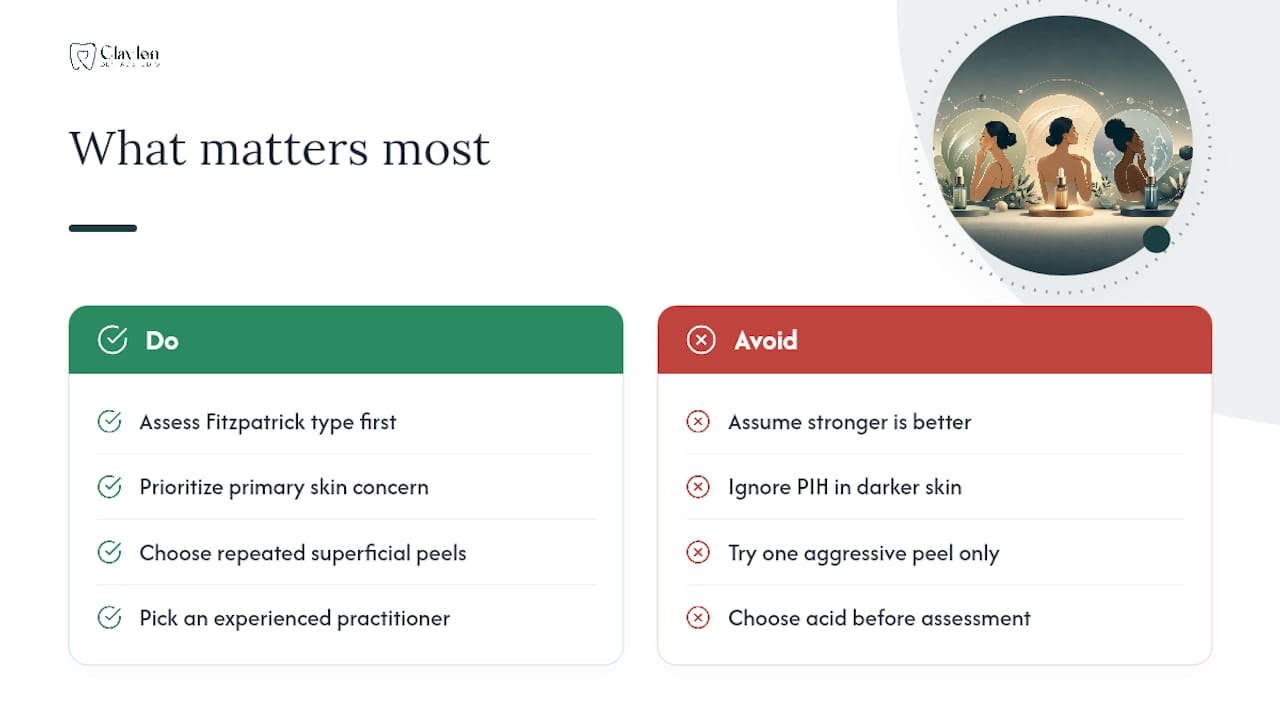
Most of the confusion around chemical peels comes from treating “chemical peel” as one product instead of a spectrum. The marketing around aggressive peels tends to imply that stronger automatically means better, and that’s simply not supported by how skin heals. A well-matched superficial peel repeated consistently often outperforms a single aggressive medium peel that leaves skin raw for a week and still doesn’t address the actual concern.
The conventional advice to “just try a peel and see” also falls short for anyone with a medium to deep skin tone. PIH risk isn’t a footnote, it’s often the deciding factor in which agent and concentration make sense, and it deserves more weight in that decision than downtime tolerance or price. Our honest take: prioritize getting your Fitzpatrick type and primary concern assessed accurately before you ever discuss which acid to use. The agent matters less than most marketing suggests. The match between your skin and the person applying the peel matters more.
— Clayton Dental Studio
Ready for a Personalized Skin Assessment?
Reading about depth classifications and acid concentrations only gets you so far. Your skin’s actual behavior, your Fitzpatrick type, your acne history, your pigment patterns, needs a trained eye in the room, not a chart. Clayton Dental Studio’s Dermal Hygiene™ consult gives you exactly that: a hands-on assessment where treatment is matched to your specific skin, not a generic protocol.
A Dermal Hygiene™ consult makes sense if you’ve been guessing your way through drugstore acids, if a past peel left you with uneven results, or if you simply want a clinician to map out a realistic plan before you spend money on the wrong treatment. During the visit, Dr. Kamboj reviews your history, skin type, and goals, then recommends a conservative, individualized starting point rather than pushing the strongest option available. If jaw tension or facial discomfort is part of your picture too, ask about how Emface TMJ therapy fits alongside skin care at the same visit. Schedule your Dermal Hygiene™ consultation to get a plan built around your actual skin, not a generic one.
Sources
- Chemical Peels for Skin Resurfacing - StatPearls (NCBI Bookshelf)
- Chemical peels (DermaNet NZ)
- A comparative study of 30% salicylic acid peel and 50% glycolic acid peel in mild to moderate acne vulgaris (2025)
- Chemical peels - Cleveland Clinic
This article is general information, not a substitute for advice from a qualified doctor. Consult a qualified healthcare professional about your own circumstances before acting on anything here.
Ready to Schedule Your Appointment?
Dr. Kamboj and the Clayton Dental Studio team are here to help. Call us or book online today.