Discover the porcelain veneers cost in Houston. Learn about pricing, what affects costs, and schedule a personalized consultation today!
Porcelain Veneers Cost in Houston: 2026 Price Guide
Porcelain veneers in Houston typically run $1,200–$2,200 per tooth for traditional porcelain, with a 6-tooth smile makeover package ranging from $8,000–$18,000 depending on the lab, the dentist’s cosmetic experience, and any preparatory work your teeth need. A separate data set puts the Houston per-tooth average closer to $1,390, with a typical self-pay range of $1,030–$1,716. Both ranges are accurate — the spread reflects real differences in material quality, lab sourcing, and case complexity, not just marketing.
If you’re budgeting for veneers in the greater Houston area, the single most useful next step is scheduling a consult with a cosmetic dentist who can give you a written, itemized quote. At Clayton Dental Studio in Humble, TX, Dr. Navneet Kamboj offers personalized cosmetic consultations where she walks you through your options, your candidacy, and a realistic cost breakdown before any treatment begins.
- Per tooth (porcelain): $1,200–$2,200
- Per tooth (average, self-pay): ~$1,390
- 6-tooth package: $8,000–$18,000 (typical range)
- Full smile (8–10 teeth): $12,000–$22,000+
- Next step: Book a consult and request a written, itemized quote
Key Takeaways
Porcelain veneers in Houston cost $1,200–$2,200 per tooth, with a 6-tooth package typically ranging $8,000–$18,000, and the final number depends on lab quality, case complexity, and any preparatory work your teeth need.
| Point | Details |
|---|---|
| Houston per-tooth range | Porcelain veneers run $1,200–$2,200 per tooth; the self-pay average is approximately $1,390. |
| Package pricing | A 6-tooth smile-zone case typically totals $8,000–$18,000; a full smile (8–10 teeth) runs $12,000–$22,000+. |
| Biggest cost drivers | Lab quality, dentist cosmetic experience, and preparatory dental work move the price more than geography. |
| Insurance and financing | Veneers are rarely covered by insurance; third-party dental financing and in-office plans are the most common payment routes. |
| Clayton Dental Studio | Dr. Navneet Kamboj offers personalized veneer consultations in Humble, TX, with written cost breakdowns and financing guidance. |
Table of Contents
- How much do porcelain veneers cost in Houston?
- Porcelain, composite, and Lumineers: how material changes your cost and results
- Insurance, HSA/FSA, and financing options for veneers in Texas
- Lower-cost alternatives to porcelain veneers and when they make sense
- Who is and isn’t a good candidate for porcelain veneers
- How long do porcelain veneers last, and what does maintenance look like?
- Clayton Dental Studio: local expertise for your veneer consultation
- Why the consult matters more than the price list
- Ready to plan your smile? Schedule a consult at Clayton Dental Studio
- Sources and further reading
How much do porcelain veneers cost in Houston?
Houston sits close to the national average for porcelain veneer pricing, though your final cost depends heavily on the specific factors covered below. Here’s a practical breakdown by case size to help you map your budget.
| Case size | Teeth covered | Estimated total range |
|---|---|---|
| Single tooth | 1 | $1,030–$2,200 |
| Small correction | 2–4 | $1,200–$2,200 |
| Smile zone | 6 | $8,000–$18,000 |
| Full smile | 8–10 | $12,000–$22,000+ |
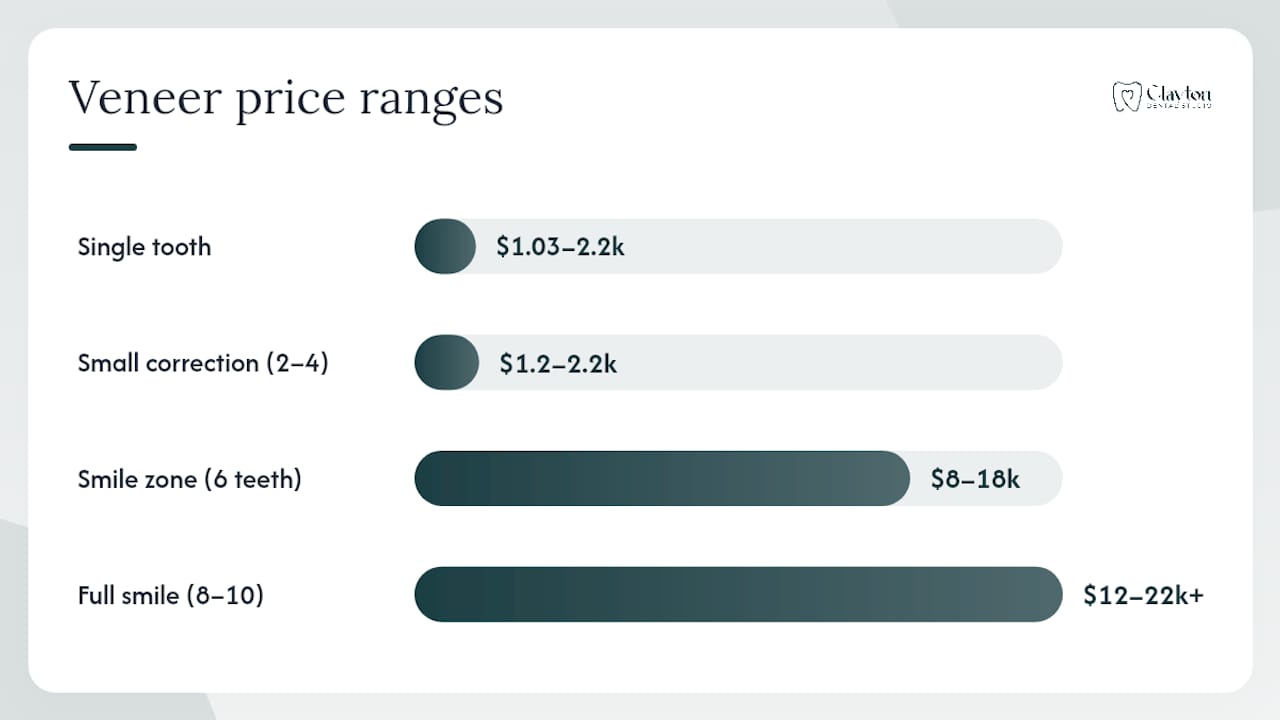
The overlap between the low end of a 6-tooth case and the high end of a 4-tooth case is intentional. A 4-tooth case with premium lab work and digital smile design can cost more than a 6-tooth case done with a mid-tier lab. Price per tooth often drops slightly as the case size grows, but lab fees, temporaries, and prep costs scale with the number of teeth involved.
Six-tooth cases are among the most commonly requested packages because they cover the “smile zone” — the teeth visible when you smile naturally. Patients considering bundled 6-unit pricing should ask whether the quoted total includes temporaries, shade consultations, and follow-up adjustments, since those line items vary by clinic.
Porcelain, composite, and Lumineers: how material changes your cost and results
The term “veneers” covers several distinct products with very different price points, lifespans, and clinical outcomes. Understanding the differences helps you ask better questions at your consult.
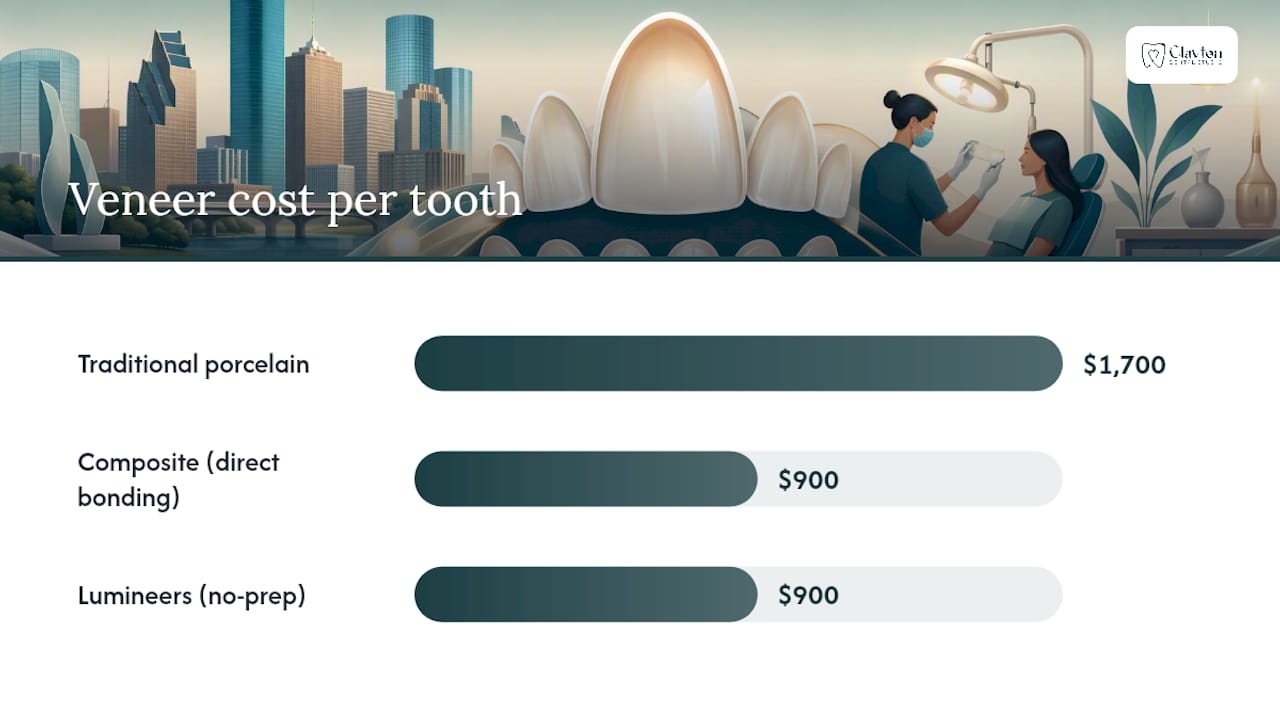
| Type | Cost per tooth | Typical lifespan | Prep required | Esthetic outcome |
|---|---|---|---|---|
| Traditional porcelain | $1,200–$2,200 | 10–20 years | Yes (enamel reduction) | Excellent — natural translucency |
| Composite (direct bonding) | $300–$1,500 | 5–7 years | Minimal to none | Good — less translucent than porcelain |
| Lumineers / no-prep veneers | $300–$1,500 | 10–20 years | Minimal | Good — slightly bulkier appearance |
Traditional porcelain veneers require a small amount of enamel removal (usually 0.3–0.5 mm) so the finished veneer sits flush with your natural tooth line. That prep is permanent, which is why candidacy matters so much. Composite bonding skips the lab entirely — the dentist sculpts resin directly onto your tooth in a single visit — making it a genuinely reversible, lower-cost option for minor corrections.
Lumineers and similar no-prep brands use ultra-thin porcelain that bonds over the existing tooth with little to no reduction. They’re a reasonable choice for patients with healthy enamel and mild cosmetic concerns, though the slightly thicker profile can look less natural on some tooth shapes. One practical note: whitening products don’t change the color of existing porcelain veneers or crowns, so if you’re considering whitening your natural teeth to match new veneers, that whitening needs to happen before the shade is selected and the veneers are fabricated.
Insurance, HSA/FSA, and financing options for veneers in Texas
Porcelain veneers are classified as a cosmetic procedure by virtually every U.S. dental insurance plan, which means standard dental insurance won’t cover them. There are narrow exceptions — if a veneer is placed to restore a tooth fractured in an accident or to address a documented functional problem — but for elective smile improvement, you should plan to pay out of pocket.
That said, you have more options than you might expect.
- HSA and FSA accounts. Health Savings Accounts (HSA) and Flexible Spending Accounts (FSA) can sometimes be used for veneer-related costs when a portion of the treatment is medically necessary (for example, a preparatory crown or treatment for decay). Check with your plan administrator before assuming eligibility, since purely cosmetic veneers are typically excluded.
- Third-party dental financing. Companies like CareCredit and Lending Club Patient Solutions offer dedicated dental financing with promotional periods that can include deferred interest or low monthly payments. Applying for a dental financing plan typically involves a soft credit check, and approval decisions are often same-day. Down payments vary by lender and case size.
- In-office payment plans. Some practices offer their own installment arrangements, particularly for established patients. These vary widely — ask directly whether the clinic offers in-house financing and what the terms are.
- Combined treatment financing. If your veneer case includes preparatory restorative work (fillings, crowns, gum treatment), some of that work may be partially covered by insurance, reducing your net out-of-pocket cost for the overall treatment plan.
The cosmetic dentistry services at Clayton Dental Studio include guidance on payment options during your consultation, so you can plan your budget before committing to a treatment plan.
Lower-cost alternatives to porcelain veneers and when they make sense
Porcelain veneers are a long-term investment, and they’re not the right solution for every cosmetic concern. Several alternatives deliver meaningful results at a lower price point.
- Composite bonding. Direct resin bonding costs $300–$1,500 per tooth and can correct chips, small gaps, and minor discoloration in a single visit. It’s reversible, requires no enamel removal, and is a smart starting point for younger patients or anyone not ready to commit to permanent prep. The trade-off is durability — composite stains and chips more easily than porcelain and typically needs replacement or touch-ups within 5–7 years.
- Professional teeth whitening. For patients whose primary concern is color rather than shape, professional whitening ($300–$700 for an in-office treatment) is the most conservative option. Keep in mind that whitening won’t correct chips, gaps, or uneven edges, and it has no effect on existing restorations.
- Clear aligners. If spacing or mild crowding is the core issue, clear aligner treatment addresses the root problem rather than masking it with a restoration. Aligning teeth first can also reduce the number of veneers needed, lowering your total cost.
- Dental crowns. When a tooth is structurally compromised — heavily filled, cracked, or root-canal treated — a crown is often the more appropriate restoration. Crown costs in Houston are generally comparable to or slightly higher than veneers per tooth, but they cover the entire tooth and provide more structural support.
A good cosmetic dentist will tell you honestly when a less invasive option is the better clinical choice. If a practice pushes veneers on every patient without discussing alternatives, that’s worth noticing.
Who is and isn’t a good candidate for porcelain veneers
Not everyone who wants veneers is ready for them on the first visit. Several conditions need to be addressed before veneer placement is appropriate.
Common disqualifiers — these need to be treated first:
- Untreated tooth decay or active gum disease — veneers placed over unhealthy teeth will fail prematurely
- Severe bruxism (teeth grinding) without a protective nightguard plan — grinding generates forces that crack porcelain
- Insufficient enamel — veneers bond to enamel; if too much has been lost to erosion or prior prep, bonding strength is compromised
- Significant misalignment — veneers can mask minor crowding, but moderate-to-severe cases are better corrected with orthodontics first
- Unrealistic expectations — veneers improve shape, color, and proportion, but they don’t change your facial structure
Red flags to watch for in a quote or clinic:
- No before-and-after photo portfolio from actual patients
- No written warranty or repair policy
- No digital planning or shade consultation included in the process
- A quote with no itemized breakdown (just a single total number)
Questions to bring to your consult:
- “What condition does my enamel need to be in for veneers to bond properly?”
- “Do I need any preparatory work before we can start?”
- “What happens if a veneer chips or debonds — is that covered?”
- “Can I see before-and-after photos of cases similar to mine?”
How long do porcelain veneers last, and what does maintenance look like?
Well-placed porcelain veneers typically last 10–20 years with proper care. The range is wide because lifespan depends heavily on your habits, your bite, and how consistently you follow up with your dentist.
Factors that shorten veneer lifespan:
- Untreated bruxism — grinding is the leading cause of premature veneer fracture
- Biting hard objects (ice, fingernails, pen caps)
- Poor oral hygiene leading to gum recession, which exposes the veneer margin
- Acidic diet that weakens the bonding interface over time
Routine maintenance checklist:
- Wear a custom nightguard if you grind or clench
- Brush with a non-abrasive toothpaste (avoid whitening formulas with heavy abrasives)
- Floss daily — gum health directly affects how long your veneers look good
- Schedule routine hygiene visits every 6 months so your dentist can check margins and bonding
- Avoid using your veneered teeth to open packaging or bite into very hard foods
One thing worth knowing: whitening products have no effect on porcelain. If your natural teeth yellow over time while your veneers stay the same shade, the color mismatch becomes visible. Some patients address this with periodic professional whitening of their non-veneered teeth to maintain a consistent look.
Repair and replacement costs: A chipped or debonded veneer can sometimes be repaired for $200–$500 depending on the extent of damage. Full replacement runs the same as the original cost per tooth. After 15–20 years, full replacement of a smile-zone case is a realistic budget item — plan for it.
Clayton Dental Studio: local expertise for your veneer consultation
Dr. Navneet Kamboj brings nearly a decade of experience serving patients across the greater Houston area from Clayton Dental Studio’s Humble, TX location. She earned her Doctor of Dental Surgery (DDS) from the University at Buffalo and completed a specialized restorative preceptorship at UCLA — training that directly informs how she approaches cosmetic cases, from shade selection to final bite adjustment.
Patients throughout the Humble and Atascocita communities know Dr. Kamboj for her honesty and her attention to detail. She takes the time to explain every step of the process, discuss realistic outcomes, and make sure you feel comfortable before any treatment begins.
What Clayton Dental Studio offers veneer patients:
- Personalized cosmetic consultations with digital smile planning
- Traditional porcelain veneers and cosmetic bonding options
- Preparatory restorative care (fillings, crowns, gum treatment) handled in-house before veneer placement
- Same-day CEREC crown technology for patients who need restorative prep
- Financing guidance and payment plan options discussed at your first visit
- Before-and-after documentation so you can see realistic outcomes
- Follow-up care and adjustment appointments as part of your treatment plan
The practice’s approach to cosmetic dentistry is grounded in the same philosophy that guides all of Dr. Kamboj’s work: honest assessment, careful planning, and results that feel natural. You can explore the full range of cosmetic services at Clayton Dental Studio to see what’s available for your specific goals.
Why the consult matters more than the price list
Price shopping for veneers online gives you a useful starting range, but it can create a false sense of certainty. The $1,200–$2,200 per-tooth range is real, but where your case lands within that range — and what your total actually includes — only becomes clear after a dentist examines your teeth, reviews your X-rays, and understands what you’re trying to achieve.
What I see consistently is that patients who focus only on the per-tooth number often underestimate the full scope of their case. A quote that looks lower can exclude temporaries, shade consultations, or follow-up adjustments that another quote bundles in. And patients who skip the preparatory assessment sometimes discover mid-treatment that they need a gum lift or a crown before the veneers can even be placed — costs that weren’t in the original number.
The consult is where you find out whether you’re a straightforward 6-tooth case or a more complex one. It’s also where you learn whether a less invasive option — composite bonding, whitening, or alignment — might give you 80% of the result at a fraction of the cost. That conversation is worth having before you commit to anything.
Ready to plan your smile? Schedule a consult at Clayton Dental Studio
Clayton Dental Studio offers something most online price guides can’t: a real, in-person assessment from a cosmetic dentist who will tell you exactly what your case involves and what it will cost before any treatment begins. Dr. Kamboj’s consultations are thorough, unhurried, and designed to give you a clear picture of your options — including financing — so you can make a confident decision.
Located in Humble, TX and serving the greater Houston area, Clayton Dental Studio handles everything from your initial cosmetic consultation through preparatory restorative care and final veneer placement. You won’t need to coordinate between multiple providers. Book your consultation online or call the practice directly, and come ready with your smile goals and any questions from this guide. Visit the Clayton Dental Studio services page to learn more and request your appointment.
Sources and further reading
The figures and guidance in this article draw from the following sources. Each is worth reviewing if you want to dig deeper into local pricing, candidacy criteria, or financing options.
- Dental Veneers Cost in Houston, TX | 2026 Average Prices
- Clayton Dental Studio | General & Cosmetic Dentistry in Humble, TX
- Key Facts About Dental Veneers Before Treatment
- Dental Veneers Cost in the UK – Everything You Need to Know
- Teeth Whitening with Crowns and Veneers: The Real Truth – Blanca Whitening
- How to Use Dental Financing Payment Plans in Kennebunk
This article is for general informational purposes only and does not constitute dental or medical advice. Pricing, candidacy, and treatment recommendations vary by individual case. Consult a licensed dentist for an assessment specific to your situation.
Recommended
Ready to Schedule Your Appointment?
Dr. Kamboj and the Clayton Dental Studio team are here to help. Call us or book online today.