
How space maintainers protect permanent teeth and when to act. Guidance backed by research and a clinic checklist for Humble parents.
Humble Parents: Space Maintainers Prevent Tooth Drift in Six Months
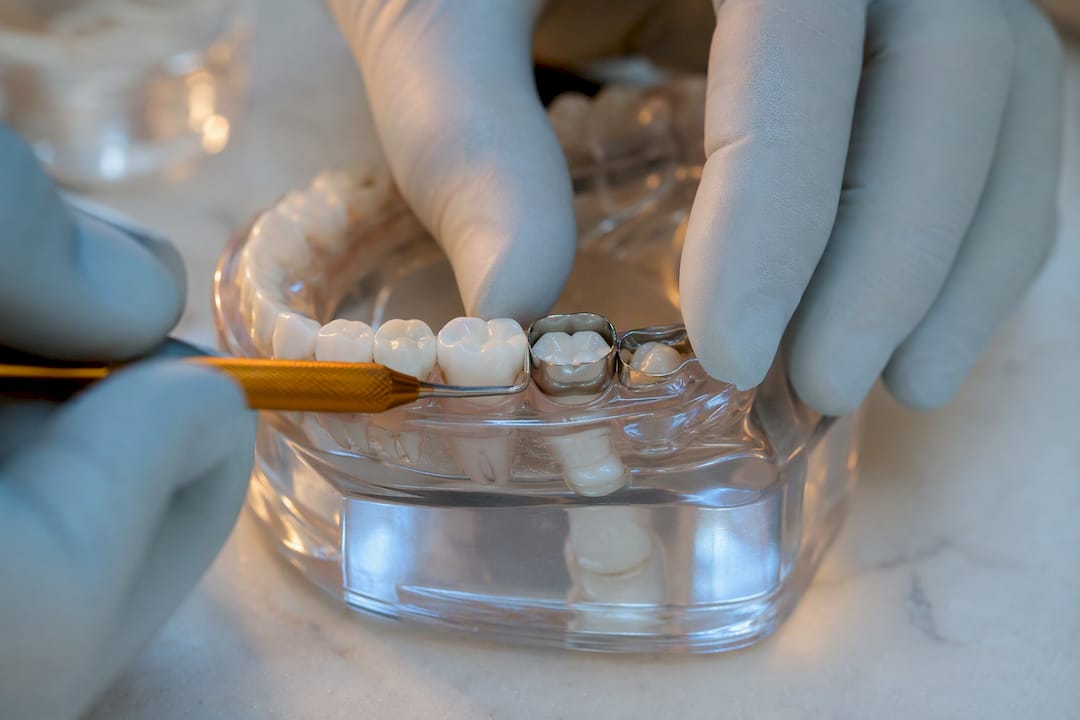
A space maintainer holds open the room a baby tooth leaves behind so the permanent tooth underneath can erupt where it belongs, instead of drifting or getting blocked out by neighboring teeth. Dentists usually recommend one when a molar is lost early and its replacement is still months or years from coming in. Your dentist decides between a fixed or removable design based on your child’s age, hygiene habits, and how soon that permanent tooth is due, and both hygiene and follow-up visits matter just as much as the appliance itself.
TL;DR:
- Space maintainers are most critical when a molar is lost early and the permanent tooth is still several months or years away from eruption.
- Fixed appliances generally have higher success rates and lower risk of dislodgement compared to removable options, especially in younger children.
- Placement should occur as soon as possible after early tooth loss, ideally within six months, to prevent mesial migration and space loss.
- Ongoing hygiene and regular check-ups are vital to prevent plaque buildup, decay, and appliance damage during space maintainer use.
- Delayed evaluation and action after early tooth loss significantly increase the risk of crooked eruption, bite shifts, and future orthodontic needs.
Table of Contents
- Why Baby Teeth Matter for the Permanent Teeth Behind Them
- When Does a Dentist Recommend a Space Maintainer?
- Types of Space Maintainers: Fixed vs. Removable Options
- What Happens at the Placement and Removal Appointments?
- Benefits, Risks, and Daily Care for Space Maintainers
- How Long Does a Child Wear a Space Maintainer?
- When a Space Maintainer Isn’t the Right Call
- Clayton Dental Studio’s Approach to Early Tooth Loss
- Our Take: Don’t Treat Space Maintainers as an Afterthought
- Getting Your Child Evaluated for a Space Maintainer in Humble
- Sources
Why Baby Teeth Matter for the Permanent Teeth Behind Them
Every primary molar acts as a placeholder. It holds the exact width the jaw needs so the permanent tooth waiting beneath the gum line has a clear path into the mouth. When a baby molar comes out too soon, whether from decay, trauma, or extraction, that placeholder disappears, and the mouth doesn’t just wait patiently for the successor tooth to catch up.
Neighboring teeth start moving almost immediately. Molars behind the gap tip forward, a shift dentists call mesial migration, and front teeth can drift toward the missing space too, sometimes pulling the midline of the smile off-center. The longer the gap sits open, the more room disappears.
That’s not a minor cosmetic issue. It’s a mechanical problem with real consequences:
- Less room for the permanent tooth, which can force it to erupt crooked, sideways, or impacted
- A shifted bite that changes how the upper and lower teeth meet
- Crowding elsewhere in the arch as teeth compensate for lost space
A 2025 systematic review and meta-analysis covering 479 patients across 11 studies found that space maintainers prevent this drift effectively and can reduce how much orthodontic work a child needs down the road. Preserving space early is often a lot simpler than fixing crowding later with braces.
When Does a Dentist Recommend a Space Maintainer?
Not every lost tooth needs an appliance. Front teeth (incisors) rarely require one, since their neighbors don’t drift much and the permanent teeth erupt fairly soon after. Molars are a different story, and here’s how dentists typically decide:
- Timing of the successor tooth. If the permanent tooth isn’t expected for many months, or even a couple of years, the case for a maintainer is strong. Clinical guidance notes that tooth migration can start within roughly six months of the loss, so waiting too long to decide often means waiting too long to act.
- Which tooth was lost. Losing the second primary molar is the classic scenario, since it guards the “leeway space” that first and second permanent molars rely on to settle correctly.
- Your child’s oral health and cooperation. Active cavities need to be treated first, and your dentist will weigh how well your child brushes, flosses, and tolerates dental visits before deciding between a fixed or removable option.
Types of Space Maintainers: Fixed vs. Removable Options
Once a dentist confirms a maintainer is the right call, the next decision is which design fits your child’s situation.
Fixed appliances are cemented onto a neighboring tooth and stay in place until it’s time to remove them. They’re the more common choice, and for good reason:
- Band-and-loop: a small metal band wraps around the tooth next to the gap, with a wire loop extending across to hold the space. This is the workhorse design for a single lost molar.
- Lingual holding arch: a wire running along the inside of the lower front teeth, used when multiple molars are missing on both sides.
- Nance appliance: anchors to the upper molars with an acrylic pad resting against the roof of the mouth, useful for upper-arch space loss.
- Crown-loop: combines a stainless steel crown with a loop, often used when the anchor tooth itself needs a crown due to decay.
A systematic review found that fixed designs like these have better survival rates and lower loss rates than removable ones, largely because they don’t depend on a child remembering to wear them.
Removable appliances look more like a small retainer with an artificial tooth or spacer built in. They work well for cooperative older kids or short-term needs, but success hinges entirely on consistent wear, which is why most dentists reserve them for specific cases rather than defaulting to them.
What Happens at the Placement and Removal Appointments?
Getting a space maintainer placed is a straightforward visit. Your dentist examines the gap, selects a properly sized band for the anchor tooth, and either takes an impression for a lab-made appliance or, in some cases, fits a pre-formed design chairside. Dental cement locks the band onto the tooth, and the loop or wire is checked to confirm it holds the correct amount of space without pressing too tightly against the gum.
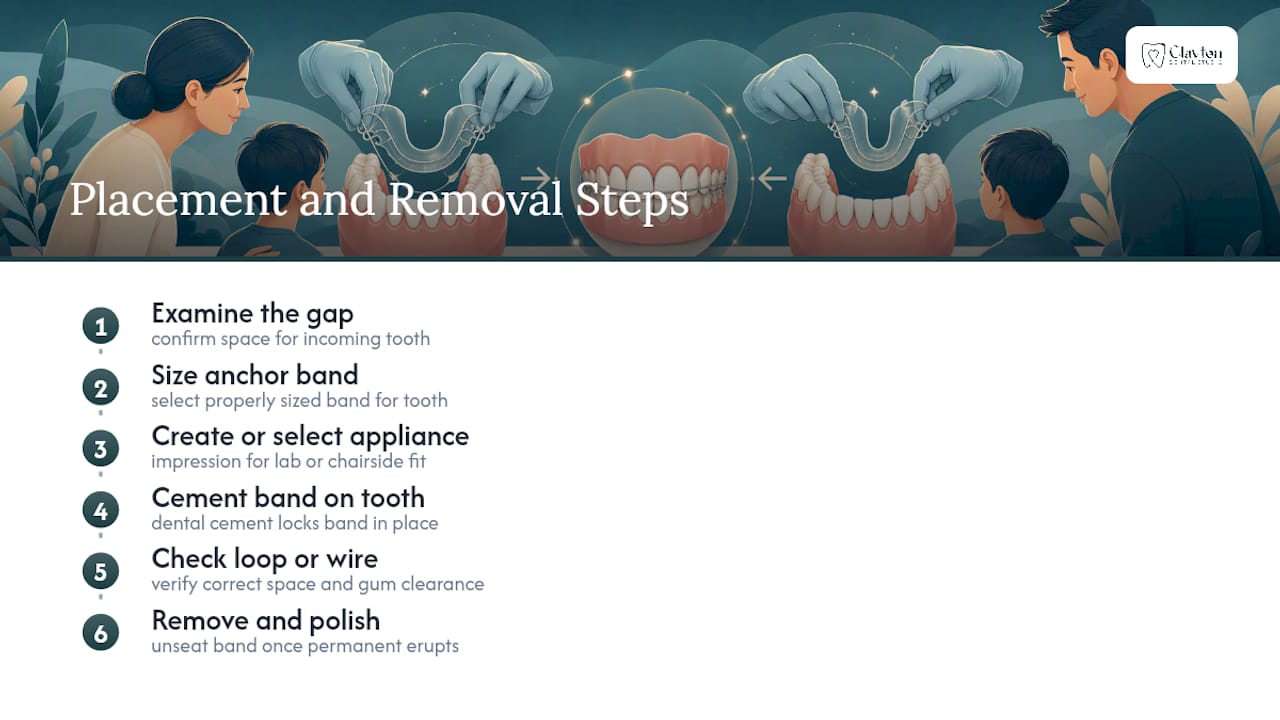
There’s no drilling and typically no numbing needed, since the procedure doesn’t touch the tooth’s nerve. Most kids describe mild pressure for a day or two, similar to the feeling of a new retainer.
Removal is even simpler. Once the permanent tooth starts pushing through, your dentist gently unseats the cemented band and polishes the anchor tooth. The whole process takes just a few minutes.
Benefits, Risks, and Daily Care for Space Maintainers
The upside is straightforward: a well-placed maintainer prevents drifting, protects normal chewing and speech patterns, and can meaningfully cut down on future orthodontic treatment. But an appliance sitting in a child’s mouth for months or years isn’t maintenance-free.
Plaque tends to build up around bands and loops more than it does on natural tooth surfaces, and clinical reviews point to a real risk of decalcification and gum irritation if that plaque isn’t cleared regularly. A loose band or bent wire can also poke the cheek or catch food.
Here’s what keeps things on track between visits:
- Brush around the band and loop morning and night, angling the brush to reach under the wire
- Floss threaders help clear food trapped near the appliance
- Skip sticky candy, gum, and ice, which can bend or dislodge the loop
- Call the dentist promptly if you notice looseness, swelling, or a sore spot
Pro Tip: Have your child rinse with water right after snacks if a full brushing isn’t possible. It won’t replace brushing, but it cuts down on the plaque that collects around the loop between meals.
How Long Does a Child Wear a Space Maintainer?
Wear time depends entirely on when the permanent successor is due, which can range from several months to a couple of years depending on the child’s age and which tooth was lost. A five-year-old missing a second molar might wear one considerably longer than an eight-year-old close to that tooth’s natural eruption window.
Because tooth migration can begin within about six months of losing a molar, dentists don’t wait around once the decision is made. Getting the appliance placed promptly matters more than most parents expect.
Follow-up visits, usually every four to six months, let the dentist confirm the band still fits snugly, check for early decay around the edges, and track how close the permanent tooth is to erupting.
When a Space Maintainer Isn’t the Right Call
A space maintainer isn’t automatic just because a tooth was lost early. Dentists typically hold off when a child has uncontrolled cavities, ongoing gum inflammation, or hygiene habits that make an appliance more risk than benefit. If the permanent tooth is due within a few months, monitoring alone is often the smarter path.
When space has already been lost to drifting, a space regainer or a referral to an orthodontist becomes the more appropriate tool. Every decision comes down to weighing the appliance’s benefit against the child’s ability to keep it clean and intact.
Clayton Dental Studio’s Approach to Early Tooth Loss
I’m Dr. Navneet Kamboj, and I’ve spent years watching how a single early tooth loss, if left unmanaged, can turn into years of orthodontic correction later. My training, including a restorative preceptorship at UCLA, taught me that the smallest interventions, placed at the right moment, prevent the biggest problems.
Before recommending an appliance at Clayton Dental Studio, we walk through the same checklist every time: stabilize any active decay first, confirm your child’s hygiene routine can support an appliance, map out roughly when the permanent tooth is expected, and talk honestly about your child’s ability to cooperate with either a fixed or removable option. If your child has recently lost a tooth ahead of schedule, we’re happy to take a look and talk through what makes sense.
Our Take: Don’t Treat Space Maintainers as an Afterthought
The evidence on space maintainers is more convincing than most parents realize, but the bigger issue is timing, not the appliance itself. Too many families wait weeks after a tooth is lost to even schedule a consult, and that delay is exactly when drifting starts. The conventional advice, “see your dentist eventually,” undersells how quickly a gap becomes a real orthodontic problem.
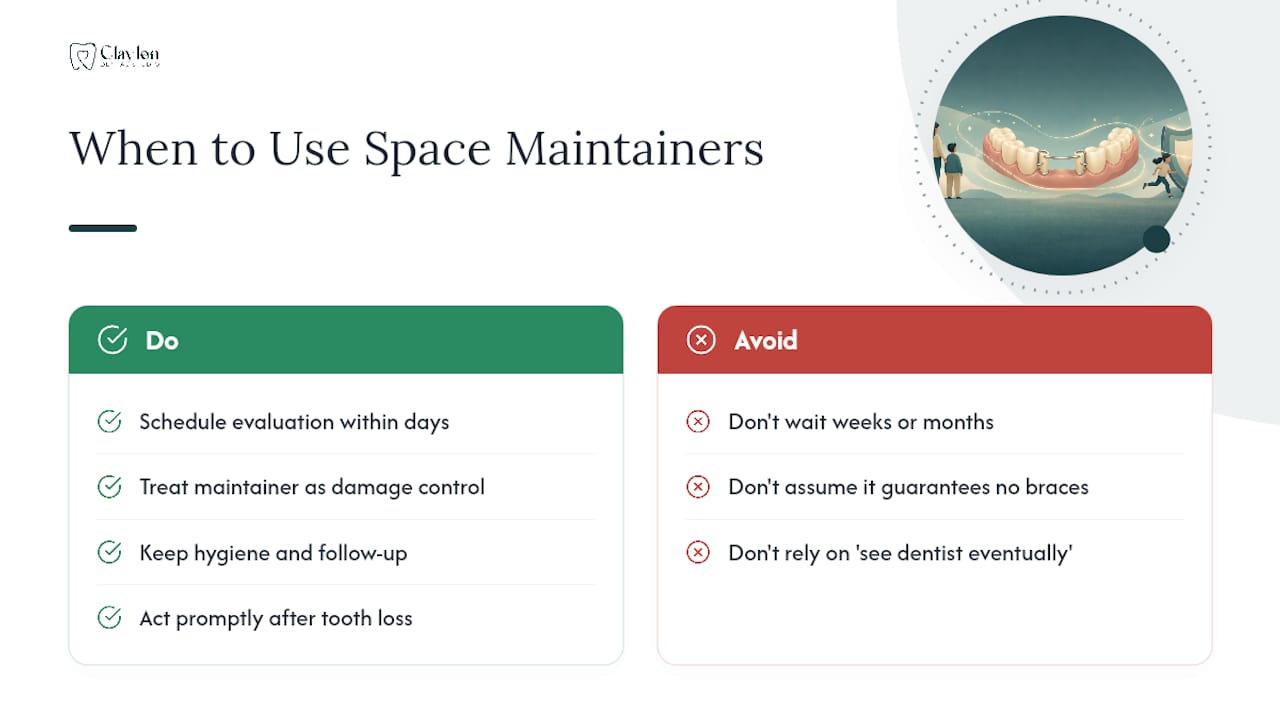
What gets overlooked is that a space maintainer isn’t a guarantee against future braces. It’s a way to reduce the odds and the severity, not eliminate the need entirely. Parents who expect a maintainer to solve everything end up disappointed; parents who understand it as damage control tend to make better decisions about hygiene and follow-up.
If we had to prioritize one thing for families reading this: get the evaluation scheduled within days of the loss, not months. The appliance matters less than the timeline you act on.
— Clayton Dental Studio
Getting Your Child Evaluated for a Space Maintainer in Humble
Clayton Dental Studio gives Humble-area families a direct path to an evaluation, without the wait times and referral loops that come with larger pediatric networks. If your child recently lost a tooth early, we can typically assess the gap, check for decay, and discuss whether a fixed or removable appliance fits your situation in a single visit.

Bring your child’s dental records if you have them, though it’s not required. We accept most dental insurance plans for the exam and appliance, and offer financing for families paying out of pocket. Your first visit includes an exam, any needed X-rays to check the successor tooth’s position, and a straightforward conversation about timing and cost before anything is placed. Explore our full range of family dental services or call our Humble office to schedule an evaluation this week.
This article is general information, not a substitute for advice from a qualified doctor. Consult a qualified healthcare professional about your own circumstances before acting on anything here.
Sources
- Effectiveness of space maintainers in pediatric patients: systematic review and meta-analysis
- Survival rates and effectiveness of space maintainers (systematic review)
Recommended
Ready to Schedule Your Appointment?
Dr. Kamboj and the Clayton Dental Studio team are here to help. Call us or book online today.