If you’ve lost most or all of your teeth, you understand the daily challenges. It impacts more than just your smile; it affects your ability to eat, speak confidently, and feel your best.
If you’ve lost most or all of your teeth, you understand the daily challenges. It impacts more than just your smile; it affects your ability to eat, speak confidently, and feel your best. For years, the main solutions were removable dentures or a lengthy, costly process of replacing each tooth individually. But a modern, efficient alternative exists.
All-on-Four dental implants are a full-arch restoration that provides a complete set of permanent, non-removable teeth supported by just four titanium posts. This technique is engineered to deliver a stable, new smile, bypassing many drawbacks of traditional options.
Imagine building a sturdy bridge. Instead of placing a support pillar for every single section, engineers use a few strategically placed, heavy-duty supports to hold the entire structure. All-on-Four applies the same principle to your smile, rebuilding its foundation with remarkable strength and efficiency.
This approach uses advanced biomedical engineering to give you a full set of fixed teeth without requiring an implant for every single missing one. For many of our patients, this procedure is genuinely life-changing. You can learn more about how dental implants anchor new teeth in our detailed guide.
One of the most significant advantages of the All-on-Four technique is the possibility of immediate function. This concept often surprises people. Many patients can have their failing teeth extracted, the four implants placed, and a functional temporary bridge attached—all in a single appointment.
You can walk into our office with a compromised smile and leave the same day with a full set of teeth you can use immediately.
This is made possible by the strategic placement of the implants:
- Two anterior implants are inserted vertically into the front of your jaw, where bone density is naturally higher.
- Two posterior implants are placed in the back and tilted at a precise angle, typically up to 45 degrees. This tilt is the key—it engages more of your existing jawbone, often allowing us to bypass the need for separate bone grafting procedures.
The core principle of All-on-Four is to provide a complete, fixed, and highly functional set of teeth that look, feel, and perform like natural ones. It is designed for both an immediate aesthetic improvement and long-term oral health.
To clarify how this works, let's examine the key components of the system.
This table breaks down how each component works together to create a durable, new smile.
Component Description Key Benefit Titanium Implants Four biocompatible posts surgically placed into the jawbone to serve as artificial tooth roots. Fuses with the bone (osseointegration) to create a permanent and stable anchor for your new teeth. Custom Abutments Connectors attached to the implants that serve as the base for the prosthetic teeth. Provide a secure and stable link between the implant posts and the final bridge. Prosthetic Arch A full bridge of custom-made, natural-looking teeth (e.g., acrylic or zirconia) fixed to the abutments. Restores a complete, beautiful smile that is non-removable, highly durable, and easy to maintain.
Each part plays a vital role, from the solid implant foundation to the beautiful, custom-crafted teeth. Together, they form a solution engineered for longevity.
Understanding the process is key to feeling confident in your decision. Getting a new smile with All-on-4 is a carefully planned journey, not a single appointment. It is a multi-stage project, with each phase designed to ensure a predictable, successful, and lasting outcome.
The All-on-4 technique revolutionized full-arch restoration. It enables the replacement of an entire upper or lower set of teeth with just four strategically placed implants. Introduced in the late 1990s and refined in the early 2000s, this method has become a highly effective option, even for patients who have experienced significant bone loss.
This innovation is a major reason the global dental implants market is projected to reach USD 13.02 billion by 2026. You can learn more about this growing market and its impact.
Let's walk through the exact steps on the path to your new smile.
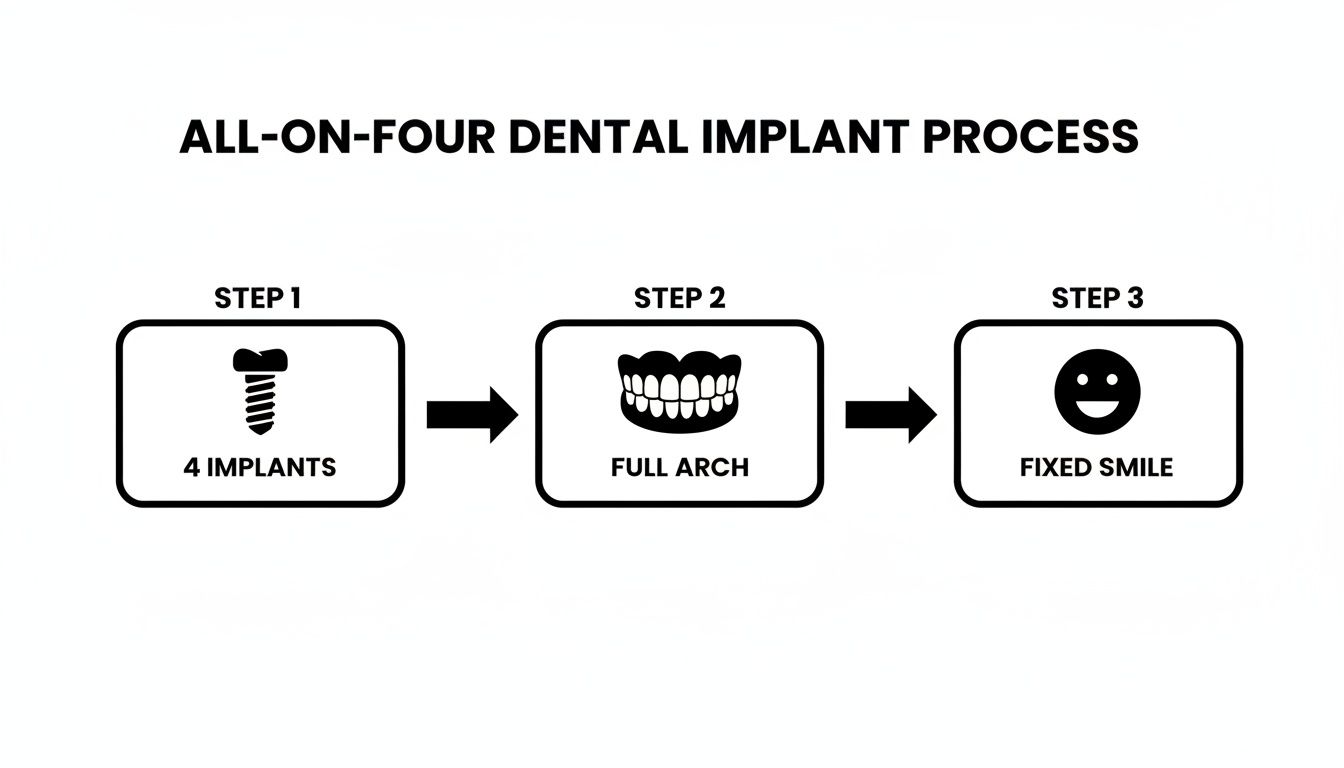
This graphic illustrates the core concept: four implants serve as the foundation for a complete set of fixed, functional teeth, providing an efficient and incredibly stable system.
Your journey begins with a detailed consultation. This initial meeting is a crucial diagnostic step where we gather all necessary information to create a complete picture of your oral health.
We use advanced diagnostic tools like AI-powered digital X-rays and 3D CBCT (Cone Beam Computed Tomography) scans. These modern imaging techniques provide a precise, 3D view of your jawbone density, the location of nerve pathways, and your sinus cavities. This detailed anatomical map is essential for planning a safe and successful procedure.
With the diagnostic information gathered, your dentist designs your personalized treatment plan. This is the blueprint for your new smile. Using specialized software, we digitally map the exact position, angle, and depth for each of the four implants.
This meticulous planning is what makes the All-on-4 procedure so reliable and predictable. It ensures that each implant is placed in the strongest available bone, maximizing stability and often eliminating the need for extensive bone grafting. We will review this entire plan with you, ensuring you understand every step and have an opportunity to ask questions.
The objective of this stage is to create a predictable surgical guide. By knowing exactly where each implant will be placed before the procedure starts, we remove guesswork and ensure optimal support for your new teeth.
This is the day your smile transformation occurs. Your comfort is our top priority, and we utilize effective anesthesia to ensure the procedure is pain-free.
The process on the day of surgery typically includes:
- Extracting any remaining failing teeth.
- Preparing the jawbone to create a solid foundation.
- Placing the four titanium implants according to the pre-planned surgical guide.
- Attaching a temporary—yet beautiful and functional—set of teeth to the new implants.
You will leave our office on the same day with a complete set of teeth. This temporary set looks natural and allows you to function normally while being gentle on your implants as they heal.
After your procedure, your body begins a natural process called osseointegration. This is when your jawbone grows around and fuses directly with the biocompatible titanium implants, making them a permanent part of your anatomy. This biological bond provides the incredible strength and stability that dental implants are known for.
This healing phase typically lasts a few months. During this time, you will follow a soft diet to avoid placing excessive pressure on the healing implants. We provide detailed aftercare instructions to promote a smooth and efficient recovery.
Once osseointegration is complete and your gums have fully healed, you are ready for the final step. You will return to our office to have your permanent teeth fitted.
This final set of teeth is custom-crafted in a dental lab from premium, highly durable materials like zirconia. It is meticulously designed for a perfect fit, optimal function, and the beautiful, natural appearance you desire. After this final fitting, your All-on-4 journey is complete, and you can enjoy your strong, permanent, and confident new smile.
Determining if All-on-4 dental implants are the right solution for you depends on several factors, including your current dental health, bone structure, and long-term goals. The ideal candidate is often someone frustrated with the limitations of major tooth loss or unreliable dentures and is seeking a permanent solution that functions like natural teeth.
This procedure is an excellent fit for individuals missing most or all of their teeth in an upper or lower arch. It is also a viable solution for those whose remaining teeth are failing due to severe decay or advanced gum disease and require extraction.

A common concern for prospective patients is whether they have sufficient bone for implants. This is where the innovative design of the All-on-4 system is particularly beneficial. Historically, significant bone loss often disqualified patients from receiving implants without undergoing a separate, and often lengthy, bone grafting procedure.
The All-on-4 technique, however, utilizes two of its four implants at a specific angle in the back of the jaw. This strategic placement maximizes contact with existing bone. This engineering often allows patients with some bone resorption to receive implants without preliminary grafting, making a new smile accessible to a wider range of people. A 3D CBCT scan during your consultation provides the precise data needed to determine if your bone density is adequate.
The key advantage is that by tilting the posterior implants, we can utilize the stronger bone typically found in the front of the jaw, bypassing areas where bone has atrophied. This makes the path to a new smile faster, less invasive, and more cost-effective.
While bone health is a primary consideration, other factors contribute to a successful outcome. A strong candidate for what is all on four dental implants typically exhibits the following characteristics:
- Good General Health: You must be healthy enough to undergo a routine dental surgical procedure. Chronic conditions like diabetes must be well-managed to ensure proper healing.
- Commitment to Oral Hygiene: While your new teeth will not decay, maintaining healthy gums around the implants is essential for long-term success.
- Non-Smoker or Willingness to Quit: Smoking significantly impairs healing and is a primary risk factor for implant failure. Quitting before the procedure is strongly advised.
- Realistic Expectations: A clear understanding of the procedure, recovery process, and maintenance requirements helps ensure satisfaction with the final result.
Conversely, certain health conditions and lifestyle habits can pose risks to the success of the procedure. It is vital to provide a complete and honest health history during your consultation.
Factors that may require a cautious approach or could make you a less-than-ideal candidate include:
- Uncontrolled Chronic Illnesses: Conditions like unmanaged diabetes can interfere with the body's ability to heal and for implants to integrate with the bone.
- Certain Medications: Some drugs, particularly bisphosphonates used for osteoporosis, can affect bone healing. A thorough review of all medications is necessary.
- Heavy Smoking or Alcohol Use: Both habits compromise blood flow to the gums and bone, significantly increasing the risk of complications and implant failure.
- Bruxism (Teeth Grinding): Unmanaged, severe teeth grinding can place excessive stress on the implants and the prosthetic bridge.
The only way to determine your candidacy definitively is through a comprehensive evaluation. We will assess your unique situation, provide clear answers, and help you decide if All-on-4 is the right path to res...
Ready to Schedule Your Appointment?
Dr. Kamboj and the Clayton Dental Studio team are here to help. Call us or book online today.