Discover how a lymphatic drainage facial can reduce puffiness, enhance your complexion, and relax facial tension for a brighter look.
Lymphatic Drainage Facial: Reduce Puffiness the Right Way
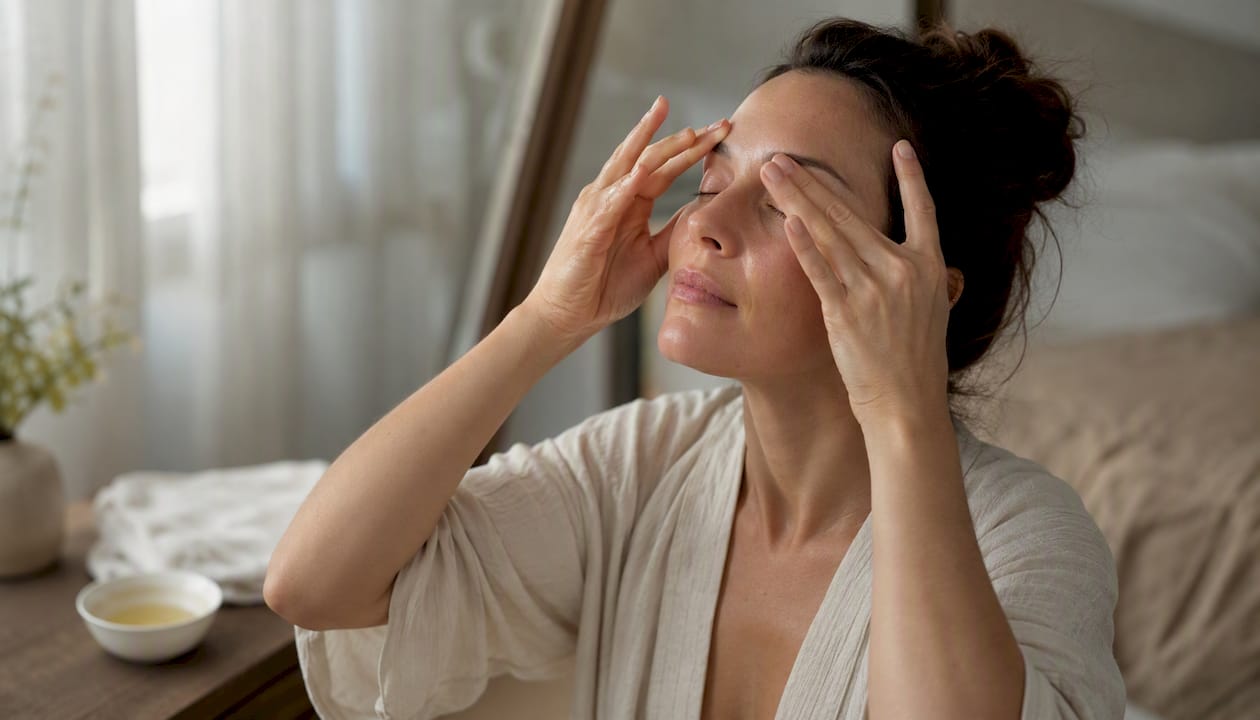
A lymphatic drainage facial reliably reduces temporary facial puffiness, but it does not change your bone structure or replace clinical treatment for a lymphatic disorder. Here is what you can realistically expect:
- Reduced puffiness: Gentle, rhythmic strokes move excess surface fluid toward draining lymph nodes, visibly deflating morning swelling within minutes.
- Brighter complexion and temporary “lift”: Improved circulation brings a short-lived glow and a slightly more sculpted appearance that typically lasts hours to about a day.
- Relaxation and reduced facial tension: The light touch calms overworked facial muscles, which many people find as valuable as the cosmetic effect.
Practical recommendation: An at-home routine works well for everyday puffiness and glow. If you have persistent one-sided swelling, recent facial surgery, or a known lymphatic condition, see a clinician before self-massaging.
Key Takeaways
A lymphatic drainage facial reliably reduces temporary facial puffiness through feather-light, node-primed strokes, but effects last hours to about a day and do not change facial structure.
| Point | Details |
|---|---|
| Effects are real but temporary | Visible puffiness reduction is immediate; the sculpting effect typically lasts hours to about 24 hours per session. |
| Node priming is non-negotiable | Always clear the clavicle, neck, and axillary nodes before working the face, or fluid has nowhere to drain. |
| Pressure must stay feather-light | Firm pressure compresses superficial lymph vessels and stops flow; the skin should move, not the muscle beneath. |
| Contraindications matter | Skip self-massage if you have active infection, unilateral swelling, clotting disorders, or recent facial surgery without clearance. |
| Clayton Dental Studio’s Dermal Hygiene™ | Offers clinician-supervised facial lymphatic care in Humble, TX with personalized assessment and a tailored treatment plan. |
Table of Contents
- What is a lymphatic drainage facial and how does it work?
- Benefits of facial lymphatic drainage: what the evidence actually says
- Who should avoid a lymphatic drainage facial?
- What tools work for facial lymphatic massage?
- How to do a facial lymphatic drainage routine at home
- How often should you do facial lymphatic massage?
- Common mistakes and expert tips for better results
- Risks, side effects, and when to call a clinician
- When does a professional lymphatic facial treatment make more sense?
- Dermal Hygiene™ at Clayton Dental Studio: professional facial care in Humble, TX
- Sources
What is a lymphatic drainage facial and how does it work?
Your face is covered by a network of superficial lymph vessels that sit just beneath the skin. These vessels collect excess fluid, proteins, and cellular waste, then channel everything toward lymph nodes clustered in the neck, clavicle area, and armpits. Unlike your cardiovascular system, the lymphatic system has no central pump. It depends on movement, breathing, and gentle external stimulation to keep fluid flowing.
That physiology is exactly why light, rhythmic strokes can temporarily reduce fluid buildup in the face. When you apply feather-light pressure in the right direction, you encourage surface fluid to move toward those draining nodes. The effect is real, but it is also temporary because you are not changing the underlying anatomy.
Medical MLD vs. cosmetic facial massage. Manual lymphatic drainage (MLD) is a clinically recognized therapy developed by Danish physicians Emil and Estrid Vodder in the 1930s. In a medical context, a certified therapist uses MLD to treat lymphedema, post-surgical swelling, or other confirmed lymphatic disorders. UCLA Health notes that medical MLD helps true lymphatic problems and can meaningfully reduce swelling, while cosmetic facial massage mainly produces temporary movement of surface fluid and short-term cosmetic effects. The technique looks similar, but the clinical indication and expected outcome are very different.
Benefits of facial lymphatic drainage: what the evidence actually says
The cosmetic claims are popular, and some of them hold up reasonably well under scrutiny. Others are mostly anecdotal.
What is reasonably supported:
- Reduced morning puffiness. Light facial massage moves surface fluid that pools overnight, particularly around the eyes and jawline. The effect is visible and consistent, even if it fades within hours.
- Temporary sculpting and “glow.” Practitioners and patients consistently report a brighter complexion and slightly more defined features immediately after a session. British Vogue’s coverage of practitioner interviews confirms a short-lived sculpting effect, though it is not a substitute for procedures that change facial structure.
- Improved circulation. The gentle stimulation increases blood flow to the skin surface, which contributes to the post-massage glow.
What the evidence does not support:
- Permanent facial reshaping or contouring
- Detoxification in any clinical sense
- Replacing medical treatment for lymphedema or post-surgical swelling without clinician guidance
Realistic timeline:
- Immediate (0–30 minutes): Visible reduction in puffiness, brighter skin tone, relaxed facial muscles.
- Short-term (a few hours to about 24 hours): Sculpting effect and glow gradually fade as fluid redistributes.
- Long-term: No structural change. Consistent practice may help you manage recurring puffiness more effectively, but the benefits reset with each session.
UCLA Health and other medical sources are candid: healthy people with normally functioning lymphatic systems usually do not need lymphatic help. The benefits are most convincing for people with actual lymphatic disruption, post-operative swelling, or chronic puffiness from lifestyle factors like high sodium intake or poor sleep. For everyone else, it is a pleasant, low-risk addition to a skincare routine.
Who should avoid a lymphatic drainage facial?
Most people can safely try a gentle at-home facial massage. A few conditions make it inappropriate without medical clearance, and some make it outright unsafe.
Skip lymphatic drainage facials if you have:
- An active skin infection, open wound, or inflamed acne in the treatment area
- An untreated blood clotting disorder or are on anticoagulant therapy without medical guidance
- Active or untreated cancer affecting the lymphatic system
- Uncontrolled congestive heart failure or kidney disease
- Unexplained unilateral (one-sided) facial swelling, which needs a diagnosis before any massage
- A recent surgical procedure in or near the face or neck (wait for your surgeon’s clearance)
- Acute fever or systemic infection
Before you start, tell your provider if you:
- Have a history of deep vein thrombosis or blood clots
- Are currently undergoing cancer treatment
- Have thyroid disease or a known lymphatic condition
- Experience recurring facial swelling with no clear cause
If any of those apply, a brief conversation with your doctor or a licensed massage therapist (LMT) certified in MLD takes only a few minutes and protects you from a potentially harmful session. Persistent or worsening facial swelling, especially on one side, warrants medical evaluation rather than self-massage. Readers dealing with facial tension or headaches alongside swelling should have a clinician rule out jaw or muscular causes before attributing symptoms to lymphatic congestion.
What tools work for facial lymphatic massage?
Hands-only manual massage
Your hands are the safest and most versatile tool. Fingertips and the flat of your fingers let you feel the tissue response, adjust pressure instantly, and follow the contours of your face precisely. For sensitive skin, rosacea, or active breakouts, hands-only technique is the right choice because you eliminate the risk of dragging or applying uneven pressure with a hard tool.
Gua sha
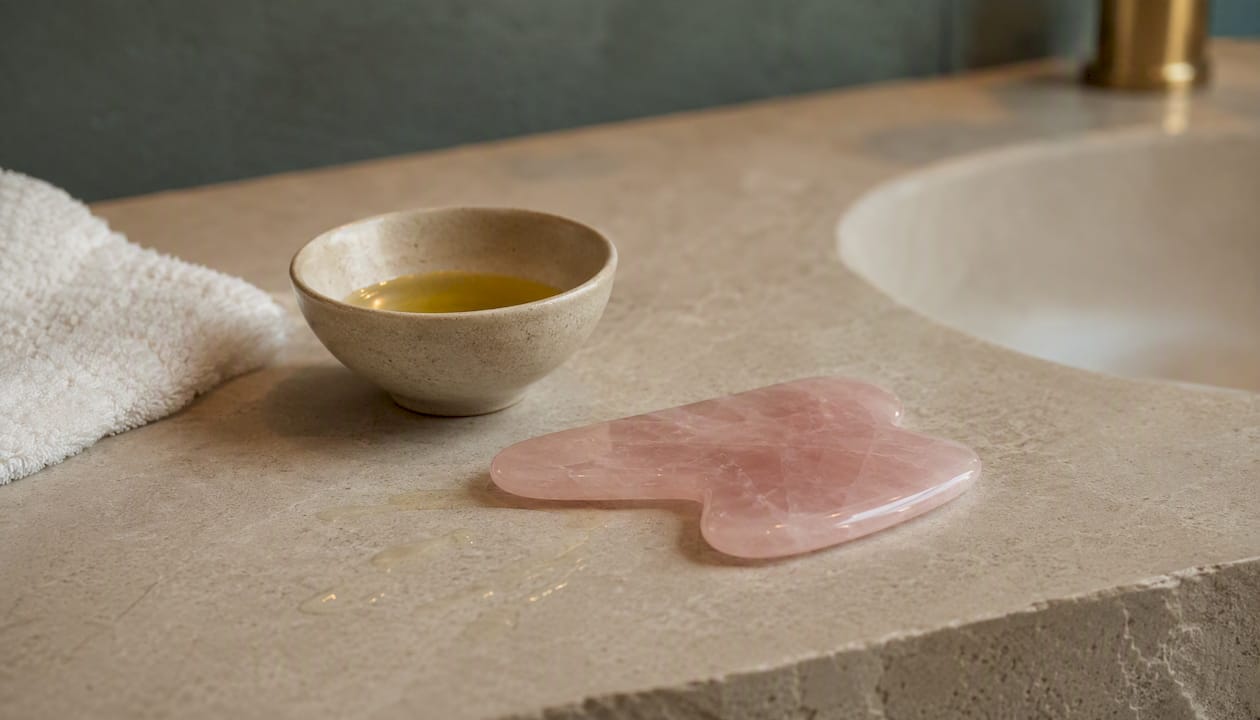
A gua sha stone (traditionally jade or rose quartz, though stainless steel versions exist) is held flat against the skin and glided along the face with light, upward strokes. Used correctly, it can increase circulation and encourage fluid movement. The most common misuse is applying too much downward pressure, which can irritate capillaries, worsen redness in rosacea-prone skin, and cause micro-tears if the skin is not well-lubricated. Always use a facial oil or serum as a slip agent.
Jade and ice rollers
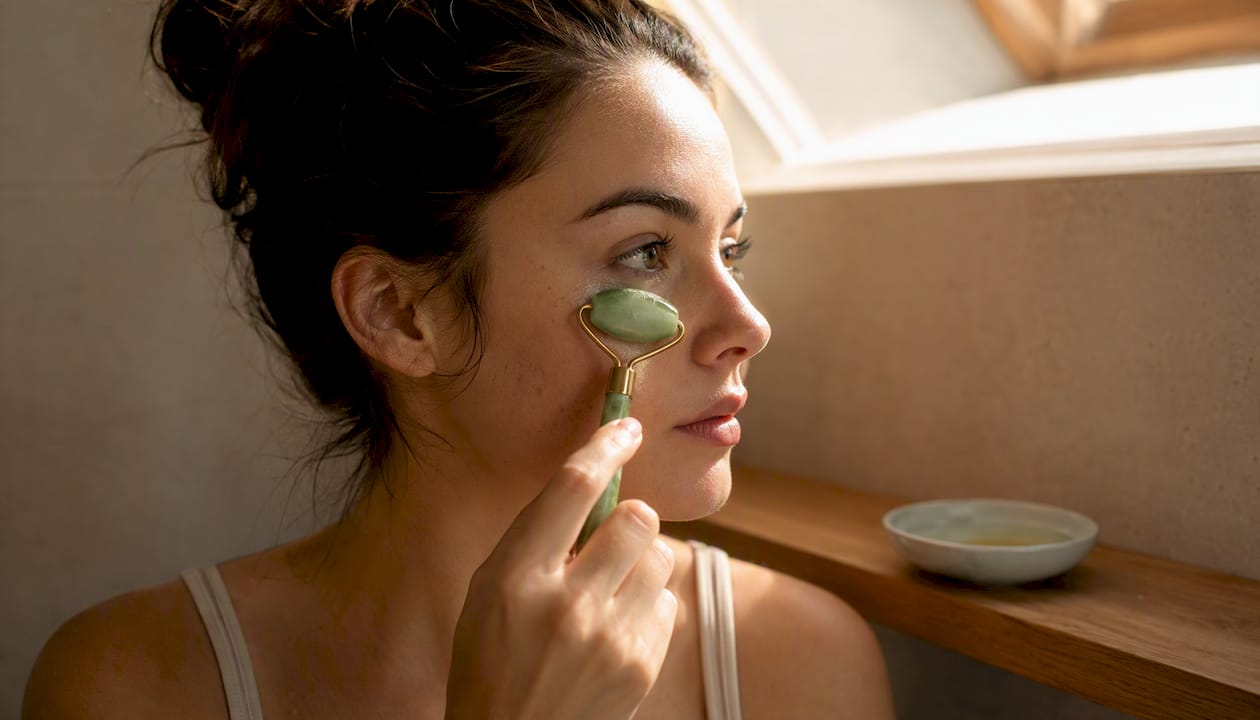
A jade roller or chilled facial roller provides a soothing, cooling effect that temporarily constricts blood vessels and reduces puffiness, particularly around the eyes. The rolling motion is gentler than gua sha and harder to misuse, making it a reasonable starting point for beginners. Chilling the roller in the refrigerator (not the freezer) amplifies the depuffing effect. NBC Select’s reporting on practitioner interviews confirms that rollers and gua sha can increase circulation and depuffing when used gently, but misuse through excessive pressure or dragging can irritate skin or worsen certain conditions.
Vibrating and T-shaped tools
Electric vibrating massagers and T-bar tools are marketed for lymphatic work, but they carry a higher risk of over-stimulation. The vibration can feel effective, but it is easy to apply too much pressure without realizing it. These tools are best reserved for people who have already learned the correct pressure with their hands.
Safety by skin type:
- Sensitive or rosacea-prone: Hands only, no tools, avoid the cheek area where redness concentrates.
- Acne-prone: Avoid tools over active inflamed breakouts; hands-only light strokes around (not over) active lesions.
- Dry or mature skin: Always use a facial oil for slip; never drag a dry tool across dry skin.
How to do a facial lymphatic drainage routine at home
This sequence follows the clinician-backed guidance from Cleveland Clinic and the stroke patterns outlined in NHS patient guidance for head and neck self-massage. The whole routine takes about 8–10 minutes.
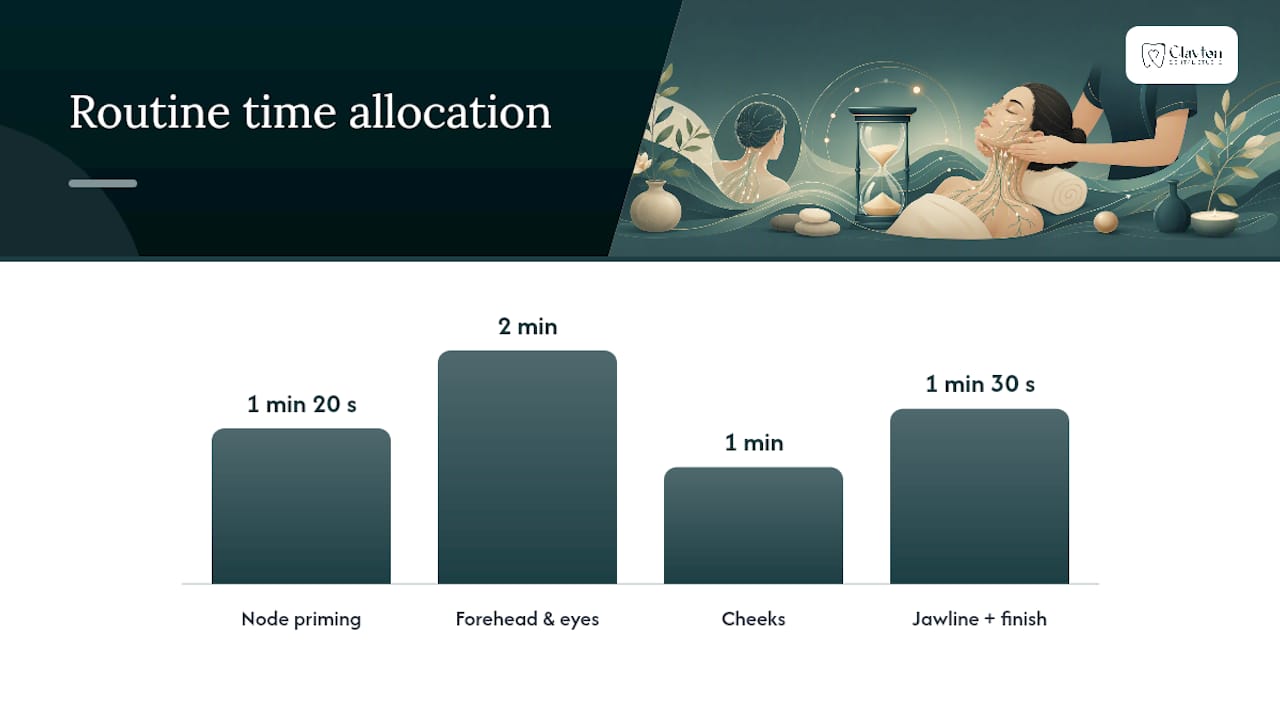
Before you begin: Wash your hands thoroughly. Apply a light facial oil or serum to create slip. The best time is after a warm shower, when circulation is already elevated. Take three slow, deep breaths to activate the parasympathetic nervous system and encourage lymph flow through the thoracic duct.
Why node priming matters: Skipping straight to the face is like trying to drain a sink with the drain still plugged. Priming the major node clusters first creates space for fluid to flow into. Without this step, facial strokes have nowhere to send the fluid.
- Prime the clavicle nodes (30 seconds). Place your fingertips just above your collarbone on both sides. Press gently inward and downward with a light pumping motion, about 10 repetitions. You are activating the terminus, the main drainage point for the entire upper body.
- Prime the neck nodes (30 seconds). Using flat fingers, stroke gently down the sides of your neck from just below the ears toward the collarbone. Repeat 5–8 times per side. Keep the pressure feather-light; you should feel the skin move, not the muscle beneath.
- Prime the axillary (armpit) nodes (20 seconds). Cup each armpit lightly and pulse gently 5–8 times. This clears the downstream path before fluid from the face arrives.
- Forehead (1 minute). Starting at the center of the forehead, use flat fingers to stroke outward toward the temples, then sweep down in front of the ears toward the neck nodes. Repeat 3–5 times.
- Temples and eye area (1 minute). Use your ring fingers (lightest natural pressure) to make small, gentle circles at the temples, then sweep under the eyes from the inner corner outward. Never press on the eyeball. Finish by sweeping down in front of the ear.
- Cheeks (1 minute). Starting at the nose, stroke outward across the cheeks toward the ears, then sweep down the neck. Repeat 3–5 times per side.
- Jawline and chin (1 minute). Using the backs of your fingers or flat fingertips, stroke from the chin outward along the jaw toward the earlobes, then sweep down the neck. This is where morning puffiness often concentrates.
- Finish at the neck and clavicle (30 seconds). Repeat the neck sweep (step 2) and the clavicle pump (step 1) to flush the collected fluid toward the terminus.
| Zone | Pressure | Repetitions | Time |
|---|---|---|---|
| Clavicle nodes | Feather-light pump | 10 pumps | 30 seconds |
| Neck | Skin-level glide | 5–8 strokes per side | 30 seconds |
| Forehead | Flat-finger sweep outward | 3–5 strokes | 1 minute |
| Eye area | Ring-finger circles | 3–5 passes | 1 minute |
| Cheeks | Outward sweep | 3–5 strokes per side | 1 minute |
| Jawline | Back-of-finger sweep | 3–5 strokes per side | 1 minute |
| Finish: neck + clavicle | Skin-level glide + pump | 5–8 strokes + 10 pumps | 30 seconds |
How long do results last? Visible puffiness reduction is typically immediate. The sculpting and glow effect lasts roughly a few hours to about 24 hours for most people. Repeat sessions do not permanently change the lymphatic anatomy, but consistent practice helps you recognize what “depuffed” feels like and makes the routine faster over time.
How often should you do facial lymphatic massage?
For everyday puffiness management, a short 5-minute version of the routine above works well daily, ideally in the morning. A longer 10-minute session once or twice a week is a reasonable alternative if daily practice feels like too much of a commitment.
Healthline’s clinical guidance confirms that at-home sequences are safe for most people when light pressure and hygiene are maintained. The key variable is consistency rather than frequency. A daily 5-minute routine tends to produce more noticeable cumulative results than an occasional longer session, simply because you are managing fluid before it accumulates significantly.
Most visible effects are temporary, often lasting hours to about a day, unless paired with lifestyle changes that reduce the underlying causes of puffiness. Cutting back on sodium, improving sleep quality, and staying well-hydrated all extend the visible benefit of each session. Think of the massage as the tool and those habits as the foundation.
If you notice no visible change after two weeks of consistent practice, that is useful information. It may mean your puffiness has a cause other than lymphatic sluggishness, such as allergies, hormonal fluctuation, or a structural concern, and a clinician can help you identify it.
Common mistakes and expert tips for better results
Mistakes that undermine your results:
- Too much pressure. The lymphatic vessels in the face are superficial and delicate. Pressing hard does not move more fluid; it compresses the vessels and stops flow. Cleveland Clinic is explicit: pressure should be feather-light, enough to move the skin but not the muscle beneath.
- Skipping node priming. Starting on the face without clearing the neck and clavicle nodes first limits how much fluid can actually drain. Clinicians describe this as creating a traffic jam with nowhere for the fluid to go.
- Overdoing tools on sensitive skin. Gua sha and rollers amplify both the benefit and the risk. Using them daily on rosacea-prone or acne-prone skin often causes more irritation than the puffiness they were meant to address.
- Rushing the sequence. Moving too quickly through the zones means each stroke does not have time to encourage fluid movement. Slow, deliberate strokes are more effective than fast ones.
- Skipping lubrication. Dragging a dry tool or dry fingers across dry skin creates friction that irritates the skin surface without moving lymph.
Pro tips from practitioners:
Pro Tip: Always prime your clavicle nodes before touching your face. This single step is what separates an effective session from one that just feels nice.
- Breathe slowly and deeply throughout the routine. Diaphragmatic breathing creates pressure changes in the thoracic duct that actively assist lymph flow.
- Drink a glass of water after your session. Lymphatic work mobilizes fluid, and hydration helps the body process it efficiently.
- Watch for skin irritation after using tools. Redness that persists more than 20 minutes after a session suggests the pressure or tool was too aggressive.
- Integrate the routine with good sleep and low-sodium evenings for noticeably better morning results.
One non-obvious insight: certified MLD therapists report that the direction of the stroke matters more than its speed or force. Every stroke should end pointing toward a draining node, not just moving “upward” in a general sense. Strokes on the lower face drain toward the neck nodes; strokes on the forehead drain toward the temples and then down in front of the ears.
Risks, side effects, and when to call a clinician
For most healthy people, a gentle at-home facial lymphatic massage carries minimal risk. Mild, transient side effects can include a slight headache, brief fatigue, or a feeling of needing to urinate more, all of which reflect the body processing mobilized fluid. These typically resolve within a few hours.
Stop immediately and seek medical care if you notice:
- Increasing swelling on one side of the face or neck that does not resolve
- Warmth, redness, or tenderness over a swollen area (possible infection or clot)
- Fever developing after a session
- A new lump or hardened node in the neck or jaw area
- Numbness or tingling that was not present before
Self-massage over an active infection can spread bacteria through the lymphatic channels. Massaging over an area with a blood clot can dislodge it. Neither scenario is common with a gentle cosmetic routine, but both are serious enough to warrant the caution. If you have any of the contraindications listed earlier in this guide and you attempt self-massage anyway, you are taking a risk that a brief clinician conversation could have prevented.
When does a professional lymphatic facial treatment make more sense?
At-home technique works well for everyday cosmetic maintenance. A professional session is a different experience and, in some situations, the only appropriate choice.
Concrete differences between professional and at-home care:
- Training and certification. A licensed massage therapist certified in MLD or a trained esthetician has completed formal coursework in lymphatic anatomy, contraindication screening, and technique sequencing. They can identify when a client’s presentation warrants referral rather than treatment.
- Technique depth. Professional MLD uses specific hand positions, pressures, and sequences calibrated to the individual’s anatomy and condition. The Cleveland Clinic treatment guidance notes that trained therapists can adapt techniques and teach safe self-care, which is something a YouTube tutorial cannot replicate.
- Integration with post-procedure care. Clinical MLD is commonly included in post-operative protocols for facial and body procedures because it can reduce swelling and support recovery. This must be coordinated with your surgeon’s timing and guidance.
- Equipment and combination treatments. In-clinic sessions may combine manual technique with complementary modalities for a more complete result.
Choose a professional when:
- You are recovering from facial surgery or an aesthetic procedure and your provider has cleared you for lymphatic work
- You have persistent unilateral swelling that has been medically evaluated and cleared for massage
- You want clinically supervised care as part of a broader facial health plan
- You have skin laxity concerns or other structural issues where a coordinated treatment plan makes more sense than isolated massage
What to expect at a first professional appointment: a thorough intake assessment covering your health history and contraindications, a tailored treatment plan, and a session that typically feels noticeably different from self-massage in terms of precision and depth. Following up with appropriate post-treatment skincare extends the benefit and reduces the chance of irritation.
Clayton Dental Studio’s Dermal Hygiene™ program brings this clinician-led approach to facial care in Humble, TX, integrating lymphatic and skin health within a supervised, personalized plan.
A perspective from Clayton Dental Studio
At Clayton Dental Studio, we see patients who are genuinely curious about facial wellness and want guidance they can trust. Facial lymphatic massage is one of the few at-home techniques where the evidence and the experience align: done gently and consistently, it delivers a real, if temporary, cosmetic benefit with very little risk. What we appreciate about it is the honesty built into the technique. It does not promise to reshape your face or reverse aging; it simply helps your skin look its best on a given morning. That measured, evidence-informed approach is exactly what we try to bring to every conversation about aesthetic care, whether it involves a dental procedure or a skincare routine. If you are curious about how professional facial care fits into your overall health picture, we are always glad to talk it through.
Dermal Hygiene™ at Clayton Dental Studio: professional facial care in Humble, TX

Clayton Dental Studio’s exclusive Dermal Hygiene™ program takes the philosophy behind facial lymphatic massage and builds it into a clinician-supervised, personalized treatment plan. Rather than a one-size routine, each patient receives a thorough assessment covering skin health, contraindications, and aesthetic goals before any treatment begins. The program pairs non-surgical facial rejuvenation with the same preventive mindset that defines the clinic’s dental care.
Your first appointment includes a full skin and facial health consultation, a safety screening, and a tailored plan that may incorporate lymphatic techniques alongside other non-surgical options. Post-treatment care guidance is included so your results last as long as possible. To schedule a consultation or learn more about the full range of services at Clayton Dental Studio, call the Humble, TX office or book online today.
Sources
- Lymphatic drainage massage — separating fact from fiction | UCLA Health
- How To Perform a Lymphatic Drainage Self-Massage | Cleveland Clinic
- Lymphatic drainage massage - Cleveland Clinic (treatment page)
- How to do self-lymphatic massage on your head and neck | WSH (NHS)
Recommended
Ready to Schedule Your Appointment?
Dr. Kamboj and the Clayton Dental Studio team are here to help. Call us or book online today.