Conservative, midface first approach to nasolabial fold treatment. Learn when fillers, biostimulators, devices, or surgery best fit your anatomy. Book in...
Midface First Nasolabial Fold Treatment for a Natural Look, Humble TX
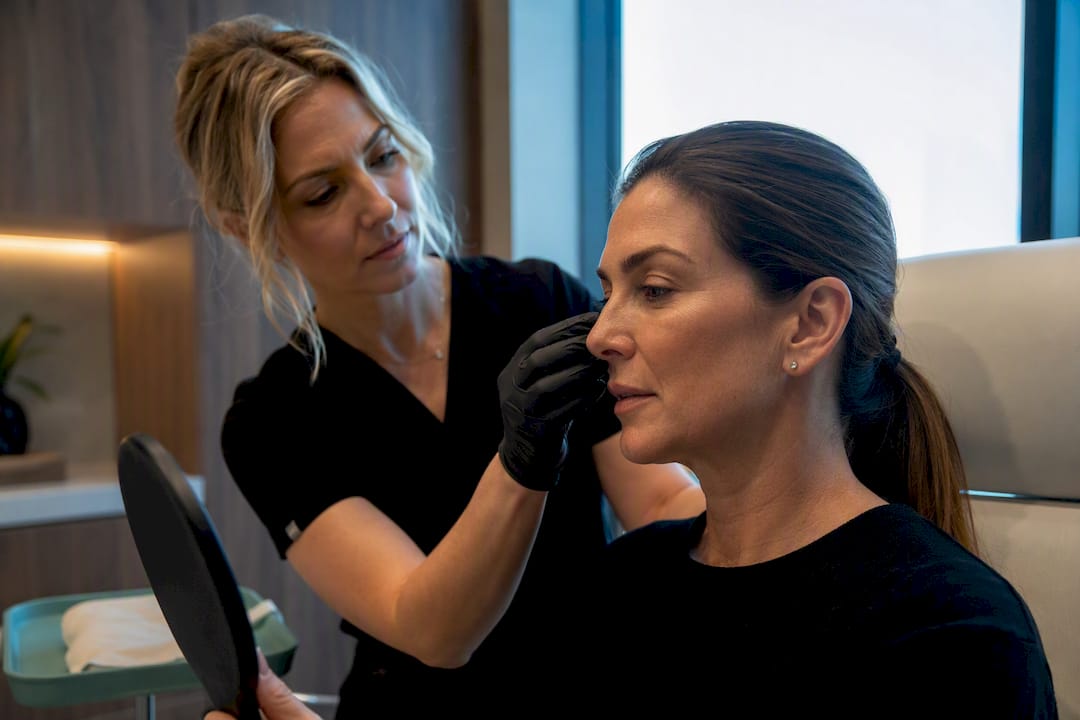
The most reliable path is an assessment-led plan that restores lost midface volume with HA fillers or biostimulators, adding skin-quality treatments where needed. HA fillers work immediately and can be reversed if something looks off. Whether you need volume restoration or laxity correction depends on your anatomy, so seeing a trained medical injector for a proper evaluation matters more than picking a product name off a list.
TL;DR:
- Volume restoration with HA fillers is most effective when combined with midface support to achieve natural, long-lasting results.
- Direct injection into the fold should be paired with support of the midface, preferably through indirect methods, to avoid overfilling and unnatural appearance.
- Neurotoxins help improve dynamic folds but are insufficient for static creases caused by volume loss or skin laxity.
- Biostimulators like PLLA and CaHA offer gradual, durable correction by stimulating collagen, but require multiple sessions and time for full effect.
- Proper assessment of underlying causes such as volume loss, skin laxity, and structural support is key, making personalized consultation more important than choosing a specific product.
Table of Contents
- Nonsurgical Nasolabial Folds Treatment Options at a Glance
- Dermal Fillers: HA, CaHA, and PLLA Compared
- Do Neurotoxins Help With Nasolabial Lines?
- Biostimulators and Energy Devices: Building Collagen Over Time
- When Do Thread Lifts or Surgery Make More Sense?
- How to Choose the Right Provider and Avoid Overtreatment
- What Recovery and Side Effects Actually Look Like
- At-Home Care That Actually Slows Progression
- How Clayton Dental Studio Approaches Facial Assessment
- The Case for Restraint in Nasolabial Fold Treatment
- Ready to Discuss Your Facial Assessment?
- Sources
Nonsurgical Nasolabial Folds Treatment Options at a Glance
Most nonsurgical treatments for nasolabial lines fall into a handful of categories, each solving a slightly different problem. Matching the tool to the actual cause, rather than just filling the crease, is what separates a natural result from an obviously “done” one.
- HA fillers — immediate volume replacement, lasts 6 to 18 months, fully reversible.
- CaHA and PLLA biostimulators — stimulate your own collagen over weeks to months, with results building gradually and lasting longer.
- Neurotoxins — relax the muscle pull that deepens dynamic folds, lasting 3 to 4 months, not a standalone fix for static creases.
- RF, microneedling, and HIFU — tighten skin texture and mild laxity, weaker for deep volume loss.
- Thread lifts — mild repositioning for early laxity, moderate duration.
Volume loss responds best to fillers or biostimulators. Skin laxity responds better to devices or, in advanced cases, surgical referral. Superficial texture lines often improve with topical retinoids alone, covered later in this piece.
Dermal Fillers: HA, CaHA, and PLLA Compared
Hyaluronic acid fillers remain the most widely studied first-line option for nasolabial folds, and for good reason. They add volume on contact, the effect is visible immediately, and if you or your injector aren’t happy with the placement, hyaluronidase dissolves it. That reversibility is a genuine safety advantage over almost every other option on this list.
Not all HA fillers behave the same way. Products vary by G’ (a measure of gel firmness) and cohesivity, which determines how well the filler holds its shape versus spreading under tissue movement. Firmer, more cohesive gels tend to work better for structural support in the midface, while softer formulations blend more naturally into the superficial fold itself.
Clinical evidence: A split-face randomized trial found one HA product noninferior to Restylane at one month, with greater improvement at three and six months for moderate to severe folds. Separately, protocols combining direct and indirect injection with Belotero Balance and Belotero Volume showed sustained improvement out to 18 months, with continued volumetric change reported at two years in observational case series.
The strategic decision that matters most isn’t which brand to choose. It’s whether to inject the fold directly or support the midface first. A midface-first, or indirect, approach restores volume to the deep cheek and treats the crease as a downstream symptom of descent rather than the problem itself. This staged approach often produces more natural, longer-lasting results and typically requires less filler placed directly in the fold. Direct injection still has a role for isolated, superficial creases, but combining both approaches, sometimes across two visits, tends to look less “filled” than direct injection alone.
Safety checklist worth asking your injector about:
- Familiarity with facial artery anatomy in the nasolabial and cheek region.
- Use of microboluses (under 0.05 mL per pass) rather than large boluses.
- Cannula versus needle technique, and when each is chosen.
- A documented emergency protocol for vascular occlusion, including on-site hyaluronidase.
CaHA (Radiesse) and PLLA (Sculptra) work differently than HA. They’re covered in the next section, since their timeline and mechanism deserve separate attention.
Do Neurotoxins Help With Nasolabial Lines?
Neurotoxins like Botox or Dysport relax the muscles that pull the fold deeper during expression, particularly the levator muscles around the upper lip and nose. They’re rarely a standalone treatment for nasolabial folds, but they’re a common adjunct in a broader plan, especially when combined with filler in the midface or a “lip flip” pattern nearby.
- Duration: Roughly 3 to 4 months before a repeat treatment is needed.
- Contraindications: Neuromuscular disorders, pregnancy, active skin infection at the injection site.
- Common side effects: Temporary bruising, mild headache, occasional asymmetry that resolves as the product wears in.
If your fold is purely dynamic, meaning it only appears when you smile and disappears at rest, neurotoxin alone might soften it. If the crease is visible even with a relaxed face, that’s static volume loss, and filler or a biostimulator is what actually addresses it.
Biostimulators and Energy Devices: Building Collagen Over Time
Biostimulators take a different approach than fillers. Instead of adding volume directly, PLLA and CaHA trigger your body to produce its own collagen over several weeks, and the correction builds gradually rather than appearing overnight.
That slower onset comes with a payoff. One multicenter comparison found higher durable correction rates for PLLA than HA at the 48-week mark, suggesting biostimulators can outlast a single round of HA filler at later follow-up points. The trade-off is real: biostimulators typically require two to three sessions spaced a month apart, and you won’t see the full effect until months later. For patients comfortable with a longer runway, that durability can mean fewer total touch-ups over a year.
Energy-based devices sit in a different lane entirely. RF microneedling, fractional lasers, and HIFU (high-intensity focused ultrasound) improve skin texture, tightness, and mild laxity, but the evidence for correcting deep volume loss is mixed at best. If your fold is driven mainly by fat pad descent or bone resorption, no amount of skin tightening replaces the lost structural support underneath. These devices work best as an adjunct to volume correction, not a replacement for it.
Sequencing generally follows the cause:
- Volume-loss-dominant folds: Filler or biostimulator first, addressing the midface before or alongside the crease itself.
- Laxity-and-texture-dominant folds: Devices first or alongside filler, since tightening the overlying skin changes how any added volume sits.
- Combination cases: Most patients over 45 fall here, and a staged plan across two or three visits usually outperforms trying to solve everything in one session.
When Do Thread Lifts or Surgery Make More Sense?
Thread lifts use dissolvable sutures with tiny barbs to reposition sagging tissue slightly upward. They can offer a modest lift for early-stage laxity, with results typically lasting 1 to 2 years, but they don’t remove excess skin or replace true structural support.
If your nasolabial fold is driven primarily by loose, descended tissue rather than volume loss, you may be a laxity-dominant case. In that scenario, surgical facelift techniques remain the definitive solution, since injectables and threads can’t reposition or excise tissue the way a deep-plane or SMAS lift can. A consult with a facial plastic surgeon is worth the conversation before committing to repeated rounds of filler that won’t address the underlying laxity.
- Thread lift recovery: mild swelling and pulling sensation for about a week.
- Facelift recovery: typically two to three weeks before returning to normal activity, with broad costs running well into the thousands depending on extent.
How to Choose the Right Provider and Avoid Overtreatment
Picking the right nasolabial fold filler or approach starts with an honest assessment, not a product menu. Before you book anything, run through this checklist:
- Fold severity and cause — is this volume loss, skin laxity, or both?
- Midface volume — has the cheek itself lost support, pulling the crease deeper?
- Skin quality — is texture or elasticity part of the problem, suggesting a device adjunct?
- Structural factors — dental or skeletal changes sometimes contribute to midface flattening over time.
At consultation, ask direct questions: What’s your training background for injecting this area? Do you keep hyaluronidase on site, and what’s your protocol if you suspect vascular occlusion? Can I see before-and-after photos of patients with a similar fold pattern to mine?
Watch for red flags. A provider who promises complete erasure of the fold in one session, who can’t describe an emergency plan, or who lets nonmedical staff perform deep midface injections is not someone to trust with a procedure this close to major facial vasculature.
Pro Tip: Bring a photo of your face from ten years ago to your consult. It helps your injector distinguish volume loss from lines that were always there, which changes the entire treatment plan.
What Recovery and Side Effects Actually Look Like
Most patients see mild swelling and bruising after filler injections, typically resolving within 3 to 7 days. Biostimulators can cause small, temporary nodules as the product settles, usually smoothing out within a couple of weeks.
- Common and expected: Bruising, tenderness, mild asymmetry that settles within days.
- Rare but serious: Vascular occlusion, presenting as sudden severe pain, blanching, or a mottled skin pattern near the injection site.
- Vision changes: Any sudden visual disturbance after facial filler is an emergency, requiring immediate contact with your provider and, for HA products, prompt hyaluronidase treatment.
Keep ice on hand for the first 24 to 48 hours, avoid strenuous exercise for a day or two, and skip aggressive facial massage unless your provider specifically instructs it. If swelling or pain worsens instead of improving after the first few days, call your injector rather than waiting it out.
At-Home Care That Actually Slows Progression
No skincare routine erases a deep nasolabial fold, but daily habits genuinely slow how fast it forms and support results after in-office treatment.
- Broad-spectrum SPF 30+ is the single highest-impact step, since sun exposure drives the majority of visible facial aging.
- Topical tretinoin, a prescription retinoid, increases dermal collagen production with consistent use over several months. Over-the-counter retinol offers a milder version of the same effect, with slower results.
- Vitamin C serums support collagen synthesis and help even out photodamage that makes folds look more pronounced.
- Oral collagen peptides, taken at 2.5 to 10 grams daily, were linked to improved skin elasticity and hydration over 8 to 12 weeks in one review, though effects are modest compared to injectables.
- Facial exercises may tone underlying muscle slightly, but there’s no strong evidence they reverse volume loss or reposition descended fat pads.
Pro Tip: Apply retinoid at night and vitamin C in the morning. They can deactivate each other if layered together, so splitting the routine by time of day gets you the benefit of both.
How Clayton Dental Studio Approaches Facial Assessment
Dr. Navneet Kamboj, DDS, brings nearly a decade of clinical experience and a UCLA-honed eye for facial structure to every aesthetic consult at Clayton Dental Studio. That combination of dental training and facial anatomy knowledge shapes how the practice evaluates the midface, not just the crease itself.
Clayton Dental Studio’s Dermal Hygiene™ program applies a conservative, midface-first philosophy borrowed directly from restorative dentistry: assess the structure first, treat proactively, and layer gradually. At your consult, expect a full facial assessment before any product recommendation, not the other way around.
The Case for Restraint in Nasolabial Fold Treatment
The biggest misconception about nasolabial folds treatment isn’t about which filler brand works best. It’s the assumption that more product, injected directly into the crease, equals a better result. The evidence points the other way. Staged, anatomy-first plans that restore midface support before filling the fold itself tend to look more natural and often need less total filler over time.
Conventional advice treats the nasolabial fold as an isolated line to erase. It isn’t. It’s usually the visible edge of a support system, cheek fat, bone, skin elasticity, that has shifted with age. Fillers and biostimulators each have a real role, but the sequencing matters as much as the product choice, and biostimulators’ slower timeline is a legitimate trade for patients willing to wait for more durable correction.
If you take one thing from this article, it’s this: prioritize the consultation over the product name. A skilled injector who assesses your midface before touching a syringe to the fold will consistently outperform someone who defaults straight to direct injection, regardless of which brand is in the syringe.
— Clayton Dental Studio
Ready to Discuss Your Facial Assessment?
If you’re weighing fillers, biostimulators, or device treatments for nasolabial folds, the honest answer is that the right choice depends on your specific anatomy, something no product comparison chart can tell you on its own. Clayton Dental Studio’s Dermal Hygiene™ program starts every case with that structural assessment first, evaluating midface volume, skin quality, and fold severity before recommending a single treatment.

Dr. Kamboj’s background bridging restorative dentistry and facial aesthetics means your consult looks at the full picture, including how dental and skeletal structure influence midface support, not just the crease you’re worried about. For patients dealing with related concerns like skin laxity or early fine lines and wrinkles, the same conservative, layered approach applies.
If you’re in the Humble, TX area and ready to move past guessing which treatment fits your fold pattern, book a Dermal Hygiene™ consultation to get a real assessment and a treatment plan built around your own anatomy.

This article is general information, not a substitute for advice from a qualified doctor. Consult a qualified healthcare professional about your own circumstances before acting on anything here.
Sources
- ESTLF vs Restylane split-face trial (PMC11288387)
- Best treatments for nasolabial folds compared (SpaLens)
- How to Reduce Nasolabial Folds: 7 Treatments Compared (The Face Report)
- Nasolabial folds overview and prevention (Cleveland Clinic)
Recommended
Ready to Schedule Your Appointment?
Dr. Kamboj and the Clayton Dental Studio team are here to help. Call us or book online today.