
Clinic-backed advice for parents on thumb sucking and teeth: signs to act by age 4, three gentle home steps to try tonight, and when to see a dentist.
Act by Age 4: Clinic Backed Thumb Sucking Help Parents Can Use Tonight

Thumb sucking will not necessarily harm your child’s teeth, but the risk climbs sharply with age and intensity. The American Dental Association and Mayo Clinic both note that most children stop thumb sucking naturally by preschool age with no lasting damage. We watch closely once a child is older or when permanent front teeth begin to erupt, because that is when anterior open bite, overjet, and crossbite become real possibilities. If you notice the front teeth no longer meeting when your child bites down, that is the moment to schedule a dental evaluation rather than wait.
TL;DR:
- The risk of dental misalignment increases significantly after age 4 or when permanent front teeth start to erupt, especially with vigorous or prolonged thumb sucking.
- Prolonged thumb sucking applies steady pressure that can cause anterior open bite, increased overjet, palate narrowing, and speech issues like lisps.
- Behavioral strategies such as rewards, replacement objects, and routine consistency are most effective for quitting before age 4, with appliances used if habits persist.
- Thumb sucking impacts tongue posture and muscle function, which can interfere with speech development and normal orofacial muscle coordination.
- Both thumb sucking and pacifier use carry risks of malocclusion, but thumb sucking more strongly links to front teeth protrusion, while pacifiers tend to cause crossbites.
Table of Contents
- How Thumb Sucking Affects Teeth and Facial Development
- When Should You Be Concerned About Thumb Sucking?
- How to Stop Thumb Sucking Gently at Home
- Dental and Orthodontic Options for Thumb Sucking Damage
- Clinical Perspective From Clayton Dental Studio
- Does Thumb Sucking Affect Speech and Oral Muscle Function?
- Thumb Sucking vs. Pacifier Use: What’s the Dental Difference?
- Why Do Kids Suck Their Thumbs, and How Do You Address the Root Cause?
- Balancing Comfort and Long-Term Dental Health
- How Clayton Dental Studio Supports Families Through This Habit
- Sources
- FAQ
How Thumb Sucking Affects Teeth and Facial Development
Picture the thumb as a tiny, constant wedge sitting between the upper and lower teeth for hours every day. Over months and years, that pressure reshapes the mouth the way a retainer would, just in a direction nobody wants.
Dentists describe a few specific patterns:
- Anterior open bite: the front upper and lower teeth don’t touch when the jaw closes, leaving a visible gap.
- Increased overjet: the upper front teeth flare outward, protruding beyond the lower teeth.
- Posterior crossbite: the back teeth on one or both sides bite incorrectly against the opposing arch.
- Palate narrowing: constant tongue and thumb pressure pushes the roof of the mouth into a narrower, higher shape than it should have.
The biomechanics are straightforward. A thumb resting against the palate and front teeth for long stretches applies steady, low-grade force. Teeth are remarkably responsive to sustained pressure, which is exactly how orthodontic appliances work. A thumb just applies that pressure in an uncontrolled direction, and the tongue often drops into a lower resting position to make room, which narrows the palate further over time.
A systematic review and meta-analysis found that digit sucking is strongly linked to anterior open bite, while pacifier use carries higher odds for posterior crossbite specifically. Duration matters more than most parents assume.
Statistic Callout: Research reviewed by NCBI shows that how long the thumb stays in contact with the palate and teeth predicts dental change better than how vigorously the child sucks. A child who passively rests a thumb in their mouth for hours can develop similar issues to a child who sucks more forcefully but for shorter periods.
Beyond the bite itself, prolonged habits can trigger a lisp or other speech changes, plus skin problems on the thumb itself, including calluses, cracked skin, or nail deformities from constant moisture and pressure.
When Should You Be Concerned About Thumb Sucking?
Most toddlers who suck their thumbs stop on their own during the toddler years, and pediatric dentists generally advise against forcing the issue before then. Heavy intervention before toddler age usually creates more frustration than benefit.
The calculus changes after age 4, or as soon as permanent central incisors start erupting. That eruption timing is a practical marker clinicians watch closely, since dental structures become more vulnerable to lasting change once adult teeth are involved.
Watch for these signals that it’s time to act:
- Front teeth that no longer touch when your child bites down
- A visible gap between upper and lower teeth at rest
- New or worsening speech changes, especially a lisp
- Vigorous, forceful sucking rather than passive resting
- A habit that continues both day and night
- Calluses, redness, or nail changes on the thumb itself
- Comments from other children or self-consciousness about the habit
Left unaddressed past age 4, these signs tend to compound. Minor gaps can widen, and palate narrowing can progress to the point where an orthodontic device becomes the primary fix instead of a phased-in behavioral approach.
How to Stop Thumb Sucking Gently at Home
Punishing or shaming a child for thumb sucking almost always backfires. It’s a self-soothing behavior, often tied to stress, tiredness, or boredom, so the goal is to replace the habit, not just suppress it.
Start with a simple three-step micro-plan:
- Observe the triggers. For a few days, notice when the thumb goes in: bedtime, car rides, TV time, moments of stress. You cannot replace a habit you haven’t mapped.
- Offer a replacement. Hand your child something else to do with that hand during trigger moments: a soft stuffed animal to hold, a textured fidget toy, or a small task like holding a book.
- Reward the win, not the absence. Praise your child specifically when you catch them using the replacement, rather than only commenting when you notice the thumb is out of the mouth.
A few more tactics tend to work well alongside that plan:
- Reward charts with stickers for thumb-free stretches, especially during the day, build momentum without pressure.
- Scheduled hands-occupied activities during known trigger times (drawing, building blocks, dough) crowd out the opportunity.
- Gentle verbal reminders, delivered without frustration, help more than nagging.
- Bedtime adjustments, like reading an extra story or adding a comfort object, address night sucking specifically.
- Mild coverings, such as soft mitts or thumb tape at night, work as a last resort for children who are motivated but struggle with the unconscious nighttime habit.
Avoid bitter-tasting nail polishes or paints unless your dentist specifically recommends one for your child’s situation. Clinical guidance from JADA supports positive reinforcement first, with appliance therapy reserved for cases where behavioral strategies alone haven’t worked.
Pro Tip: Pair a single nightly routine, like a specific story followed by a hands-occupied object such as a small stuffed toy, and repeat it every night without variation. Night sucking is often the hardest to break because it’s unconscious, and a consistent substitution routine gives the brain something automatic to reach for instead of the thumb.

Sometimes the message lands better coming from a professional. Dentists often find greater success motivating children to quit than parents do, simply because the explanation comes from a neutral authority rather than mom or dad.
Dental and Orthodontic Options for Thumb Sucking Damage
When you bring your child in for an evaluation, several things may be checked: the stage of tooth eruption, how the upper and lower jaw meet, the width of the palate, and whether speech is being affected. For many younger children, the first step is simply monitoring and counseling, since the habit may still resolve naturally.
If the habit persists and dental changes are already visible, a few options come into play:
- Habit-breaking appliances, like a palatal crib or a simple reminder appliance, work either by physically blocking thumb-to-palate contact or by interrupting the unconscious habit. These typically come into play for children beyond toddler age who haven’t responded to behavioral strategies alone.
- Space maintainers sometimes come into the conversation too, particularly if early tooth loss or spacing issues complicate the picture.
Severe skeletal jaw discrepancies are uncommon, and surgical correction is only considered after growth is complete, in the rare cases where it’s needed at all. Early, conservative intervention tends to reduce how much orthodontic work is needed down the road, and timely referral can correct many effects before they become permanent.
Clinical Perspective From Clayton Dental Studio
I’m Dr. Navneet Kamboj, and I earned my Doctor of Dental Surgery degree from the University at Buffalo, with additional restorative training through a preceptorship at UCLA. Nearly a decade of practice in the Humble community has taught me that thumb sucking cases call for patience over pressure.
At Clayton Dental Studio, our approach starts with conservative monitoring and honest conversations with families, not an immediate push toward appliances. When a habit-breaking device or orthodontic referral does make sense, we walk through it in terms your child can understand, and we work with your insurance or financing options to keep the plan manageable.
Does Thumb Sucking Affect Speech and Oral Muscle Function?
Yes, and it’s one of the effects parents notice least until a teacher or speech therapist points it out. A J O C P D study found prolonged thumb sucking associated with speech issues such as lisps, alongside the dental changes.
The mechanism connects directly to tongue posture. When a thumb occupies the space between the tongue and the palate for hours a day, the tongue adapts by resting lower and further forward than it should. That altered resting position can carry over into how a child produces sounds that require precise tongue placement against the teeth or palate, particularly “s,” “z,” “th,” and similar sounds.
Muscle function around the mouth adapts too. The lips, cheeks, and tongue develop their coordination partly through normal chewing, swallowing, and talking. A thumb wedged in the mouth for extended periods can interfere with that coordination, contributing to what’s sometimes called an orofacial myofunctional issue, essentially a mismatch between how the muscles move and how they should move for clear speech and efficient swallowing.
If you notice your child struggling with specific sounds well past the age when peers have mastered them, a speech development checklist can help you figure out whether it’s timing, the thumb habit, or something else worth discussing with a specialist. Addressing the thumb sucking habit alongside speech concerns tends to produce better results than tackling either one alone.
Thumb Sucking vs. Pacifier Use: What’s the Dental Difference?
Both habits raise the odds of malocclusion, but they don’t affect the mouth in quite the same way. A systematic review and meta-analysis found that digit sucking carries a stronger link to anterior open bite, while pacifier use shows higher odds specifically for posterior crossbite.
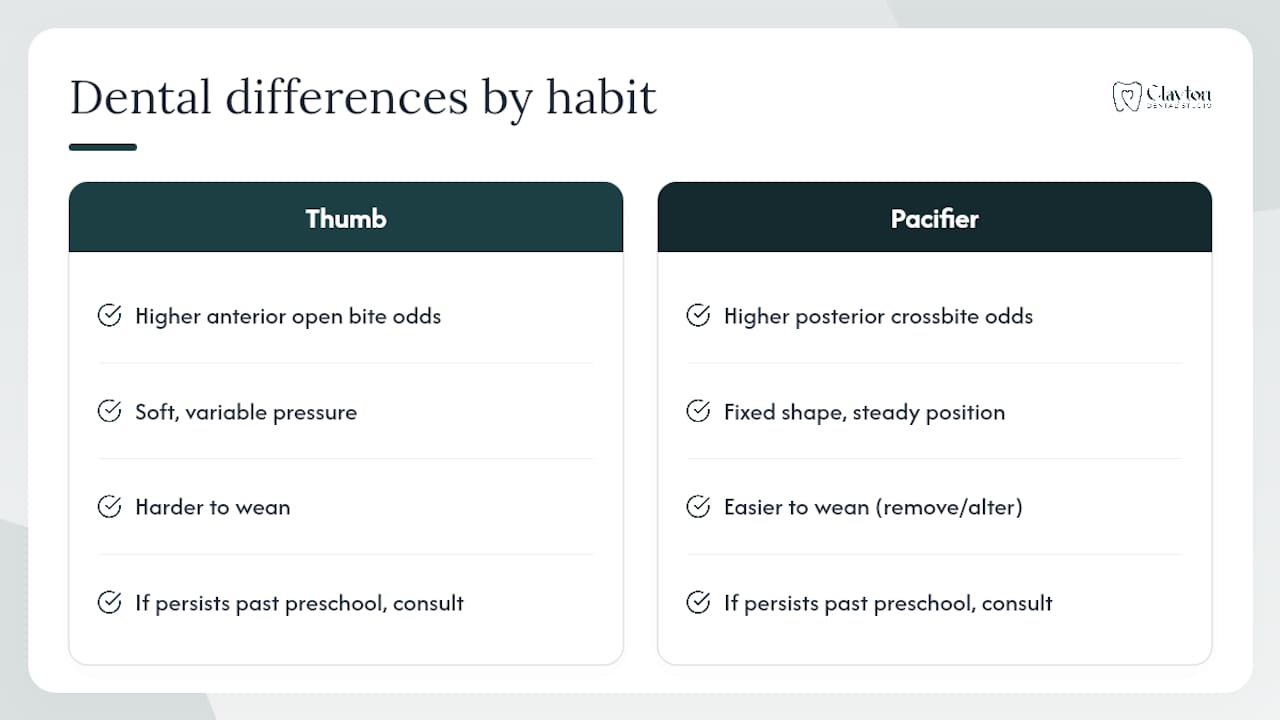
The distinction makes practical sense once you consider the shape and rigidity of each object. A thumb is soft, warm, and molds slightly to the mouth, but a child can vary the pressure and angle constantly, which tends to push the front teeth outward over time. A pacifier holds a more fixed shape and position, which more often pushes the sides of the palate inward, narrowing the back of the arch and creating that crossbite pattern.
There’s a practical upside to pacifiers worth mentioning: many pediatricians find it easier to phase out a pacifier than a thumb, simply because you can take the object away, hide it, or gradually cut down the tip. A thumb is always available, which is part of why thumb sucking often proves harder to break through willpower alone.
Neither habit is risk-free past the toddler years, and the same age guidance applies to both: most children age out of the behavior by preschool age, and any persistent habit beyond that point deserves a dental conversation.
Why Do Kids Suck Their Thumbs, and How Do You Address the Root Cause?
Thumb sucking is fundamentally a self-soothing mechanism, not a bad habit chosen out of stubbornness. Infants suck reflexively for feeding, and many carry that comfort-seeking behavior forward into toddlerhood, reaching for it during stress, fatigue, boredom, or transitions like starting daycare or welcoming a new sibling.
Recognizing the emotional trigger matters more than most parents expect. A child sucking their thumb only at bedtime is soothing themselves to sleep, while a child sucking constantly throughout the day, including during play or while watching television, may be using it to manage anxiety, overstimulation, or simply habit born of boredom.
Addressing the psychological driver, rather than the behavior alone, tends to produce more lasting results. If stress or transition is the trigger, extra reassurance, consistent routines, and predictable bedtime rituals often reduce the urge without any direct intervention on the thumb itself. If boredom drives it, keeping hands occupied during known lull periods, art projects, building toys, simple chores, closes the gap the thumb was filling.
Shaming rarely works and can add a layer of anxiety that makes the habit stickier, not looser. Praise for effort, patience through setbacks, and treating the transition as a shared project rather than a correction tend to get children to a thumb-free mouth faster and with far less friction at home.
Balancing Comfort and Long-Term Dental Health
Thumb sucking comforts kids, and that’s worth remembering before you feel any urgency to intervene. Most children age out of it naturally by 4, and the real threshold to watch is visible bite change, whether it’s a gap between the front teeth or a bite that no longer meets correctly. Try the nonpunitive strategies first. If you spot red flags, or you’re simply unsure, book a pediatric dental assessment. A short conversation now beats a longer correction later.
— Clayton Dental Studio
How Clayton Dental Studio Supports Families Through This Habit
Families benefit from having a single, trusted place to handle thumb sucking concerns from first observation through any correction that’s needed, rather than bouncing between a general dentist and an orthodontist for separate opinions. Pediatric assessments cover key aspects such as bite relationship, palate width, and whether speech is being affected, explained in terms that make sense to parents and children alike.

If behavioral strategies at home haven’t fully resolved the habit, we can talk through habit-breaking appliances or, when appropriate, clear aligner options as your child gets older. Dr. Kamboj’s approach favors conservative monitoring and family counseling first, escalating only when the evidence supports it. We work with dental insurance for covered evaluations and offer financing for elective treatment, so cost doesn’t have to be the reason a concern goes unaddressed.
If you’ve noticed any of the warning signs covered above, from a visible gap between the front teeth to a habit that’s stuck around past age 4, the next step is simple: schedule a general dentistry appointment and get a clear answer instead of a guess.
This article is general information, not a substitute for advice from a qualified doctor. Consult a qualified healthcare professional about your own circumstances before acting on anything here.
Sources
- The Role of Digit- and Pacifier-Sucking Habits on Malocclusion Development in Children: Anterior Open Bite and Posterior Crossbite—A Systematic Review & Meta-Analysis
- Prolonged thumb sucking associated with dental and facial issues — J O C P D (2024)
- Oral habits and orofacial development — NCBI (2023)
- Mayo Clinic — Thumb sucking: Help your child break the habit
FAQ
Is Thumb Sucking Related to ADHD?
There’s no established clinical link between thumb sucking and ADHD. Thumb sucking is a common self-soothing behavior in young children and, on its own, isn’t considered a sign of any behavioral or developmental disorder.
How Do You Fix an Overbite Caused by Thumb Sucking?
Treatment depends on severity and age, ranging from habit-breaking appliances like a palatal crib to orthodontic correction with expansion appliances, braces, or clear aligners once the habit has stopped. A dental evaluation determines which approach fits your child’s specific bite pattern.
At What Age Should I Worry About Thumb Sucking?
Most children stop on their own between ages 2 and 4, so mild concern before then usually isn’t warranted. Active intervention is generally recommended once a child passes age 4 or when permanent front teeth begin erupting.
Can Thumb Sucking Cause Speech Problems?
Yes, prolonged thumb sucking is associated with speech issues, including lisps, because it can alter tongue posture and resting position over time. Addressing the habit often improves speech clarity alongside any dental correction.
Is Pacifier Use Better Than Thumb Sucking for Teeth?
Neither is entirely risk-free, but they tend to cause different problems. Pacifier use is more strongly linked to posterior crossbite, while thumb sucking carries a stronger association with anterior open bite, and pacifiers are generally easier to phase out than a thumb.
Recommended
Ready to Schedule Your Appointment?
Dr. Kamboj and the Clayton Dental Studio team are here to help. Call us or book online today.