Discover the key differences in onlay vs crown treatments. Choose wisely for your tooth health and learn which option suits your needs best!
Onlay vs Crown: What Patients Need to Know

Choose an onlay when healthy tooth walls remain and your dentist can bond to solid enamel. Choose a crown when the tooth is severely broken down, has just had root canal therapy, or has cracks that extend below the gumline. That one sentence covers the majority of cases, but the details matter for your long-term tooth health.
Common scenarios at a glance:
- Typical onlay case: A back molar with a large failing filling but intact outer walls and no root canal history. An onlay restoration removes only the damaged portion and bonds to the remaining healthy enamel.
- Typical crown case: A premolar that has lost more than half its structure, or any posterior tooth immediately after root canal therapy, where full coverage is needed to prevent fracture.
- Middle-ground cases: Some teeth fall into a gray zone where either restoration is clinically acceptable. A cracked cusp confined to the biting surface, for example, may be treated with an onlay or a crown depending on crack depth, remaining wall thickness, and your dentist’s bonding protocols.
The American Dental Association recognizes both as legitimate restorative options. The right choice depends on how much healthy tooth structure remains, not on which option is faster or cheaper to place.
Table of Contents
- What exactly are an onlay and a crown?
- Onlay vs crown: a side-by-side comparison
- When do dentists recommend an onlay versus a crown?
- What materials are used, and what does the evidence say about survival?
- What to expect during the procedure and recovery
- Crown vs onlay cost in the U.S. and how insurance works
- Questions to ask your dentist before deciding
- Key Takeaways
- A dentist’s perspective on choosing between the two
- Ready to find out which restoration is right for your tooth?
- Useful sources and further reading
What exactly are an onlay and a crown?
An onlay is a partial-coverage restoration. Think of it as a custom-fitted cap that covers the biting surface and one or more cusps of a tooth, but leaves the outer walls and sides intact. Because the preparation is defect-driven, meaning your dentist removes only what is damaged or decayed, onlays preserve substantially more natural tooth structure than a crown preparation does. That matters because preserving healthy enamel and dentin supports the long-term durability of both the tooth and the restoration.
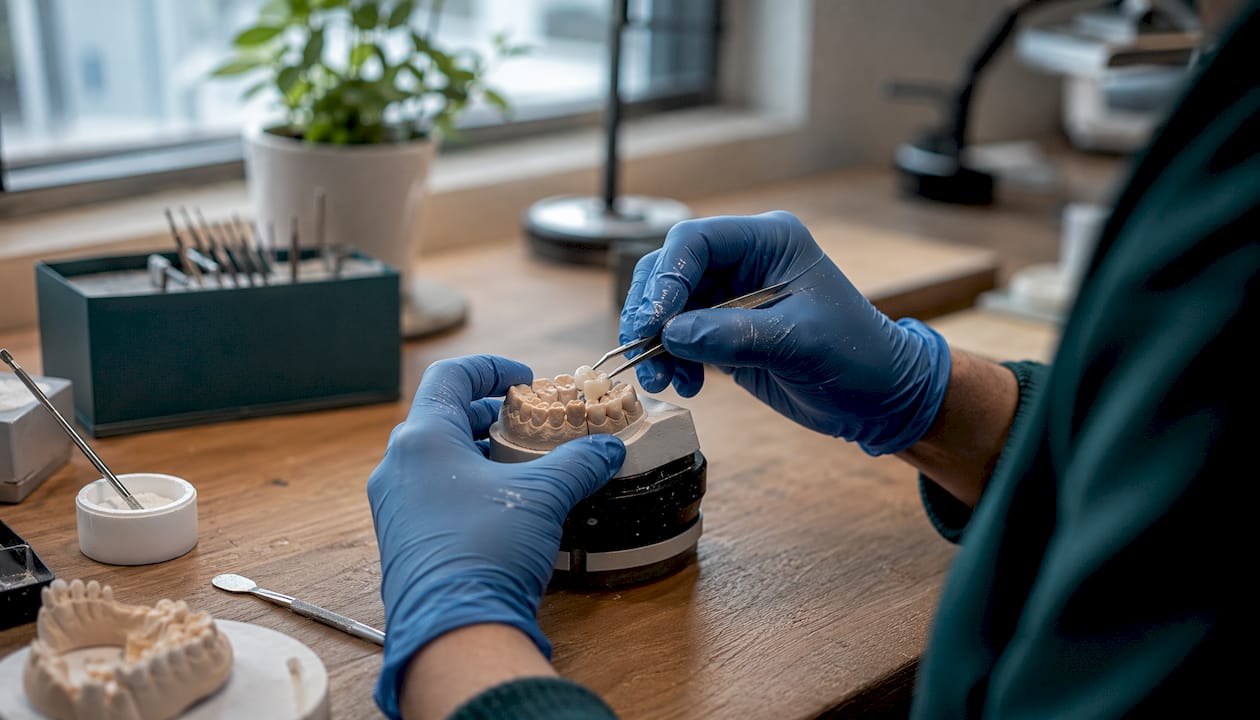
A crown is a full-coverage restoration. It encases the entire visible portion of the tooth down to the gumline, like a fitted helmet over the whole tooth. To seat a crown properly, your dentist must reduce all four sides of the tooth, which typically removes considerably more healthy structure. That reduction is worthwhile when the tooth is too compromised to support a partial restoration, but it is a permanent change.
Common materials for both:
- Porcelain/ceramic (IPS e.max, lithium disilicate): Natural-looking, strong enough for most back teeth, and the most popular choice for onlays.
- High-translucency zirconia: Extremely durable, often preferred for crowns on high-stress molars.
- Porcelain-fused-to-metal (PFM): A traditional crown option, less common now but still used.
- Gold: Excellent longevity, especially for back teeth, though rarely chosen for cosmetic reasons.
- Composite resin: Lower cost, used for onlays in some cases, but less durable under heavy bite forces.
Pro Tip: If your dentist recommends an onlay, ask specifically whether IPS e.max or lithium disilicate is planned. Research suggests these ceramics are particularly well-suited to partial-coverage restorations and perform better in that application than zirconia, which tends to excel in full-crown form.
Onlay vs crown: a side-by-side comparison
| Dimension | Onlay (partial coverage) | Crown (full coverage) |
|---|---|---|
| Coverage | Biting surface + one or more cusps | Entire visible tooth to gumline |
| Tooth structure removed | considerably less (defect-driven) | considerably more (circumferential reduction) |
| Durability / lifespan | Comparable short-term; long-term data still emerging | Well-established long-term track record |
| Best indications | Large failing fillings, cracked cusps, intact walls | Severe damage, post-root canal, cracks below gumline |
| Materials & aesthetics | e.max, lithium disilicate, composite; highly esthetic | Zirconia, PFM, gold, e.max; esthetic or functional |
| Procedure / visits | 2 visits (lab) or 1 visit (CEREC same-day) | 2 visits (lab) or 1 visit (CEREC same-day) |
| U.S. cost tendency | Often lower than a crown | Typically higher; varies by material and location |
| Insurance coverage | Variable; some plans cover at crown rate, some less | Usually covered as a major restorative service |
| Failure mode | Fractures tend to be limited to the restoration; tooth often salvageable | Failures more often extend to the root; tooth may be unrestorable |
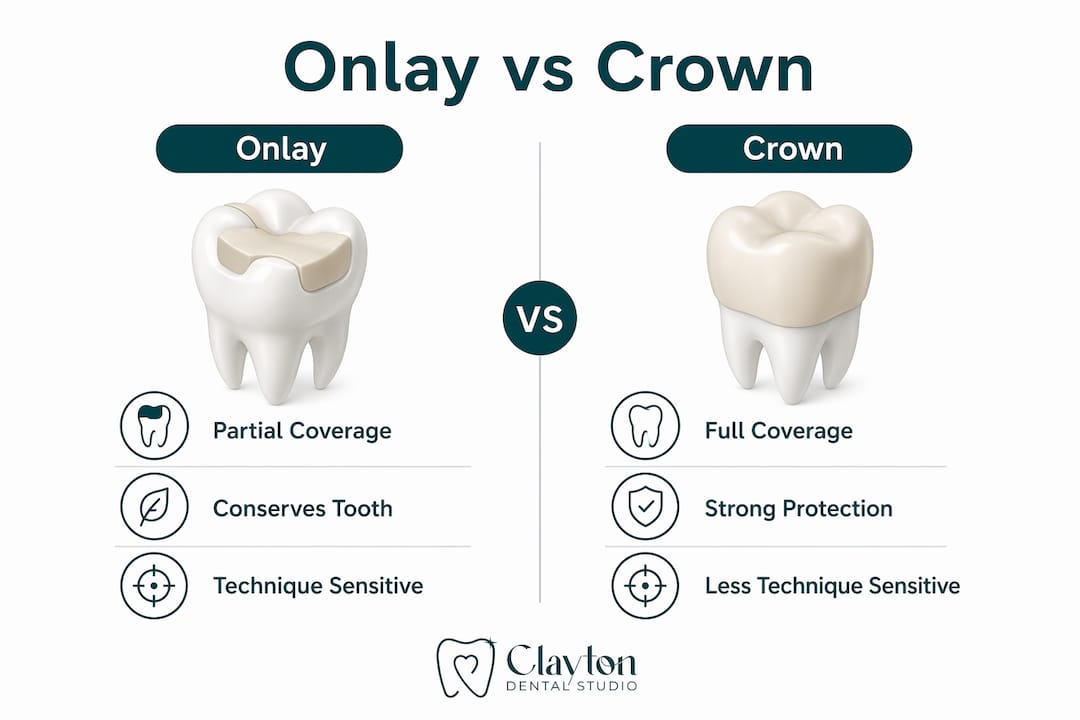
The core tradeoff is straightforward: an onlay conserves tooth structure and keeps future options open, while a crown provides maximum structural protection when the tooth can no longer support a partial restoration.
When do dentists recommend an onlay versus a crown?
The decision comes down to how much healthy tooth remains and what the tooth needs to function safely. Here is how clinicians typically think through it.
Onlays are usually the right choice when:
- A large filling has failed but the outer walls of the tooth are still solid and thick enough to bond to.
- A cusp has cracked but the crack is confined to the biting surface and does not extend below the gumline.
- The patient and dentist want to preserve as much natural enamel as possible, especially on a tooth that has never had a root canal.
- The isthmus width (the width of the cavity opening) is less than half the distance between the cusps, and remaining cusp walls meet structural thickness thresholds.
Crowns are typically necessary when:
- More than roughly half the tooth’s coronal structure is missing or unsupported.
- The tooth has just completed root canal therapy, particularly a posterior molar or premolar, where the risk of fracture without full coverage is high.
- Cracks extend below the gumline or into the root.
- There is insufficient wall height to create a proper ferrule (the band of tooth structure a crown grips), which is a key factor in crown retention and long-term success.
- The tooth has already had an onlay that failed and the remaining structure can no longer support another partial restoration.
Patient scenarios that illustrate the difference:
- Lower molar, large old amalgam filling, no root canal: Intact walls, healthy pulp. An onlay is the conservative first choice. If the onlay ever fails, a crown can still be placed afterward without losing that option.
- Upper premolar, root canal completed last month: Even with walls that look intact, the tooth is now brittle and at high fracture risk. A full crown is the standard recommendation here.
- Front tooth with a fractured corner: Front teeth carry different bite forces than molars. A veneer or crown is often preferred over an onlay for anterior teeth because the geometry and esthetics differ.
- Molar with a cracked cusp, crack depth unknown: This is a genuine gray zone. Your dentist may recommend a crown to be safe, or may place an onlay and monitor. Crack depth, confirmed under magnification, is the deciding factor.
If an onlay fails, the tooth usually remains restorable. When a crowned tooth fractures, failures tend to be more catastrophic, sometimes extending to the root and leaving the tooth unrestorable. That asymmetry in failure mode is one reason many clinicians prefer starting conservatively when the clinical picture allows it.
What materials are used, and what does the evidence say about survival?
The most commonly used materials for onlays today are IPS e.max (lithium disilicate) and high-translucency ceramics. For crowns, zirconia has become increasingly popular for posterior teeth because of its strength, while PFM remains an option and gold is still considered the gold standard for longevity in high-stress molar positions.
Material choice affects more than just appearance. Research from a 2022 systematic review and meta-analysis published in Head & Face Medicine found that IPS e.max performs particularly well for partial-coverage restorations, while monolithic zirconia tends to excel in full-crown applications.
What the clinical evidence shows: A 2022 systematic review of posterior restorations found no statistically significant difference in survival or success rates between onlays/partial crowns and full crowns at 1 year and 3 years of follow-up. At 3 years, the odds ratio for survival favored onlays slightly (OR = 0.65), but the difference was not statistically significant (P = 0.747). This means short-term durability should not be the deciding factor. Structure preservation and long-term tooth prognosis should guide the choice.
One important nuance: onlays are more technique-sensitive than crowns. They rely on adhesive bonding, precise isolation, and careful moisture control during cementation. A clinic that uses rubber dam isolation consistently and follows immediate dentin sealing protocols will get meaningfully better long-term results from an onlay than one that does not.
Pro Tip: Before committing to an onlay, ask your dentist whether they routinely use a rubber dam for bonding. This single procedural detail affects the adhesive bond quality more than the choice of ceramic material.
What to expect during the procedure and recovery
Both restorations follow a similar workflow, with one key difference: same-day technology can eliminate the second visit entirely.
Standard two-visit workflow (lab-fabricated):
- Consultation and diagnosis: X-rays, clinical exam, and discussion of options.
- Tooth preparation: Your dentist removes decay and shapes the tooth. For an onlay, only the damaged area is prepared. For a crown, the entire tooth is reduced.
- Impression or digital scan: A physical impression or an intraoral digital scan captures the exact shape of the prepared tooth.
- Temporary restoration: A temporary onlay or crown protects the tooth while the lab fabricates the final piece, usually 1–2 weeks.
- Cementation: The final restoration is bonded or cemented at a second appointment, and your bite is checked and adjusted.
Same-day CEREC workflow (single visit):
With CAD/CAM technology, the digital scan feeds directly into an in-office milling unit. The restoration is designed, milled from a ceramic block, and cemented in one appointment, typically 1.5–2 hours. Clayton Dental Studio offers same-day CEREC crowns, which means no temporary, no second visit, and no waiting. For patients with busy schedules, that convenience is real. You can also read more about how CEREC compares to a lab crown if you want to understand the tradeoffs in detail.
What to expect after the appointment:
- Mild sensitivity to temperature and pressure is normal for a few days after either restoration.
- Avoid very sticky or hard foods for the first few days while the bonding fully sets and sensitivity settles.
- Chewing will feel slightly different at first. If your bite feels uneven after a week, call your dentist for a quick adjustment.
- Call right away if you notice sharp pain, the restoration feels loose, or a piece chips off.
Crown vs onlay cost in the U.S. and how insurance works
Cost is one of the most common questions patients ask, and the honest answer is that it varies. Geography, material choice, and whether the procedure is done in-office or sent to a lab all affect the final number.
General U.S. cost context:
- Onlays typically cost less than crowns, though the gap has narrowed with same-day technology. For specific local pricing, the dental crown cost guide from Clayton Dental Studio covers Houston-area ranges and financing options.
- Crowns generally fall into the “major restorative” category for insurance purposes, which usually means 50% coverage after the deductible, subject to annual maximums.
- Onlays may be coded differently by some insurers, which can affect reimbursement. Some plans treat them at the crown rate; others reimburse at a lower tier.
Practical steps to avoid billing surprises:
- Ask your dentist’s office to submit a preauthorization (also called a predetermination) to your insurer before the procedure. This gives you a written estimate of what your plan will cover.
- Confirm the CDT (Current Dental Terminology) code your dentist plans to use. Onlays and crowns have different codes, and the code determines your benefit.
- Ask about in-house financing or payment plans if your out-of-pocket cost is significant. Many dental offices, including Clayton Dental Studio, offer financing options.
- Check whether your plan has a waiting period for major restorative work if your coverage is relatively new.
Pro Tip: A preauthorization is not a guarantee of payment, but it is the closest thing to a cost estimate you can get before treatment. Always request one for any restoration expected to cost more than a few hundred dollars.
Questions to ask your dentist before deciding
Walking into your appointment with the right questions puts you in a much stronger position. Here is a practical checklist to bring with you.
Questions to ask:
- How much of my tooth structure will be removed for each option?
- Is there a ferrule present? (This matters for crown retention.)
- Can you isolate this tooth with a rubber dam for bonding?
- Is a same-day option available, or will I need a temporary?
- What material do you recommend, and why?
- If I start with an onlay and it fails later, can a crown still be placed?
- What does my insurance cover for each option, and what is my estimated out-of-pocket cost?
Red flags to watch for:
- A dentist who recommends a crown without examining crack depth or remaining wall thickness.
- Vague answers about bonding technique or isolation protocols.
- No discussion of material options or why one material suits your tooth better than another.
- Refusal to provide a cost estimate or preauthorization before treatment.
Trust signals to look for in a clinic:
- Published clinical case photos showing before-and-after restorations.
- In-house CEREC milling for same-day restorations.
- Clear DDS credentials and documented restorative training.
- Transparent, itemized cost estimates provided before treatment begins.
- Willingness to explain the clinical reasoning behind the recommendation.
A good restorative dentist will welcome these questions. If the answers feel rushed or dismissive, that is useful information too. You can also explore cosmetic dental treatment options to understand how onlays and crowns fit within the broader range of restorative approaches available today.
Key Takeaways
Onlays and crowns perform comparably in the short term, so the decision should center on how much healthy tooth structure remains and what the tooth needs to stay functional long-term.
| Point | Details |
|---|---|
| Choose based on structure | Prefer an onlay when healthy walls remain; choose a crown when the tooth is severely compromised or post-root canal. |
| Short-term survival is similar | A 2022 systematic review found no statistically significant difference in survival between onlays and crowns at 1 and 3 years. |
| Failure modes differ | Onlay failures tend to leave the tooth salvageable; crown failures are more often catastrophic and may render the tooth unrestorable. |
| Ask the right questions | Confirm rubber dam use, ferrule presence, material choice, and CDT coding before agreeing to treatment. |
| Clayton Dental Studio | Offers same-day CEREC crowns and onlay restorations in Humble, TX, with transparent cost estimates and in-house bonding protocols. |
A dentist’s perspective on choosing between the two
I’m Dr. Kamboj, and at Clayton Dental Studio, my starting point is always conservation. When a patient comes in with a large failing filling or a cracked cusp, my first question is not “which restoration is faster to place?” It is “how much healthy tooth can we keep?” If the outer walls are solid and I can achieve reliable isolation with a rubber dam, an onlay is almost always my first recommendation. Preserving natural tooth structure is not just a philosophical preference. It directly affects how long the tooth and the restoration last together.
That said, I do not hesitate to recommend a crown when the clinical picture calls for it. A root-canal-treated molar, a tooth with cracks extending toward the root, or a tooth where the remaining walls are too thin to bond to reliably, these all need full coverage. The goal is to match the restoration to what the tooth actually needs, not to default to one option for every case. At Clayton Dental Studio, we use digital intraoral scanning and in-office CEREC milling, which means we can deliver either restoration with precision and, when appropriate, in a single visit. My training at the University at Buffalo (DDS) and through a restorative preceptorship at UCLA shaped how I approach these decisions, and I bring that same careful judgment to every patient I see in Humble.
Ready to find out which restoration is right for your tooth?
Same-day restorations and a clear explanation of your options are what patients at Clayton Dental Studio consistently tell us they value most. Whether you need a conservative onlay to preserve a healthy molar or a full crown after root canal therapy, the process starts with a thorough exam and an honest conversation about what your tooth actually needs.
At Clayton Dental Studio in Humble, TX, Dr. Kamboj offers both inlays and onlays and same-day CEREC crowns, along with transparent cost estimates and insurance verification before treatment begins. Bring your X-rays if you have recent ones, write down your questions from the checklist above, and we will walk through the options together. To schedule your restorative evaluation, visit Clayton Dental Studio’s services page or call the office directly. Financing options are available for patients who need them.
Useful sources and further reading
The following sources were used to build this article and are worth bookmarking if you want to read further.
- Onlays/partial crowns versus full crowns: systematic review and meta-analysis — Published in Head & Face Medicine (2022). The primary source for survival and success rate comparisons. Cite this for any claim about short-term equivalence between onlays and crowns.
- Onlays and crowns for MOD preparations: systematic review — Published in the Journal of Esthetic and Restorative Dentistry. The key source for failure mode differences and why onlay failures tend to be more salvageable than crown failures.
- Prosthodontips: crown or onlay? — A clinical column from Dentistry.co.uk covering the conservative-first approach, rubber dam protocols, and when clinicians default to crowns for predictability.
- HCMC Dental: inlay, onlay, overlay vs crown guide — A patient-facing guide covering CAD/CAM workflows, adhesive protocols, and the clinical metrics (isthmus width, cusp thickness) that guide restoration selection.
- Aftercare for inlays and onlays — Practical post-procedure guidance on diet, sensitivity, and when to contact your dentist.
Recommended
Ready to Schedule Your Appointment?
Dr. Kamboj and the Clayton Dental Studio team are here to help. Call us or book online today.