
Cause-first diastema closure in Humble, TX. Learn when same-day bonding (1–1.5 mm), veneers, orthodontics (12–24 months), or implants best fit your gap.
Cause First Diastema Closure in Humble, TX: 1–1.5 mm to 12–24 months
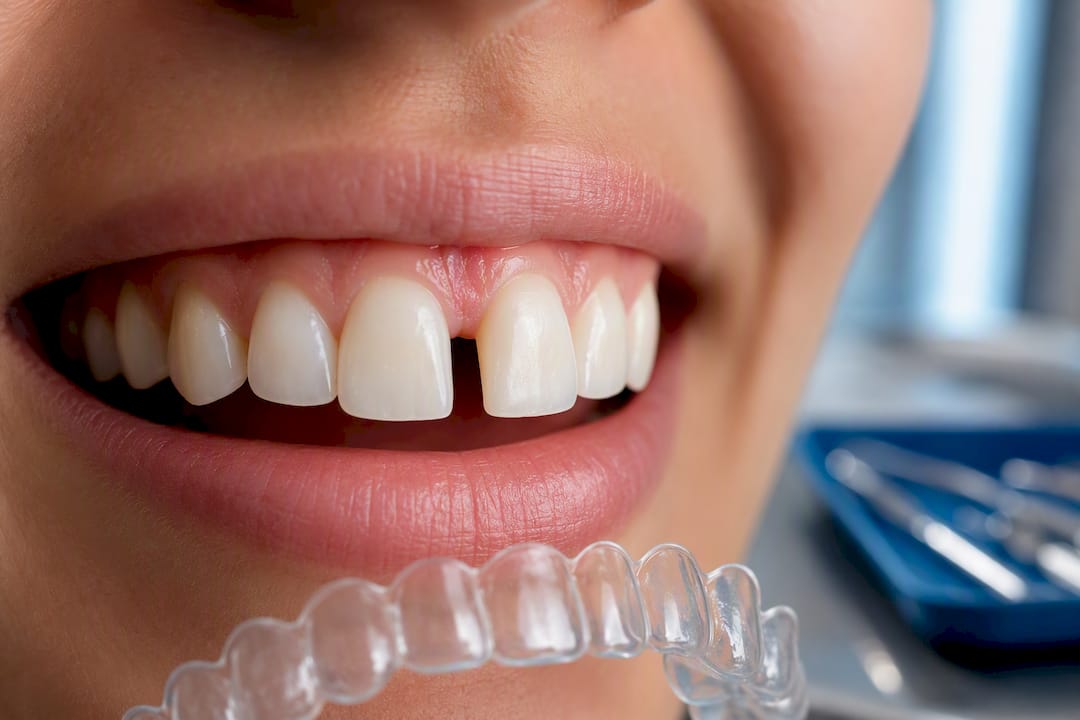
For a gap caused by tooth position, orthodontics is the definitive fix. For gaps from tooth-size mismatch or a smile shape you want changed, bonding or veneers work faster. Missing teeth need an implant or bridge, and any active gum disease or an oversized frenum has to be treated first, before cosmetic work begins.
TL;DR:
- Orthodontic treatment that physically moves teeth usually takes 12 to 24 months and requires retainers to prevent relapse.
- Bonding is ideal for gaps up to 1.5 millimeters with a well-aligned bite, lasting 5 to 10 years with proper care.
- Veneers are best for larger gaps or reshaping teeth, with a 91% success rate at 10 years when bonded properly and enamel remains intact.
- Implants or bridges are the preferred solutions for missing teeth, with implants offering longer lifespan and improved jawbone preservation.
- Correcting a gap caused by an active frenum or gum disease must happen before cosmetic treatments to ensure long-term stability.
Table of Contents
- What Are the Main Diastema Closure Options?
- When Should You Use Braces or Aligners to Close a Gap?
- Is Dental Bonding a Good Option for Small Gaps?
- Are Veneers or Crowns Better for Larger Gaps?
- What if the Gap Comes From a Missing Tooth?
- Do You Need Gum Treatment Before Closing a Diastema?
- How Do You Choose the Right Closure Option?
- What Should You Expect for Maintenance and Long-Term Results?
- Who’s Behind This Guidance?
- Our Take on Choosing a Diastema Treatment
- Ready to Talk Through Your Options?
- Sources
What Are the Main Diastema Closure Options?
Once you know what caused your gap, the right treatment usually becomes obvious. Here’s the quick menu, matched to the situation each one solves best.
- Orthodontics (braces or clear aligners): best when teeth are tipped, rotated, or spread across the arch, or when bite alignment needs correcting alongside the gap.
- Direct composite bonding: best for small gaps (roughly 1 to 1.5 millimeters) where you want a same-day, budget-friendly fix.
- Porcelain veneers or crowns: best for larger gaps, uneven tooth shapes, or when you want a longer-lasting, stain-resistant result.
- Implants or bridges: best when the “gap” is actually a missing tooth, not just spacing.
- Frenectomy or periodontal therapy: required first when an enlarged labial frenum or active gum disease is driving the gap.
- Observation: a legitimate choice for children whose teeth are still erupting, or adults with a stable bite who simply aren’t bothered by the space.
Cause matters more than gap size alone. A 2-millimeter gap from a stubborn labial frenum needs a different plan than a 2-millimeter gap from naturally small lateral incisors, even though they look almost identical in the mirror.
When Should You Use Braces or Aligners to Close a Gap?
Orthodontics is the gold-standard answer when the diastema comes from actual tooth position, meaning teeth that have drifted, rotated, or never settled into full contact with their neighbors. Because it physically moves teeth rather than covering them, it’s the only option here that also corrects an off bite at the same time.
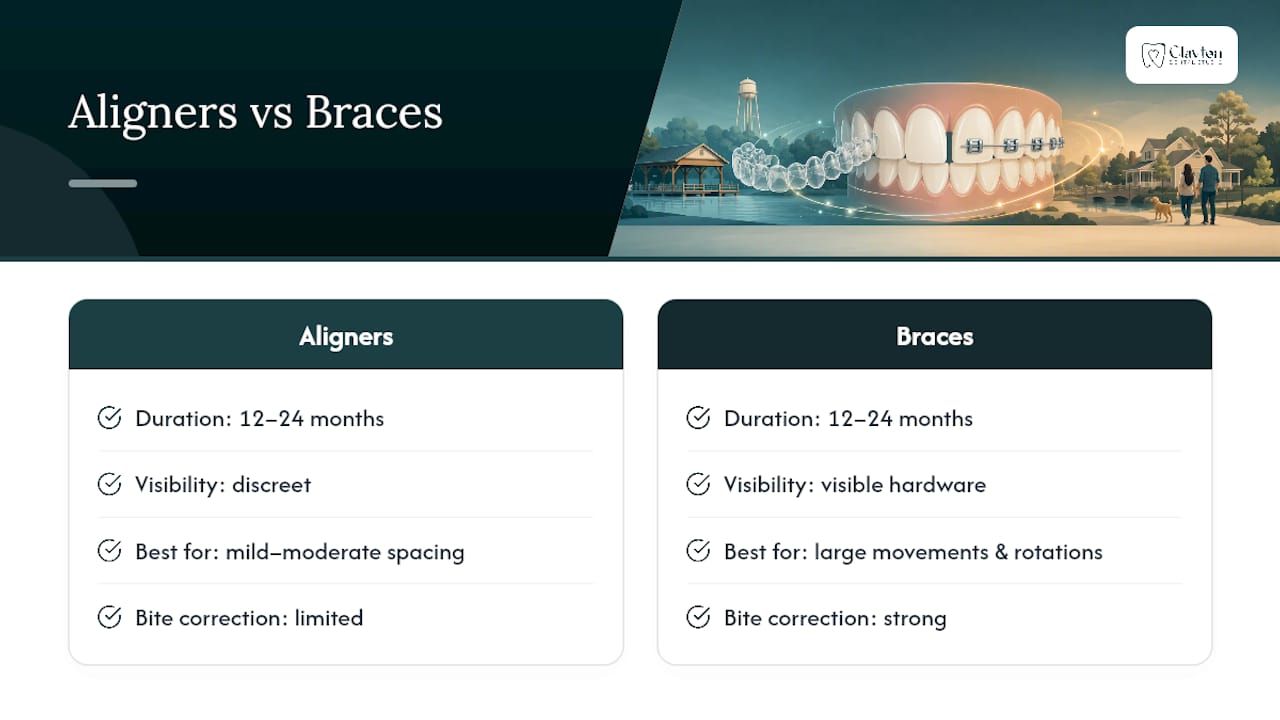
Treatment typically runs 12 to 24 months, depending on gap width, how crowded or spaced the rest of the arch is, and whether other teeth need coordinated movement. Clear aligners handle mild to moderate spacing discreetly and suit adults who don’t want visible hardware; traditional braces still perform better for larger movements, rotations, or cases involving a bite correction. We walk teens and adults through both options as part of Clayton Dental Studio’s clear aligners program, and the aligner candidacy criteria apply the same way regardless of age.
Whichever route you choose, spacing has a real tendency to drift back. Retainers are mandatory after treatment, not optional, and if a tongue thrust or another oral habit contributed to the original gap, that habit needs correcting too, or the space will likely reopen.
Pro Tip: Ask your orthodontist to show you a digital simulation of your finished smile before treatment starts. It takes the guesswork out of committing to 12 to 24 months of care.
Is Dental Bonding a Good Option for Small Gaps?
Direct composite bonding is often the fastest route to a closed gap. Your dentist sculpts tooth-colored resin directly onto the enamel bordering the space, shapes it chairside, and cures it with a curing light, usually finishing in a single visit.
It works best in specific circumstances:
- Gaps around 1 to 1.5 millimeters, small enough for resin alone to bridge convincingly.
- A bite that already fits well, so no orthodontic movement is needed.
- Patients who want a same-day improvement without the cost of veneers.
Bonding typically lasts 5 to 10 years before it needs touching up or replacing, and composite is more prone to staining than porcelain over that span. The upside is that it’s easy and inexpensive to repair if it chips, since your dentist can simply add more resin rather than remaking an entire restoration. Getting the finishing right matters more than people expect: meticulous polishing and contouring around the gum line prevents open triangular gaps from forming between the restoration and the neighboring tooth.
Are Veneers or Crowns Better for Larger Gaps?
Porcelain veneers step in where bonding runs out of room. They’re the better choice for larger diastemas, for teeth with uneven or unusually small shapes, or for anyone who wants a smile that resists staining far better than composite ever will.
The process itself involves more preparation than bonding. A dentist typically removes a thin layer of enamel, takes an impression or digital scan, and sends the case to a lab for custom porcelain shells, meaning two visits instead of one. Tools like digital smile design let you preview the finished shape before the lab ever touches porcelain.
- Ideal for gaps too large for resin alone, or teeth needing reshaping beyond what bonding can sculpt.
- Reported survival rates run around 91% at 10 years when veneers are properly bonded to enamel.
- Contraindicated when too little enamel remains to bond to securely.
- Full-coverage crowns come into play when a tooth is already structurally compromised, not just spaced.
Simple daily care protects that longevity: avoiding ice-chewing and wearing a night guard if you grind matters more for veneers than for almost any other restoration.
What if the Gap Comes From a Missing Tooth?
A diastema isn’t always about spacing between teeth that are all present. When a tooth is actually missing, closing the visible gap between existing teeth is the wrong goal entirely, replacing the missing tooth is the right one.
- Dental implants preserve the underlying jawbone, which a bridge or bonding cannot do, and typically outlast every other restorative option listed here.
- Bridges suit patients who prefer to avoid a surgical step or whose bone density makes implant placement more complex.
- Either option often gets staged alongside orthodontic or periodontal treatment, so your dentist can plan spacing and gum health together.
Clayton Dental Studio’s missing teeth guidance covers how implants and bridges compare in healing time and upkeep for your specific situation.
Do You Need Gum Treatment Before Closing a Diastema?
An enlarged labial frenum, the tissue band connecting your lip to your gums, can wedge teeth apart and keep a gap from closing permanently. Some clinicians remove it before orthodontic treatment; others prefer to wait until after closure to avoid scar tissue interfering with the movement. Either sequence can work, so this is worth discussing directly with your provider.
Active gum disease is non-negotiable to treat first. Periodontal therapy, like scaling and root planing, has to precede cosmetic or orthodontic closure whenever disease has weakened the tissue supporting your teeth. Healthy gum tissue also fills the space between teeth properly, called the papilla, which prevents the small dark triangles that can otherwise show up right at the gum line after treatment.
How Do You Choose the Right Closure Option?
Bring these six factors to your consultation, in this order of importance:
- Cause. Ask your dentist to name the specific reason for your gap, not just describe the gap itself.
- Gap size. Millimeters matter for deciding between bonding, veneers, and orthodontics.
- Bite alignment. If your bite needs correcting too, orthodontics usually becomes necessary regardless of gap size.
- Timeline. Same-day bonding, two-visit veneers, and months-long orthodontics are very different commitments.
- Budget. Costs vary by option and by how many teeth are involved, so ask for a written estimate before committing.
- Enamel preservation. Some options remove enamel permanently; others don’t touch it at all.
Ask directly about staging (does gum or frenum work need to happen first?), expected lifespan, and whether a retainer or night guard will be part of long-term care. If a provider proposes veneers without mentioning enamel removal, or orthodontics without discussing retention, get a second opinion.
Pro Tip: Request your treatment plan in writing, including which teeth are involved and the expected timeline for each phase. It makes comparing quotes between providers far easier.
What Should You Expect for Maintenance and Long-Term Results?
Longevity depends entirely on which option you chose and how well you care for it afterward.
- Bonding: 5 to 10 years, with occasional polishing or minor repairs.
- Veneers: 10 to 15+ years, with a night guard recommended for grinders.
- Orthodontics: permanent movement, but only with consistent retainer wear afterward.
- Implants: the longest-lasting option among these, with routine cleanings and checkups.
The single most common cause of relapse after any of these treatments isn’t the material failing, it’s skipping retention. Retainers are required after orthodontic closure because spacing has a real tendency to drift back once appliances come off, and the same discipline around night guards and checkups protects bonding and veneers from premature wear.
Who’s Behind This Guidance?
Dr. Navneet Kamboj earned her DDS from the University at Buffalo and completed a restorative preceptorship at UCLA, bringing nearly a decade of hands-on experience to Clayton Dental Studio. Her practice offers the full range of options covered here, including clear aligners, bonding, veneers, implants, and periodontal care, all under one roof.
Our Take on Choosing a Diastema Treatment
The biggest mistake we see is patients picking a treatment based on speed rather than cause. Bonding and veneers are genuinely excellent restorative tools, but they don’t move teeth, they cover the space in front of them. If a gap keeps returning after a “fix,” the odds are good that the original diagnosis was skipped in favor of the fastest-sounding option.
Conventional advice tends to treat diastema closure as a cosmetic menu: pick your price point, pick your material. We’d argue the more useful mental model is diagnostic first, cosmetic second. Ask what’s actually causing the space before asking what will cover it. A frenum that’s still active will eventually reopen a bonded gap. A bite that hasn’t been corrected will keep pulling veneered teeth back toward where they started.
If we had to prioritize one thing for readers to do differently, it’s this: get the cause identified in writing before agreeing to any restorative plan. Everything else, timeline, cost, material choice, follows naturally once that’s settled.
— Clayton Dental Studio
Ready to Talk Through Your Options?
If you’ve read this far, you already know that closing a diastema well starts with the right diagnosis, not the fastest fix. The full sequence can be available under one roof, from clear aligners and same-day bonding to porcelain veneers, dental implants, and the periodontal care that sometimes has to come first, to avoid being bounced between offices to finish one treatment plan.

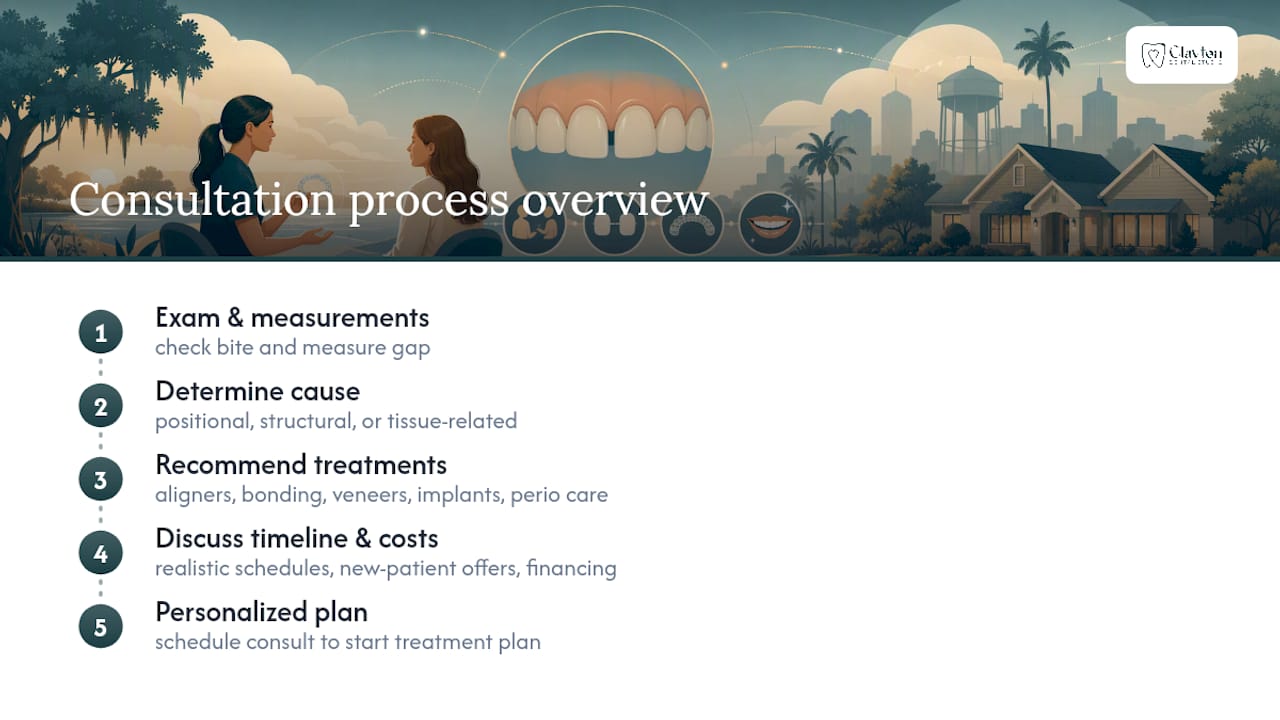
At your consultation, we’ll examine your bite, measure your gap, and identify whether the cause is positional, structural, or tissue-related before recommending anything. We’ll also walk through realistic timelines and costs so you’re deciding with full information, not guessing between options. Current new patient offers can help make treatment more accessible, and financing is available for cosmetic cases that aren’t covered by insurance.
Ready to find out which option fits your smile? Visit our cosmetic dentistry services page to see what’s involved, or schedule a consultation directly with Clayton Dental Studio in Humble, TX, to get a personalized plan started.
This article is general information, not a substitute for advice from a qualified doctor. Consult a qualified healthcare professional about your own circumstances before acting on anything here.
Sources
- Diastema: Treatment options and causes — Cleveland Clinic
- Teeth spacing: causes, concerns, and treatment options — American Association of Orthodontists (AAO)
- Bridging gaps: comparative approaches to managing midline diastema — PMC
Recommended
Ready to Schedule Your Appointment?
Dr. Kamboj and the Clayton Dental Studio team are here to help. Call us or book online today.