
Clinic-backed guide: the five checks dentists use—ferrule, apical seal, root thickness, canal curvature, and infection—to decide whether a post and core...
5 Dentist Checks to Know If You Need a Post and Core
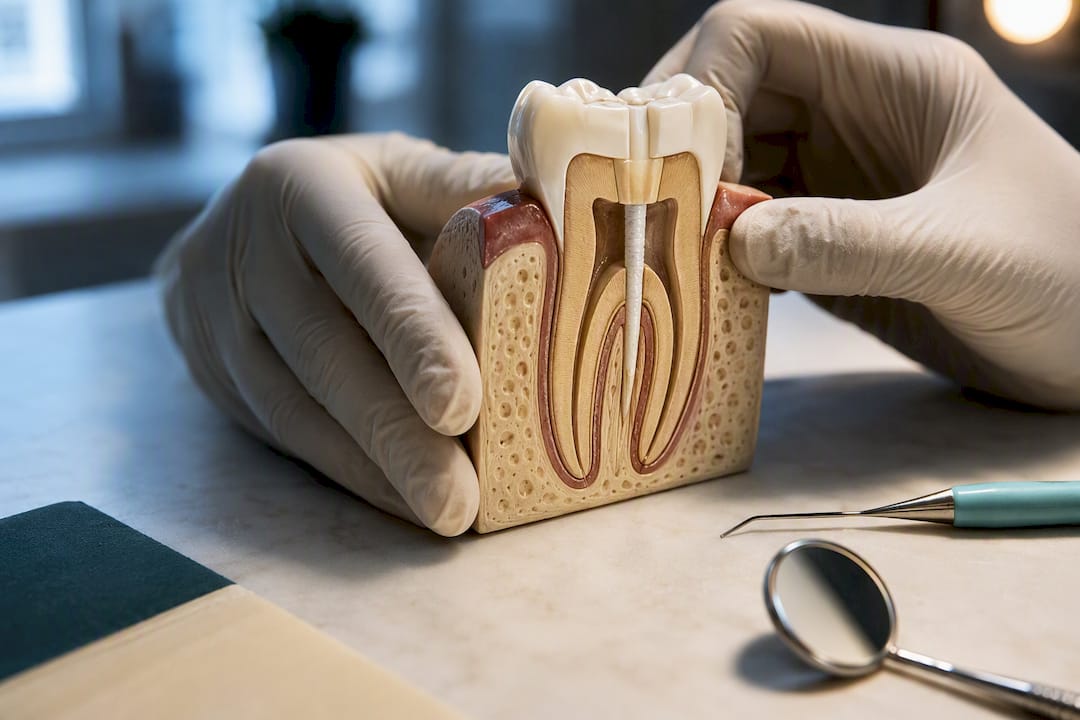
A post and core is needed when a root canal treated tooth has lost more than half of its original structure and cannot hold a crown on its own. The post anchors the core, and the core rebuilds the tooth’s shape so a crown has something solid to grip. What surprises most patients: the post does not make the tooth stronger. It just holds the filling material in place while the remaining natural tooth, especially a rim of structure called the ferrule, does the real work.
TL;DR:
- A post only provides retention for the core and does not reinforce the tooth; adequate ferrule of at least 2 millimeters is essential for success.
- The decision to use a post and core depends mainly on loss of more than 50% of the coronal structure, sufficient ferrule, good root dentin thickness, and absence of active infection or severe root curvature.
- Fiber posts are the most common today due to their flexibility and bonding ability, with material choice influencing how forces are distributed and what materials are used for the core.
- Proper case selection and preserving the apical seal are crucial for the longevity of a post and core, with failure rates generally remaining in the single digits over several years.
- Alternatives such as crown lengthening, orthodontic extrusion, or implants may be preferable if the remaining tooth structure cannot meet the ferrule requirement or if the root health is compromised.
Table of Contents
- What Is a Post and Core, and How Does It Support a Crown?
- When Do Dentists Recommend a Post and Core?
- Post and Core Materials: Fiber, Metal, or Ceramic?
- How Is a Post and Core Procedure Done?
- What Are the Risks and How Long Does the Restoration Last?
- Alternatives to a Post and Core: What Else Is on the Table?
- How Clayton Dental Studio Evaluates Post-and-Core Cases
- Tapered vs. Parallel Posts: Does Shape Actually Matter?
- What Cement Is Used to Bond a Post in Place?
- How Long Do Different Post-and-Core Systems Actually Last?
- What Happens if a Post and Core Fails?
- The Ferrule Matters More Than the Post Material
- Ready to Find Out if Your Tooth Needs a Post and Core?
- Sources
- FAQ
What Is a Post and Core, and How Does It Support a Crown?
Think of it as three separate jobs stacked on top of each other. The post is a thin rod cemented into the root canal space, reaching down into the tooth’s root. The core is the built-up material, usually resin, packed around the top of the post to recreate the shape of a natural tooth stump. The crown is the cap that goes over all of it, restoring the biting surface and the smile you see.
Here’s the part that trips people up: the post’s job is retention, not reinforcement. It gives the core something to hold onto inside a tooth that otherwise has too little structure left for a core to stay put on its own. It does not add strength to the root, and it cannot compensate for a root that is thin, cracked, or badly weakened. Clinical literature on post-and-core biomechanics consistently points to something called the ferrule, a band of at least 2 millimeters of the tooth’s own natural walls that the crown can grip around like a ring around a barrel. Without that ferrule, even the best post and core is fighting a losing battle.
- Post: anchors the core inside the root canal space
- Core: rebuilds the missing tooth structure above the gumline
- Crown: the visible cap that restores function and appearance
- Ferrule: the natural tooth structure that actually resists fracture
Curious what the crown phase itself involves once the post and core is in place? Our crown procedure walkthrough covers that step by step.
When Do Dentists Recommend a Post and Core?
The decision comes down to a handful of measurable checks, not a gut feeling. A root canal treated tooth that has kept most of its structure rarely needs a post at all. A filling or a crown alone often does the job. Once the damage crosses a certain threshold, though, a post and core becomes the more predictable path.
- Coronal structure loss exceeds roughly 50%. This is the most consistently cited threshold for recommending a post and core rather than a simple buildup.
- A ferrule of at least 2 millimeters is achievable. Dentists check this before committing to a post, because a tooth without adequate ferrule tends to fail regardless of what post material is used.
- The root has adequate dentin thickness. Thin canal walls raise the risk of perforation during post space preparation and increase fracture risk down the line.
- The canal isn’t severely curved. Sharp curvature makes it difficult to prepare a straight post space without weakening the root wall.
- There’s no active infection or significant mobility. A tooth with unresolved periapical disease or advancing periodontal breakdown is a poor candidate until those issues are addressed.
Contraindications matter just as much as indications here. A review of endodontically treated tooth restoration makes the point plainly: case selection, not the post itself, is what predicts long-term success. If your dentist tells you a tooth isn’t a good candidate for a post and core, that’s usually about root anatomy or remaining structure, not a lack of options.
Post and Core Materials: Fiber, Metal, or Ceramic?
Material choice shapes how the tooth behaves under years of chewing forces, and each option carries real tradeoffs.
- Prefabricated fiber posts are the most common choice today. They’re tooth-colored, flexible, and their elastic modulus is closer to natural dentin than metal, which helps distribute biting forces more evenly. Their performance depends heavily on bonding technique, since they rely entirely on adhesive cement rather than mechanical retention.
- Cast metal posts are custom-fabricated to match the exact shape of the prepared canal. They offer a precise fit for unusually shaped or oversized canals, but their rigidity can transfer stress directly to the root, and removing one during retreatment is far more difficult than removing a fiber post.
- Ceramic and zirconia posts show up occasionally for their esthetics in very visible front teeth, but they’re brittle under lateral forces and notoriously hard to remove if the tooth ever needs retreatment.
Core materials have narrowed over the years too. Composite resin dominates modern practice because it bonds directly to both the post and the remaining tooth structure and cures quickly. Dual-cure resins are common where light cannot fully reach the depth of the buildup. Older materials like amalgam core buildups still exist in some mouths from decades past, but they’ve largely been replaced by resin-based systems.
Pro Tip: If your dentist recommends a fiber post, ask whether they’ll use a “monoblock” bonding technique. It bonds the post, cement, and core into one continuous adhesive unit, which some clinicians believe helps the whole restoration flex together rather than creating a weak point at the interface.
If you’re weighing how the crown material on top interacts with what’s underneath, our guide to choosing the best material for dental crowns breaks that down further.
How Is a Post and Core Procedure Done?
The steps follow a sequence designed around two competing goals: retaining enough post length for stability while leaving enough of the original root canal filling in place to preserve the seal at the tip of the root.
- Post space preparation. The dentist removes gutta percha from the upper portion of the root canal, but stops well short of the apex. Clinical guidance calls for preserving at least 4 to 5 millimeters of apical seal, the gutta percha left near the root tip that keeps bacteria out of the surrounding bone.
- Post length is set at roughly two-thirds of the root. Long enough for stability, short enough to protect that apical seal. Every root is a little different, so this is judged from the X-ray, not a fixed number.
- Diameter stays conservative. Dentists aim for the narrowest post that will do the job, since removing more dentin than necessary raises perforation and fracture risk.
- Cementation with resin cement. The post space is cleaned, dried, and bonded under strict moisture control, since adhesive failure is one of the more common reasons posts loosen over time.
- Core buildup and crown preparation. Once the post is seated, the core material is packed and shaped, and the tooth is prepped for its crown.
Appointment timing depends on the system used. Chairside fiber post techniques often let the post, core, and crown prep happen in a single visit. Cast post-and-core restorations require a lab-fabricated post, which usually stretches the process to two appointments with a temporary in between.
What Are the Risks and How Long Does the Restoration Last?
Root fracture is the complication dentists worry about most, and it’s largely why the field has shifted away from rigid metal posts toward more flexible fiber systems. A metal post transfers biting force directly into the root wall. When that force exceeds what the root can absorb, the fracture often runs vertically down the root, a failure that usually means extraction rather than repair.
Other common problems are less catastrophic but still disruptive:
- Debonding or post loosening, often traced back to moisture contamination during cementation
- Recurrent decay around the margins of the core or crown
- Apical pathology if the seal at the root tip was compromised during post space preparation
Clinical outcome data gives a useful reality check here. Reviews of post-and-core failure rates report failure in the single-digit percentage range over multi-year follow-up, with post loosening and root fracture as the two leading causes. That’s a reassuring number for a well-selected case, and it also underscores why case selection matters more than post material alone.
The factors that consistently separate long-term successes from early failures are the same ones dentists check before treatment even starts: adequate ferrule, careful preservation of dentin during preparation, and a bonding protocol that isn’t rushed.
Alternatives to a Post and Core: What Else Is on the Table?
A post and core isn’t the only path forward for a heavily damaged tooth, and a good dentist will walk you through the alternatives before committing to one.
- Crown lengthening or orthodontic extrusion can expose more natural tooth structure below the gumline, sometimes creating enough ferrule to avoid a post altogether or make the post’s job easier.
- Endocrowns skip the post entirely. A single bonded ceramic restoration extends into the pulp chamber and covers the biting surface, an option that works well on molars with adequate remaining structure and short, wide root canals.
- Extraction and implant placement becomes the more sensible choice when a tooth has recurrent endodontic failure, minimal remaining structure, or a poor long-term prognosis regardless of restorative effort. Our overview of alternatives to tooth extraction walks through how that decision typically gets made.
- Cost, retreatability, and esthetics all factor in. A post and core with a crown is often less expensive upfront than an implant, but an implant sidesteps the risk of root fracture entirely since there’s no natural root left to protect.
How Clayton Dental Studio Evaluates Post-and-Core Cases
Dr. Navneet Kamboj, DDS, earned her degree from the University at Buffalo and completed a restorative preceptorship at UCLA before building her practice around exactly this kind of decision-making. Evaluating a tooth for a post and core isn’t a single glance at an X-ray. It typically involves a full restorative exam, digital imaging to assess remaining root structure and canal anatomy, and a candid conversation about whether the ferrule requirement can realistically be met.
Where the tooth has already had root canal therapy elsewhere, treatment is staged so the restorative plan lines up with what the endodontic work left behind. That coordination matters more than most patients realize. A post and core placed without knowing exactly how much apical seal remains is a post and core built on a guess.
Tapered vs. Parallel Posts: Does Shape Actually Matter?
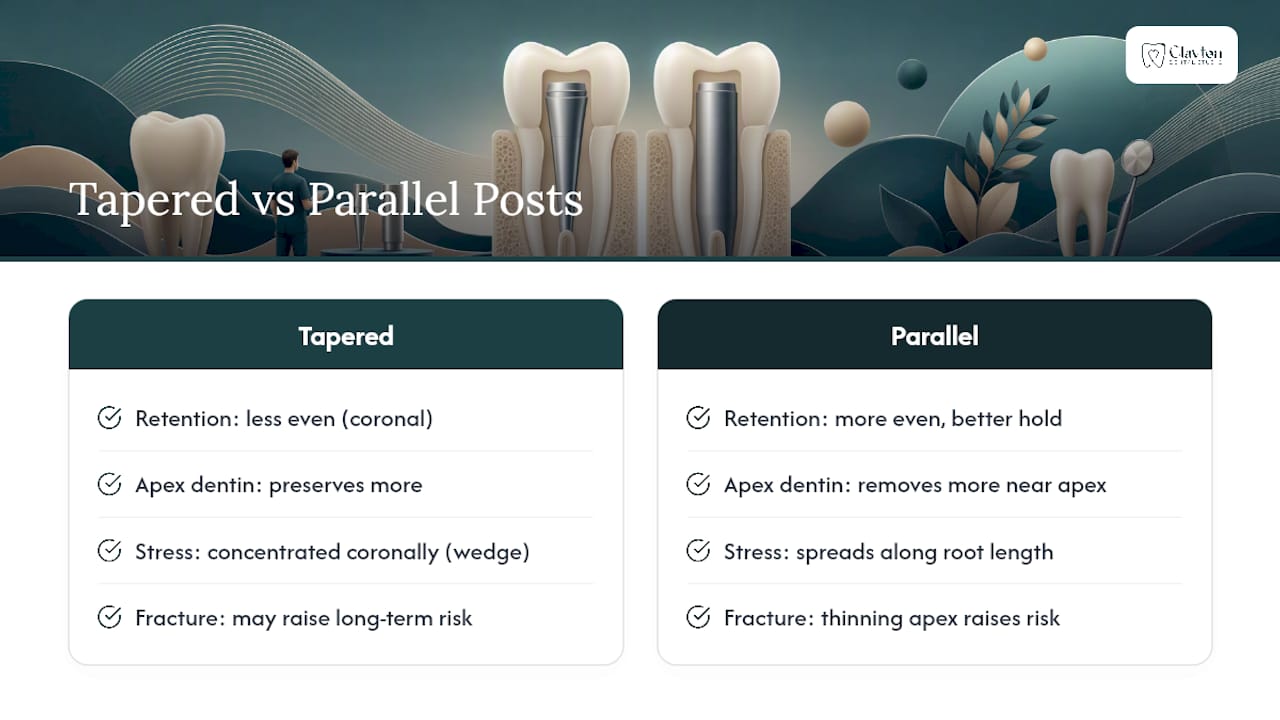
Post geometry isn’t cosmetic detail. It changes how force moves through the root. Parallel-sided posts grip more evenly along their length and generally offer better retention than tapered designs, but they require removing more dentin near the apex to fit, which can thin an already fragile root wall. Tapered posts follow the natural shape of most root canals more closely, preserving more dentin, but they concentrate stress at the coronal end rather than spreading it evenly, a tradeoff some clinicians view as a wedge effect that raises fracture risk over time.
Surface texture adds another layer to the decision. Serrated or threaded posts grip mechanically and resist dislodgement, which sounds like an advantage until you consider that threading a post into dentin can generate stress cracks, particularly in thin roots. Smooth-surfaced posts rely almost entirely on adhesive cement for retention rather than mechanical interlock, which shifts the burden onto bonding technique but avoids introducing stress during placement.
Most contemporary fiber post systems land on a smooth or lightly textured, tapered-to-parallel hybrid design, cemented with resin adhesive rather than threaded into place. That combination tends to preserve more of the natural root while still achieving reliable retention, which is a large part of why fiber systems have become the default recommendation for most teeth that meet the criteria for a post in the first place. The right choice still depends on the specific canal anatomy, which is something only a clinical exam and imaging can confirm.
What Cement Is Used to Bond a Post in Place?
Resin cement is the standard for bonding modern fiber posts, and the protocol around it matters just as much as the material itself. The canal space is cleaned of debris, often with irrigation and a drying step, since any residual moisture or contamination at the bonding surface is one of the most common reasons posts fail early through debonding.
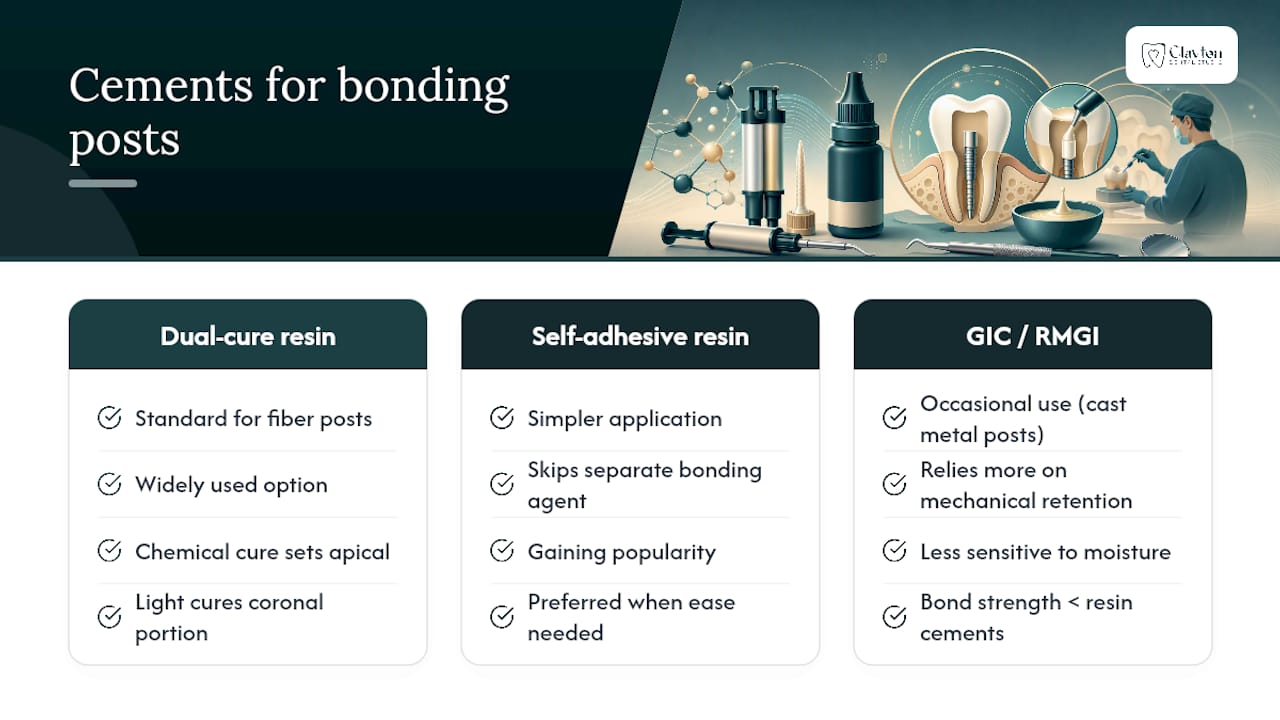
Dual-cure resin cements are the most widely used option because light from a curing lamp often can’t reach deep into a narrow canal. The initial chemical cure sets the material at the apical end, while light curing hardens the more accessible coronal portion. Self-adhesive resin cements have gained popularity for their simpler application, skipping a separate bonding agent step, though many clinicians still prefer a total-etch or self-etch adhesive system paired with a conventional resin cement for cases where maximum bond strength matters most.
Glass ionomer and resin-modified glass ionomer cements still show up occasionally, particularly for cast metal posts where mechanical retention plays a bigger role than adhesion. They’re technique-tolerant and less sensitive to moisture, which makes them a reasonable fallback when isolation is difficult, though their bond strength generally falls short of resin cement for fiber post systems.
The through-line across all of these protocols is moisture control. A perfectly chosen post material bonded under contaminated conditions is more likely to loosen than a modest material bonded correctly.
How Long Do Different Post-and-Core Systems Actually Last?
Long-term outcomes vary less by post material than most patients expect, and more by how well the case was selected in the first place. A tooth with strong ferrule and adequate remaining dentin tends to do well whether it received a fiber or cast metal post. A tooth with marginal ferrule and thin walls carries elevated risk no matter which system goes in.
That said, the failure patterns do differ by material. Fiber posts, because they flex more like natural dentin, tend to fail in ways that are repairable, debonding or loosening rather than fracturing the root outright. When a fiber post does fail, the tooth is frequently salvageable with a new post and core. Cast metal posts, being rigid, more often fail catastrophically through root fracture, which usually ends in extraction rather than retreatment.
Failure rate data across post-and-core systems places overall failure in the single digits percentage-wise over multi-year follow-up periods, a track record that reflects modern bonding protocols and better case selection criteria more than any single material breakthrough. The biggest lever a patient has isn’t which post material gets chosen. It’s whether the tooth was a good candidate to begin with.
What Happens if a Post and Core Fails?
A failed post and core doesn’t automatically mean the tooth is lost, though the path forward depends heavily on how it failed. A loosened or debonded fiber post, caught early, can often be removed and replaced with a new post and core, sometimes even with a wider or differently shaped post if the original canal preparation allows for it.
Root fracture is a different story. Once a root has fractured, particularly a vertical fracture, the tooth typically cannot be saved, and extraction followed by an implant becomes the more realistic path forward.
Recurrent decay around the core or crown margin calls for a full reassessment. If enough sound tooth structure remains once the decay is removed, a new post, core, and crown may be possible. If the decay has compromised the ferrule beyond repair, the conversation shifts toward crown lengthening to expose more structure, or toward extraction if the remaining tooth simply isn’t restorable anymore.
The key takeaway for anyone facing a failed restoration: get it evaluated promptly. A loose post left untreated invites bacteria into the canal system, turning a repairable problem into one that costs the tooth entirely.
The Ferrule Matters More Than the Post Material
Most of the marketing noise around post-and-core dentistry centers on which post material is “strongest,” and that framing misses the point entirely. The research is fairly consistent: ferrule and case selection predict outcomes far more reliably than post material choice. A premium fiber post in a tooth with no ferrule will still fail. A basic post in a tooth with 3 millimeters of solid ferrule all the way around has a genuinely good prognosis.
Where conventional patient advice falls short is in framing the post as the hero of the restoration. It isn’t. It’s scaffolding, nothing more, holding a core in place inside a tooth that has already lost enough structure to need help. The tooth’s own remaining walls are doing the actual work of resisting fracture.
If there’s one thing worth prioritizing before agreeing to any post-and-core plan, it’s asking your dentist directly whether adequate ferrule is achievable on that specific tooth. If the answer is uncertain, ask about crown lengthening or an endocrown as alternatives before committing to a post. The material debate matters far less than that single structural question.
— Clayton Dental Studio
Ready to Find Out if Your Tooth Needs a Post and Core?
If a root canal treated tooth is giving you trouble, chipped, sensitive, or simply looking too fragile to trust, guessing isn’t a strategy. Clayton Dental Studio evaluates these cases with digital imaging and a straightforward restorative exam, so you leave with an actual answer instead of another wait-and-see.

Some dental practices lean on same-day crown technology where the case allows for it, which means some patients can receive a finished crown in a single visit rather than managing a temporary for two weeks. That matters when you have a job, kids, or simply don’t want to schedule around a second appointment. Bring your most recent dental X-rays if you have them, along with your insurance information; the dental office may also provide information about financing options if the treatment isn’t fully covered.
The first step is a restorative evaluation, where the ferrule, root anatomy, and overall prognosis get assessed before any material decisions are made. If you’ve been putting off a damaged tooth because you’re not sure what it needs, that exam is where the guessing stops.
This article is general information, not a substitute for advice from a qualified doctor. Consult a qualified healthcare professional about your own circumstances before acting on anything here.
Sources
- Post and Core: Candidates, Procedure, Pros and Cons, and More — Healthline
- Post-and-core biomechanics review — PMC
- A review of the management of endodontically treated teeth — PubMed
- Post space preparation and post length guidance — Revista MedicorpA (Scielo)
FAQ
How painful is a post and core procedure?
Most patients report little to no pain because the tooth has already been root canal treated and is no longer vital. Anesthesia is often unnecessary, and recovery generally feels similar to getting a filling.
How long does a post and core procedure take?
A prefabricated fiber post can often be placed, built up, and prepped for a crown in a single visit lasting about an hour. A cast post and core typically requires two appointments since the post has to be fabricated in a lab before it’s cemented.
How much does a post and core cost?
Pricing depends on the tooth, the post material chosen, and whether a crown is included in the treatment plan, so current pricing at Clayton Dental Studio is available by contacting the general dentistry team directly.
Is a post and core better than an implant?
Neither is universally better. A post and core preserves your natural tooth root and is generally less invasive and less expensive upfront, while an implant may be the stronger option when a tooth has poor remaining structure, recurrent endodontic failure, or inadequate ferrule for a predictable restoration.
Recommended
Ready to Schedule Your Appointment?
Dr. Kamboj and the Clayton Dental Studio team are here to help. Call us or book online today.