
Can clear aligners fix an overbite? See which overbites they treat, what the research shows, how long it takes, and how a Humble dentist plans your care.
Clear Aligners for Overbite: What They Can Fix and How Long It Takes
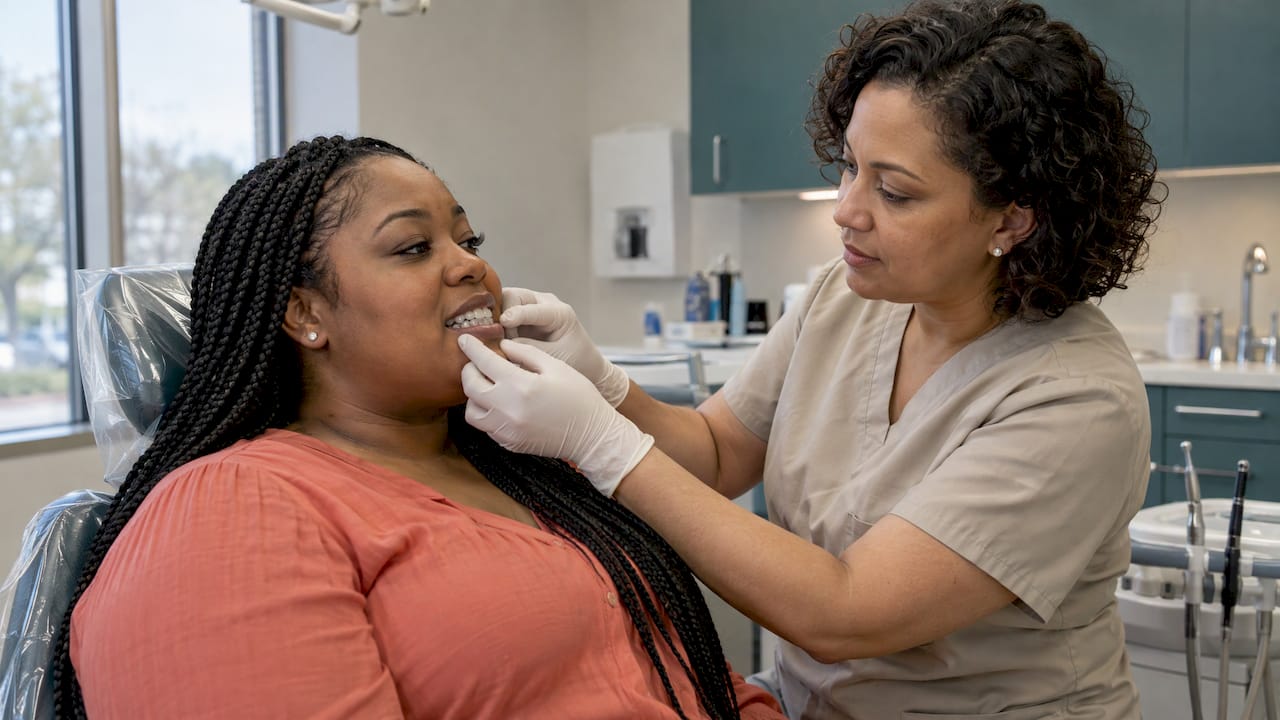
Yes, clear aligners can correct many overbites, especially mild to moderate ones where the teeth, not the jawbone, are the main cause. I’m Dr. Kamboj, and the first thing I do with an overbite is figure out which kind you have, because that decides whether aligners are the right tool. At Clayton Dental Studio in Humble, TX, we offer clear aligner treatment and plan it around your own bite, so you know what to expect before you start.
TL;DR
- Clear aligners are commonly used for mild-to-moderate bite problems, and a dentist has to prescribe and supervise them, according to the FDA.
- A 2026 meta-analysis found an average overbite reduction of about 1.79 mm, so results are real but measured in millimeters.
- In a 2026 randomized trial, aligner treatment for deep bite averaged about 21 months, versus about 27 months for braces.
- Severe overbites, especially those rooted in jaw position, may need braces, a hybrid plan, or more extensive care.
- Wear time and retainers decide how well the result lasts.
Table of Contents
- What an overbite is, in plain terms
- Can clear aligners really fix an overbite?
- Which overbites are good candidates
- How long does it take?
- What the first visit looks like
- Why a dentist should supervise your aligners
- Retainers keep the new bite in place
- Aligners for teens and adults
- Our perspective
- Start with a bite evaluation in Humble
- FAQ
- Sources
What an overbite is, in plain terms
An overbite means your upper front teeth overlap your lower front teeth vertically. A little overlap is normal. A deep bite means the upper teeth cover much of the lower teeth. Overjet, which people often confuse with it, means the upper teeth stick out forward.
There are two broad causes:
- Dental: the teeth have erupted or tilted in a way that creates the overlap. Teeth can be moved, so this type is where aligners do best.
- Skeletal: the upper and lower jaws are different sizes or positions. This type is harder to change with tooth movement alone.
An exam, photos, X-rays and a digital scan help sort out which one you have. That sorting is the most useful part of a consultation.
Can clear aligners really fix an overbite?
For the right overbite, yes. The FDA describes clear aligners as custom-made, removable plastic trays that gradually move teeth, and notes they are commonly used for mild-to-moderate issues including bite problems, while more complex conditions may require braces or other treatments.
The research gives a realistic picture:
- A 2025 systematic review of 18 studies found aligners opened deep bites by 0.4 to 3.8 mm and concluded they can effectively correct mild-to-moderate dental deep bites.
- A 2026 meta-analysis of six studies and 177 patients found an average overbite reduction of 1.79 mm.
- A 2026 scoping review put the share of planned overbite correction achieved at 28% to 55%.
What this means for you: aligners are well suited to modest vertical corrections, and the final bite often lands a bit short of the digital plan. A good treatment plan accounts for that from the start, with refinements built in when needed.
How aligners close a deep bite
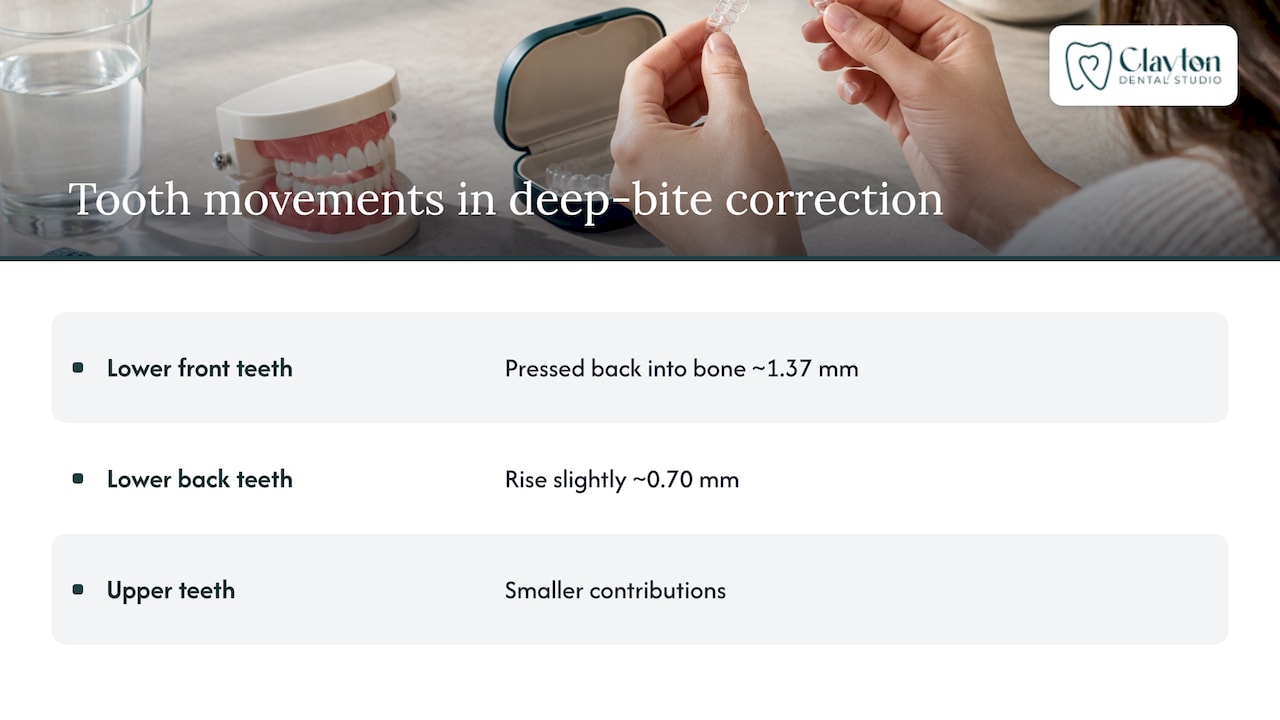
Aligners can’t pull teeth the way a hand would. They apply a gentle pushing force as the plastic holds its shape against your teeth. The 2026 meta-analysis found the correction comes mostly from pressing the lower front teeth back into the bone (about 1.37 mm) and letting the lower back teeth rise slightly (about 0.70 mm), with smaller contributions from the upper teeth. Small bumps of tooth-colored material called attachments give the trays something to grip. If you’d like more detail on that, see our guide on how research guides aligner attachments and our overview of how clear aligners work.
Sometimes a plan also includes small amounts of polishing between teeth to create space, called IPR. Here is what to expect with IPR. Aligners can also be paired with elastics, the small rubber bands used in traditional orthodontics, according to the American Association of Orthodontists.
Which overbites are good candidates
| Your situation | What it usually means |
|---|---|
| Mild to moderate overbite from tooth position | Often a good fit for aligners |
| Overbite with mild or moderate crowding | A moderate-difficulty case; aligners are commonly planned for these |
| Severe deep bite or a clear jaw discrepancy | Braces, a hybrid approach, or a joint plan with a specialist may be better |
| Very short clinical crowns or poor wear habits | Harder to predict with aligners |
The table follows published guidance. A 2025 expert consensus grades deep overbite with moderate crowding as a moderate case, while severe deep overbite with a significant jaw discrepancy is rated difficult and can call for extractions, anchorage, or surgery. The same paper says aligners are not recommended for patients with clinically short crowns or poor compliance. The 2026 meta-analysis likewise found aligners suit mild-to-moderate deep bites and recommends hybrid approaches for severe ones.
If your case needs more than aligners can offer, we will tell you so plainly and explain the options, including braces. Our comparison of clear aligners vs braces walks through how the two differ.
How long does it take?
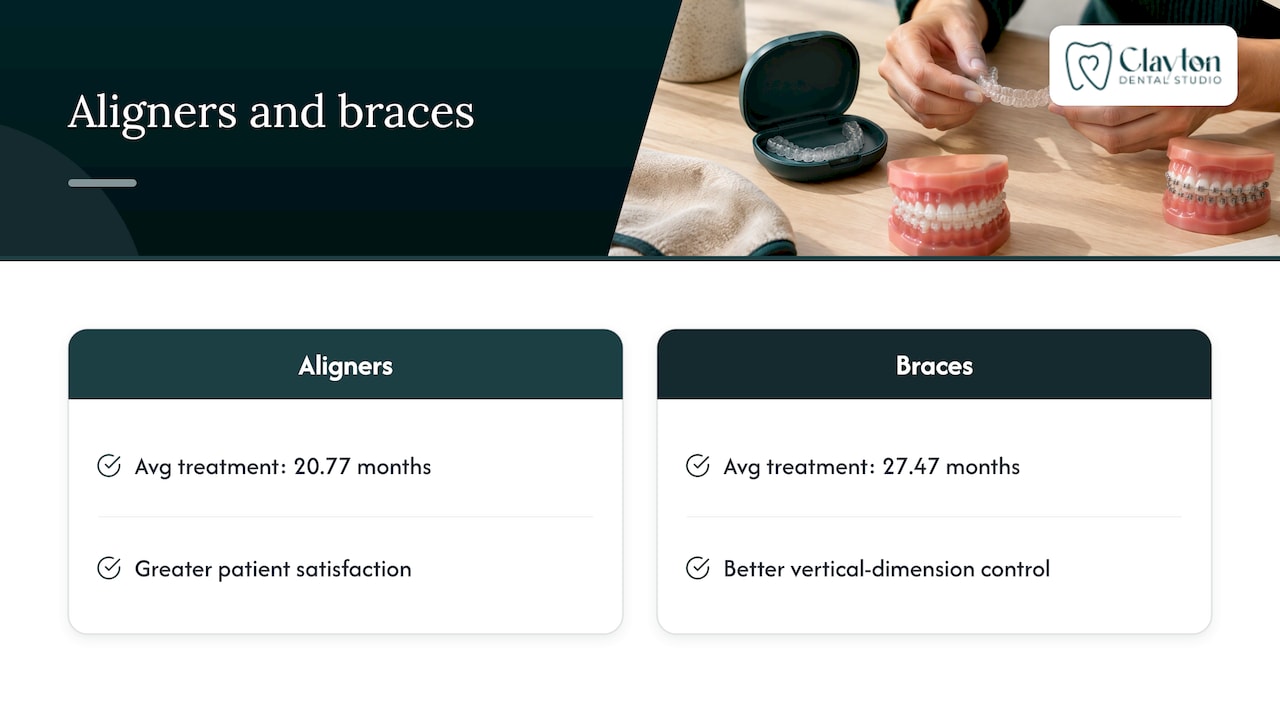
In a 2026 randomized trial of deep-bite patients, aligner treatment averaged 20.77 months, compared with 27.47 months for braces, with no significant difference in overbite improvement between the groups. The authors also reported that patients in the aligner group were more satisfied, while braces gave better control of vertical facial dimensions. They concluded the choice should rest on the individual patient’s needs.
Your own timeline depends on how deep the bite is, whether crowding is involved, and how consistently you wear the trays. The FDA says patients typically wear each aligner for one to two weeks and should wear them at least 20 hours a day, or as directed.
Habits that protect your timeline
- Wear your trays the full prescribed hours. Missed hours are the most common reason a deep bite stalls.
- Take them out to eat and drink anything but water. Our tips on eating with aligners make meals easy.
- Keep your appointments so we can check that the bite is opening as planned.
- Tell us right away if a tray cracks or goes missing.
What the first visit looks like
We start with a conversation about what bothers you: how your front teeth look, whether you bite into your gums, whether your jaw gets sore or you get tension headaches. Then we examine your teeth and bite and take a digital scan with our Trios 5 scanner, so you are not biting into trays of impression material. From that, we explain whether aligners suit your bite, what the plan involves, and what a realistic result is.
Some overbites have real health effects. A bite where the upper teeth hit the lower gums can cause soft-tissue trauma, and some dental plans treat that as a medical-necessity criterion for orthodontic care, as one 2026 plan policy shows. Coverage varies widely by plan, so bring your insurance information and we can help you understand your benefits.
Why a dentist should supervise your aligners
The FDA states that clear aligners are available only by prescription from a licensed dentist or orthodontist, and it has not authorized aligners sold directly to consumers without supervision. It has received reports from mail-order cases involving new or worsening jaw pain, bite problems and gaps. Overbite correction changes how your teeth meet, so it is the kind of treatment that benefits from in-person checks of your gums, bone, existing fillings and crowns, and your jaw joints.
The FDA’s list of risks is also useful to know as you plan safe use: trays that aren’t worn as directed won’t move teeth as intended, existing crowns, fillings or implants can occasionally loosen, speech can change briefly, and some people notice irritation. If any of this happens, call us and we’ll adjust the plan.
Retainers keep the new bite in place
After the last aligner, teeth want to drift back. The FDA says a dentist may recommend a retainer to help prevent shifting, and the AAO’s clinical guidelines state that a retention plan must be established, with some cases benefiting from indefinite wear. Our guide to retainers after aligners explains the routine.
Aligners for teens and adults
Teens and adults both can be candidates. Teens should be evaluated for growth and consistency with wear, and our page on aligners for teens covers it. Adults can see our guide to adult teeth-straightening options. If you live nearby, clear aligners in Humble, Atascocita and Kingwood explains local options.
Our perspective
I see overbite treatment as a bite question first and a cosmetic question second. The evidence says aligners work well when the overbite is mild to moderate and the teeth are the cause, and our job is to match your bite to the right plan.
At Clayton Dental Studio we pair digital scanning with personalized treatment plans, in a calm, spa-like office where you can ask every question. Whether you are a parent bringing a teen in, or an adult who has put off a consultation, we explain each step in plain language.
Flexible financing is available, so cost doesn’t have to be the thing that holds you back.
Clayton Dental Studio
Start with a bite evaluation in Humble
If you’re wondering whether aligners can fix your overbite, a short evaluation gives you a real answer. Dr. Kamboj and our team will examine your bite, scan your teeth, and explain your options. Learn more about clear aligners at Clayton Dental Studio or see our invisible braces page for Humble.
FAQ
Can Invisalign-style clear aligners fix an overbite?
They can fix mild-to-moderate overbites, particularly when the cause is tooth position. Severe or jaw-related overbites may need braces or a combined approach. An exam shows which category you’re in.
What can disqualify someone from clear aligners?
Severe skeletal discrepancies, impacted teeth, very short crowns, and difficulty wearing trays consistently can make aligners less predictable, per the 2025 expert consensus. Your dentist decides after examining you. Other options often work well in those cases.
What is the 30 minute rule with aligners?
There is no official rule by that name. The practical guidance is to keep trays in at least 20 hours daily, as the FDA advises, so any time out for meals and cleaning should fit inside the remaining hours. We’ll give you a schedule that suits your day.
Do I need a retainer after my overbite is corrected?
Yes, typically. Retainers help hold the new position, and your dentist will tell you how long and how often to wear them.
Sources
- Clear Dental Aligners | FDA
- Effectiveness and accuracy of clear aligners in deep bite treatment, 2025
- Effectiveness and biomechanical analysis of clear aligners, 2026 meta-analysis
- Clear aligner therapy: a scoping review, 2026
- Expert consensus on clinical strategies for orthodontic treatment with clear aligners, 2025
- Clinical effectiveness and patient satisfaction of clear aligners vs braces, 2026
- Clear Aligners | American Association of Orthodontists
- PEHP orthodontia coverage criteria, effective January 1, 2026
Recommended
Ready to Schedule Your Appointment?
Dr. Kamboj and the Clayton Dental Studio team are here to help. Call us or book online today.