
Explains decades long implant survival, why crowns often need replacement at about 15 years, and clinic-tested care steps from a Humble, TX dental practice.
94% of Implants Work at 15 Years: Lifespan and Care for Humble, TX

Dental implants themselves often last decades, and many patients keep the same implant post for a lifetime. The crown attached to it is a different story: crowns and bridges typically need replacement after about 15 years, even when the implant underneath stays perfectly healthy. That difference between the implant fixture and the restoration on top of it is the single most important thing to understand before you commit to treatment, and it’s exactly what we’ll walk through here.
TL;DR:
- Dental implants have a high long-term survival rate, with about 94% still functioning after 15 years, but crowns generally need replacement around the same time.
- The titanium or zirconia post can last over 40 years if properly maintained, whereas crowns often wear out in approximately 15 years due to daily chewing forces.
- Factors like smoking, uncontrolled diabetes, gum disease, bruxism, and poor hygiene significantly increase the risk of implant failure or complications.
- Regular maintenance, including brushing, flossing, professional cleanings, X-rays, and addressing grinding, is essential for maximizing implant lifespan.
- Signs of trouble, such as inflammation or looseness, require prompt treatment to prevent loss, with early detection being critical for successful outcomes.
Table of Contents
- Dental Implant Lifespan: What the Long-Term Studies Actually Show
- What’s Actually in a Dental Implant, and How Long Each Part Should Last
- What Determines How Long Your Implant Lasts
- Caring for Your Implant So It Lasts Decades, Not Years
- When the Crown Needs Replacing (and What That Actually Involves)
- Warning Signs That an Implant Is Failing
- Our Perspective on What Actually Determines Implant Longevity
- Ready to Talk About Long-Term Implant Success?
- Sources
Dental Implant Lifespan: What the Long-Term Studies Actually Show
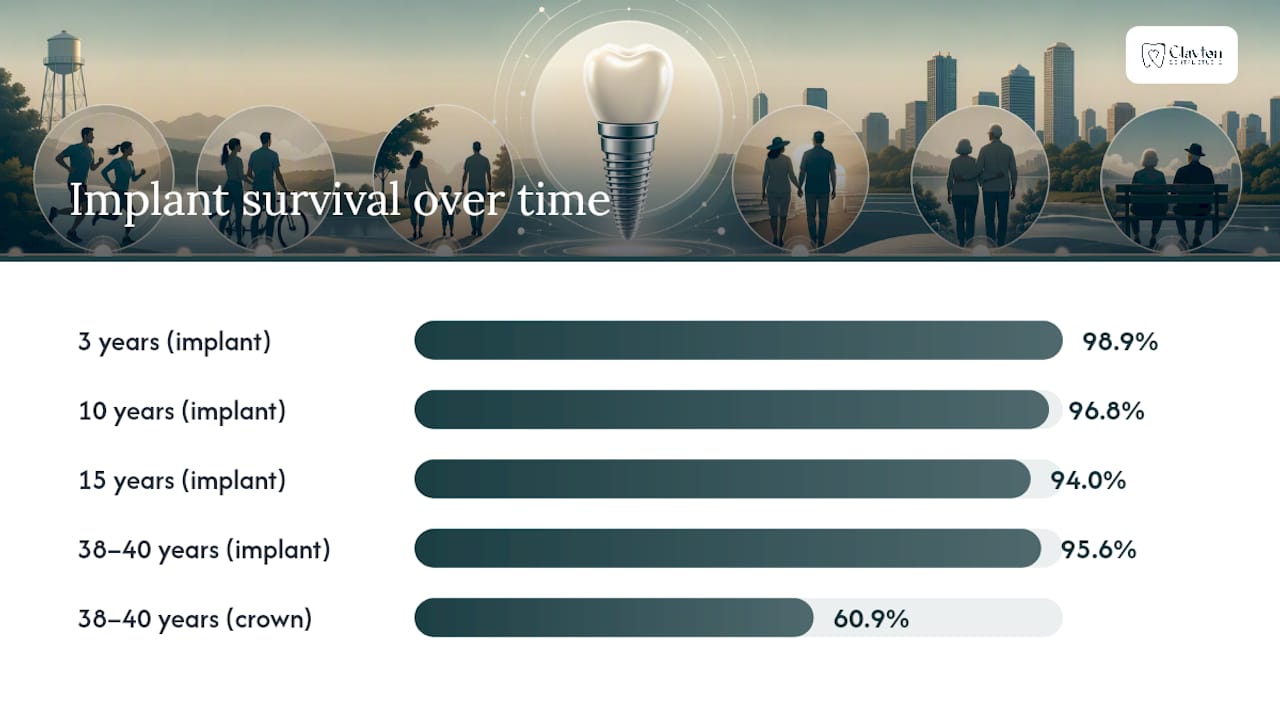
The honest answer to “how long do dental implants last” depends on which part of the implant you’re asking about, and the research backs up a genuinely encouraging picture for the titanium post itself. A cohort study following 10,871 implants in 4,247 patients over up to 22 years found cumulative survival rates of 98.9% at 3 years, 96.8% at 10 years, and 94.0% at 15 years. Push the timeline out even further, and a 38 to 40 year follow-up study found implant survival still holding at 95.6%, though implant-supported crowns in that same group survived at only 60.9% over the same stretch.
Why do numbers vary so much between studies? Sample size, length of follow-up, and whether researchers tracked single implants versus full-arch restorations all shift the results. A study following patients for 5 years will almost always report higher survival than one tracking them for 20, simply because more time means more opportunities for wear, gum changes, or a missed cleaning to catch up with someone.
Statistic Callout: At the 15-year mark, roughly 94 out of every 100 implants placed are still functioning, according to long-term cohort data. That’s a track record most other dental restorations can’t touch.
What’s Actually in a Dental Implant, and How Long Each Part Should Last
An implant is really three separate pieces working together, and they don’t age at the same rate. The implant fixture (the titanium or zirconia post) sits inside your jawbone. The abutment connects the post to your visible tooth. The crown is the part you actually chew with and show off when you smile.
The fixture is the long-haul component. Once it fuses to your jawbone through a process called osseointegration, which typically takes 3 to 9 months depending on bone quality and how soon we load it with a restoration, it behaves almost like a natural tooth root. The crown takes the brunt of daily chewing forces, so it wears down, chips, or discolors well before the post underneath shows any trouble. Harder ceramic materials and a controlled bite tend to stretch a crown’s working life considerably.
What Determines How Long Your Implant Lasts
Some factors are within your control, and some genuinely aren’t. Knowing which is which changes how you plan for the decades ahead.
- Uncontrolled diabetes and smoking both correlate with meaningfully higher implant failure rates, largely because both slow healing and impair the blood supply that gum tissue needs to fight infection.
- Active gum disease or thin, low-density bone at the implant site raises the risk of peri-implantitis, an infection that can loosen an otherwise sound implant.
- Multiple-unit cases carry more statistical risk than a single tooth replacement, simply because more implant sites means more chances for one of them to develop a complication.
- Grinding your teeth at night (bruxism) puts repeated stress on the crown and the bone around the implant, accelerating mechanical wear.
- Skipping hygiene visits or brushing carelessly around the implant site lets plaque do the same damage it does to natural teeth, just with different consequences.
Pro Tip: If you smoke and you’re weighing implants, ask about a pre-treatment cessation plan. Even a temporary reduction around surgery and healing measurably improves early integration odds.
Caring for Your Implant So It Lasts Decades, Not Years
Maintenance for dental implants isn’t complicated, but it is non-negotiable if you want the fixture to outlast your grandkids’ patience for hearing about it.
- Brush twice daily with a soft or electric brush, angled to reach the gum line around the implant collar, where plaque tends to hide.
- Clean between teeth daily using floss designed for implants, an interdental brush, or a water flosser. General guidance from the CDC on daily hygiene applies just as much to implants as natural teeth.
- Schedule professional cleanings at the interval we recommend, usually every 6 months, so we can check for early gum inflammation before it becomes bone loss.
- Get periodic X-rays and periodontal probing around the implant so we can catch bone changes that aren’t visible or painful yet.
- If you grind your teeth, wear a nightguard. It protects the crown and reduces the load transferred straight into the implant.
- Call us right away if you notice bleeding, swelling, looseness, or persistent bad breath near an implant site.
When the Crown Needs Replacing (and What That Actually Involves)
A crown replacement is normal, expected maintenance, not a sign that anything went wrong. Most crowns hold up for roughly 15 years before wear, small fractures, or cosmetic changes make replacement the sensible move, and that’s true even on implants where the underlying post remains completely stable. In fact, most late-stage failures in long-term studies were prosthetic or esthetic issues with the crown, not biological problems with the implant itself.
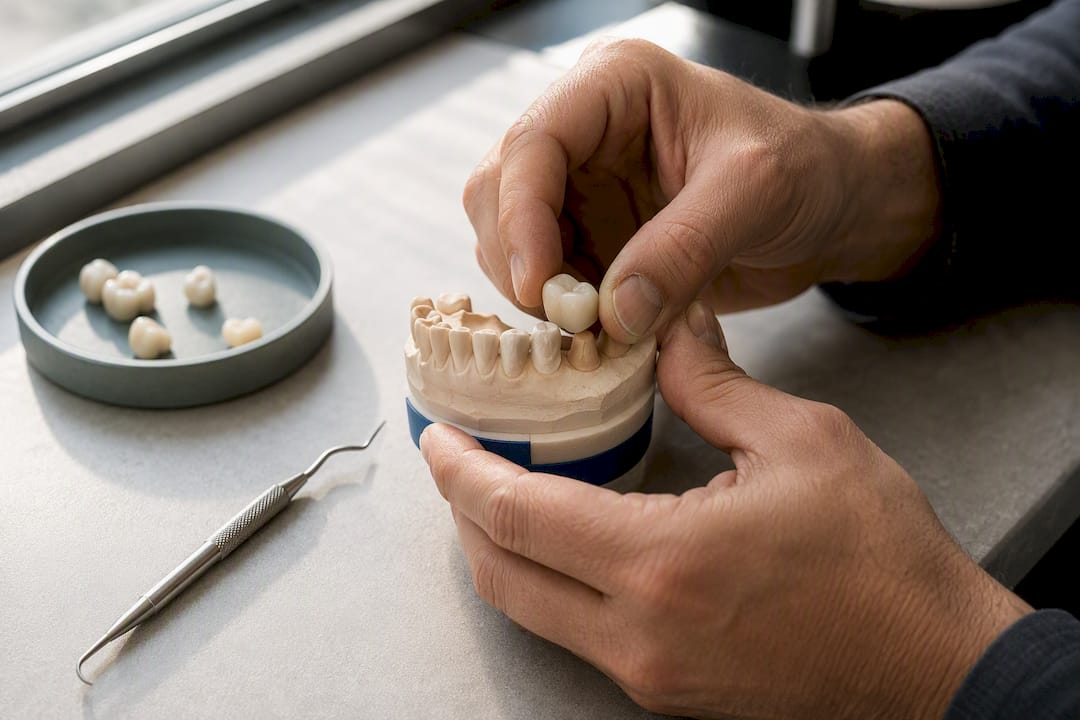
Re-treatment usually starts with an assessment of whether the implant fixture is still solidly integrated. If it is, we simply fabricate and place a new crown, similar to the process outlined in our implant timeline guide. If the post itself has failed, which is far less common, options range from bone grafting and re-implantation to a different restorative approach. Appointment counts and costs vary by case, but a straightforward crown swap is typically far simpler than the original placement.
Warning Signs That an Implant Is Failing
Most complications fall into two categories, and catching them early makes a real difference in outcome.
- Peri-implant mucositis is inflammation limited to the soft tissue around the implant, similar to gingivitis, and it’s usually reversible with professional cleaning and better home care.
- Peri-implantitis is more serious: the infection has reached the bone supporting the implant, and without treatment it can progress to implant loss.
- Early failure (within the first year) often traces back to insufficient bone integration or infection during healing.
- Late failure, appearing years later, more often stems from untreated gum disease, chronic overload from grinding, or uncontrolled smoking-related effects.
Next steps range from deep cleaning and antibiotic therapy for mild cases to surgical treatment or, occasionally, removal and replacement for advanced bone loss.
Our Perspective on What Actually Determines Implant Longevity
The dental implant lifespan conversation gets reduced to a single statistic far too often, and that oversimplification does patients a disservice. Dr. Navneet Kamboj earned her DDS from the University at Buffalo and completed a restorative preceptorship at UCLA, training that shapes how Clayton Dental Studio approaches implant planning from day one: the crown you’ll need to replace in 15 years matters just as much as the post that might outlast you.
What we see in practice is that patients who treat implant maintenance the same way they treat the rest of their oral health, consistent hygiene, regular checkups, honest conversations about smoking or blood sugar control, get results that track with the best long-term studies, not the worst ones. The same prevention philosophy behind our Dermal Hygiene™ program applies here: small, consistent habits outperform occasional heroic effort every time.
— Clayton Dental Studio
Ready to Talk About Long-Term Implant Success?
If you’re weighing implants or you already have one and want to make sure it lasts as long as the research suggests it can, an evaluation with a dental team is the clearest next step. A dental office can handle implant placement, restorative crown work, peri-implantitis treatment, and hygiene checkups that do most of the work of keeping an implant healthy for decades.
| What you get | Why it matters |
|---|---|
| Bone and gum assessment | Confirms your jaw can support long-term implant success |
| Custom maintenance plan | Matches your risk factors (bruxism, smoking, diabetes) to a specific care schedule |
| Early peri-implantitis screening | Catches infection while it’s still reversible |
We provide dental implant services in Humble, TX for patients who want a straightforward, evidence-based plan rather than guesswork. Visit our full services page to schedule an evaluation and get a clear picture of what your implant journey looks like from day one through year forty.
Sources
- Dental Implants: Types, Purpose & Benefits — Cleveland Clinic
- Long term clinical performance of 10 871 dental implants with up to 22 years of follow-up: A cohort study in 4247 patients — PMC
- Outcome of Single Dental Implants Over 38–40 Years: A Long‑Term Follow‑Up Study — Wiley
This article is general information, not a substitute for advice from a qualified doctor. Consult a qualified healthcare professional about your own circumstances before acting on anything here.
Recommended
Ready to Schedule Your Appointment?
Dr. Kamboj and the Clayton Dental Studio team are here to help. Call us or book online today.