
Humble, TX clinic guide to single tooth implants: how they work, who qualifies, realistic 3 to 8 month timelines, and what the cost covers.
Single Tooth Implant: Real Fix in 3 to 8 Months in Humble, TX
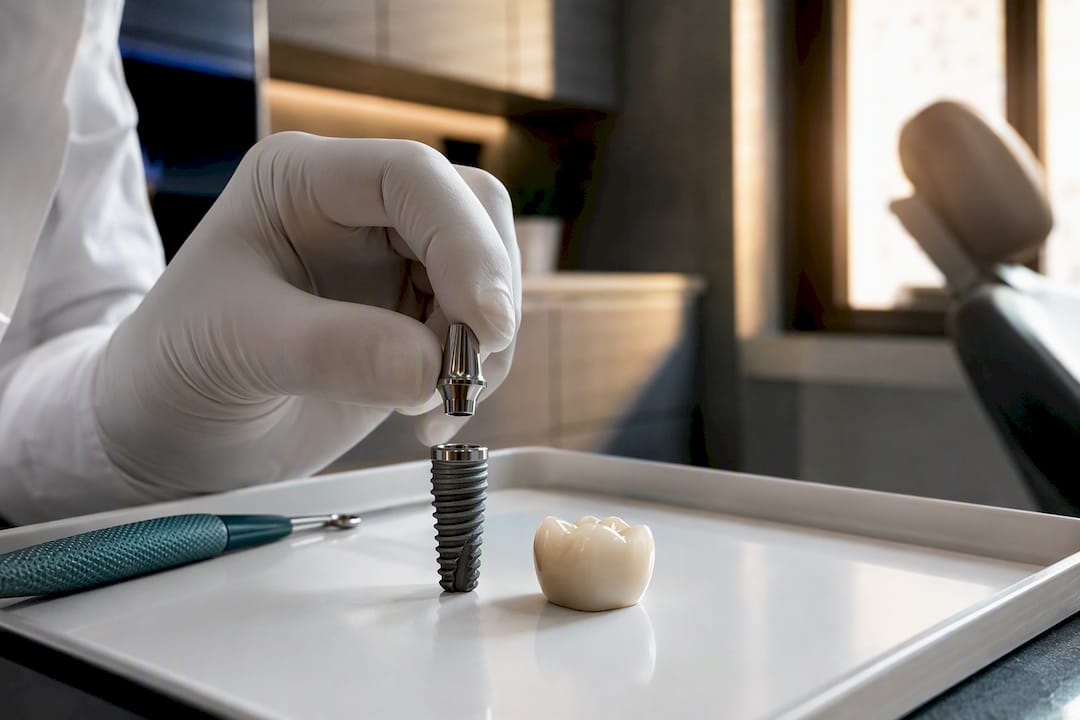
For most patients missing one tooth, a single tooth implant is the recommended long-term solution: a titanium post, an abutment, and a crown that work together to replace the tooth and its root without touching the teeth next to it. The main exceptions are patients without enough jawbone to support a post (unless they’re open to grafting), those with uncontrolled diabetes or other systemic disease, and heavy smokers, all of whom face higher failure risk.
TL;DR:
- Implants require sufficient jawbone density, meaning grafting procedures may extend healing time by up to six months before placement.
- Healing involves several stages, including osseointegration that typically takes three to six months, impacting overall treatment duration.
- Candidates need healthy gums, controlled systemic health, and non-smoking habits; inadequate bone or active disease raise failure risk.
- Total costs are broken down into component parts, with grafting, imaging, and crowns adding to the initial expense and insurance coverage varies.
- Regular post-operative care, including hygiene and plaque control, is essential to ensure long-term success and durability of the implant.
Table of Contents
- What a Single Tooth Implant Is and Why It’s Used
- Advantages and Trade-Offs Compared With Other Options
- Step-by-Step Procedure and Realistic Timeline
- Who Is a Good Candidate and How Clinicians Assess You
- Costs, Insurance, and Financial Planning
- Risks, Complications, and Aftercare
- How Clayton Dental Studio Approaches Single Tooth Implants
- Materials and Types of Implant Posts: Titanium vs Zirconia
- Crown Options for a Single Implant: Ceramic vs Porcelain Fused to Metal
- Pain Management and Anesthesia During the Procedure
- Alternative Tooth Replacement Options and When Implants Aren’t Right
- How Long Single Tooth Implants Actually Last
- Post-Operative Care and What Healing Actually Feels Like
- Where the Conventional Advice on Implants Falls Short
- Ready to Talk Through Your Options? Here’s What to Expect
- Sources
What a Single Tooth Implant Is and Why It’s Used
A single tooth implant has three parts. A titanium post is placed into the jawbone, where it fuses with living bone tissue over several months through a process called osseointegration. An abutment connects to the post above the gumline, and a custom crown attaches to the abutment to complete the tooth. The American Academy of Periodontology explains that this design replaces both the tooth and its root, which is a meaningful difference from a bridge or a removable partial denture, neither of which does anything to preserve the bone where the root used to be.
A bridge spans the gap by anchoring a false tooth to the crowns of the teeth on either side, which means those healthy teeth get ground down to hold it up. A removable partial denture avoids that but relies on clasps or suction that can shift while you eat or speak. An implant stands on its own. Patients who choose one typically notice:
- More natural chewing force, since the implant behaves like a real root instead of relying on neighboring teeth
- No alteration to adjacent healthy teeth
- Bone preservation in the jaw at the site of the missing tooth
- A crown color and shape matched to blend with the rest of your smile
Advantages and Trade-Offs Compared With Other Options
The case for an implant comes down to three things: it tends to last longer than a bridge, it preserves bone the way no other option does, and it functions independently instead of depending on neighboring teeth. Those advantages come with real trade-offs, though, and part of an honest consultation is weighing them against your specific situation.
What you gain:
- Long-term durability when properly maintained
- Bone preservation at the implant site
- No load placed on adjacent teeth
What it costs you:
- A surgical procedure, even though it’s typically done under local anesthesia in-office
- Possible bone grafting if the jaw lacks sufficient density
- A higher upfront cost than a bridge or partial denture
A bridge or removable appliance can still make sense for patients who aren’t good surgical candidates, need a faster fix, or have budget constraints that rule out grafting. Neither is a downgrade so much as a different tool for a different set of circumstances.
Pro Tip: If cost is the main hesitation, ask your dentist for a side-by-side estimate of an implant versus a bridge over a 15-year horizon. Bridges often need replacement or repair sooner, which changes the math more than the sticker price suggests.
Step-by-Step Procedure and Realistic Timeline
Most of the single tooth implant timeline isn’t chair time. It’s healing time, and that’s the piece patients underestimate most. Mayo Clinic outlines the staged nature of the process, and here’s how it typically unfolds:
- Evaluation and imaging. Your dentist examines your gums, checks bone volume with X-rays or a CBCT scan, and reviews your health history to confirm you’re a candidate.
- Preliminary procedures, if needed. If a tooth needs extraction first, or if bone volume is too low, you may need socket preservation, a bone graft, or a sinus lift before the implant can go in. These add anywhere from two to six months of healing, depending on the extent of the graft.
- Implant placement. The post is surgically placed into the jawbone in a visit that usually takes under an hour.
- Osseointegration. The bone fuses to the implant over three to six months. This is the biological waiting period, not something a dentist can speed up.
- Abutment placement and final crown. Once integration is confirmed, the abutment is attached and a custom crown is fabricated and seated, often across one or two shorter visits.
Total time from consult to finished crown usually falls between three and eight months, depending on whether grafting is needed. Some cases qualify for immediate placement, where the implant goes in right after extraction, or immediate loading, where a temporary crown is attached the same day. Clinical protocols reserve these approaches for cases with strong bone quality and stable positioning; they’re an option, not the default, according to surgical implant guidelines. You can read more about how each phase plays out in our dental implant timeline breakdown.
Who Is a Good Candidate and How Clinicians Assess You
Candidacy hinges on bone, gum health, and overall medical stability, not age alone. Adults whose jaw growth is complete are generally eligible regardless of whether they’re 25 or 75, provided the underlying tissue can support the implant.
At evaluation, your dentist checks for:
- Adequate bone volume and density, or a jaw structure that can be built up with grafting
- Healthy gums free of active periodontal disease
- Controlled blood sugar if you have diabetes, since uncontrolled disease slows healing and raises failure risk
- Non-smoking status, or a willingness to quit, since tobacco use is one of the strongest predictors of implant failure
- Certain medications, including some bone-affecting drugs, that may need review before surgery
Diagnostic tools include a clinical exam, periodontal charting to measure gum health, and a CBCT scan, which gives your dentist a 3D map of bone volume and nerve position before committing to a surgical plan.
Costs, Insurance, and Financial Planning
A single tooth implant is priced by component, not as one flat fee. You’re typically paying separately for the implant post, the abutment, the crown, any imaging like a CBCT scan, and grafting if it’s required. Specialist fees can add to the total if your general dentist refers out for the surgical placement.
Industry cost guides commonly cite per-tooth totals ranging from the low thousands to several thousand dollars, with grafting, crown material, and regional fee differences driving most of the variation. Insurance coverage for implants is inconsistent. Many dental plans classify implants as a major restorative benefit with partial coverage, while others exclude them entirely and cover only the crown portion.
Pro Tip: Ask your insurer directly which CPT and dental procedure codes apply to your case before treatment starts. Coverage decisions often hinge on the specific code submitted, not just the word “implant” on the claim.
To keep costs predictable:
- Request an itemized estimate covering every phase, not a single lump number
- Confirm which codes your insurer covers and which are excluded
- Ask about in-house financing or third-party dental savings plans if you’re paying out of pocket
Risks, Complications, and Aftercare
The most common implant complications are peri-implantitis (infection and inflammation around the implant), failed osseointegration, and, rarely, nerve or sinus involvement when the implant site sits close to those structures. Warning signs include persistent gum swelling, bleeding around the implant, looseness, or unusual numbness in the lip or chin.
Dentists manage early-stage infection with antibiotics and deep cleaning around the implant, called debridement. More advanced peri-implantitis may require revision surgery to remove infected tissue or, in rare cases, replace the implant. Our guide on peri-implantitis treatment covers what that process looks like in more detail.
Daily aftercare determines most long-term outcomes:
- Brush and floss around the implant just as you would a natural tooth, using implant-safe floss or interdental brushes
- Keep up with professional cleanings and maintenance visits on the schedule your dentist recommends
- Avoid tobacco, since smoking is consistently linked to higher implant failure rates, a topic we cover further in smoking and dental implants
How Clayton Dental Studio Approaches Single Tooth Implants
I’m Dr. Navneet Kamboj, and I’ve spent nearly a decade treating patients across the greater Houston area, with restorative training that includes a specialized preceptorship at UCLA following my DDS from the University at Buffalo. When a patient comes to me about a missing tooth, I use digital imaging to map bone volume and develop a treatment plan individualized to their needs, considering grafting when appropriate. My goal is a restoration that looks natural and holds up for years, not a one-size-fits-all protocol.
Materials and Types of Implant Posts: Titanium vs Zirconia
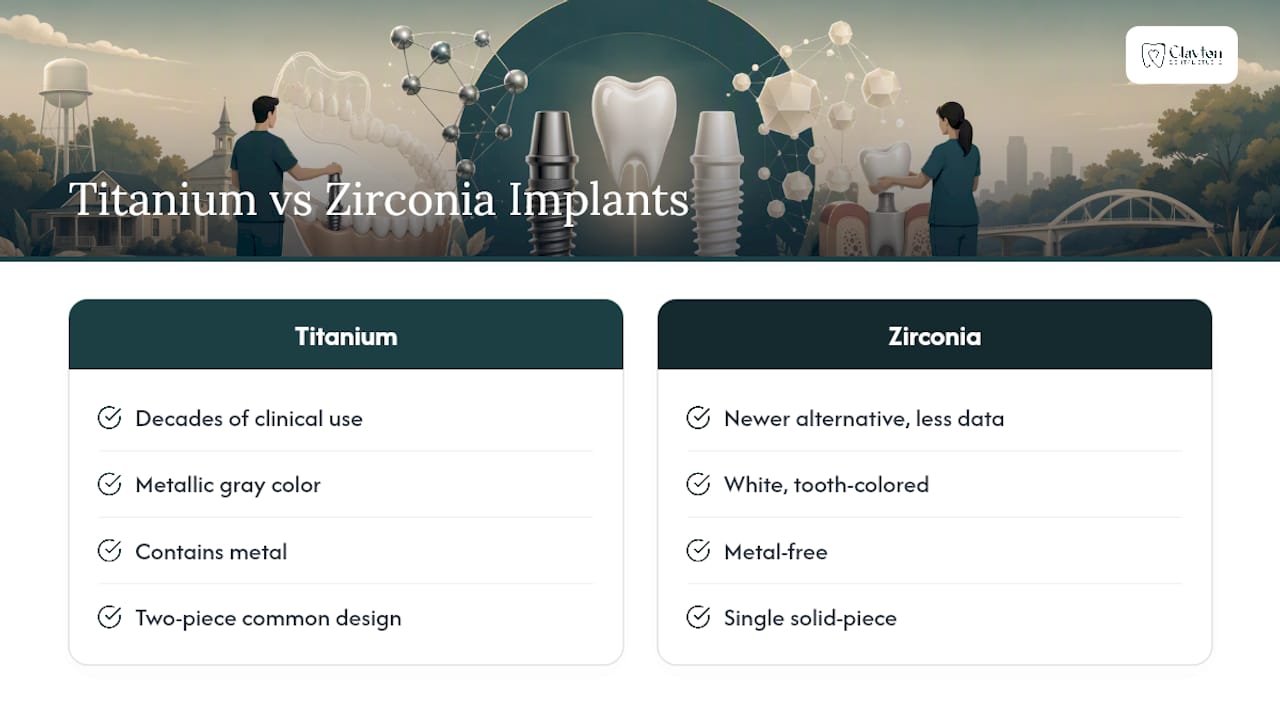
Titanium remains the standard implant post material, and for good reason. It has decades of clinical use behind it, integrates reliably with bone, and holds up under the daily forces of chewing. Most titanium implants today use a roughened surface texture that helps bone cells attach faster during osseointegration.
Zirconia is a newer alternative, valued mainly for its white color rather than the metallic gray of titanium, which can occasionally show through thin gum tissue near the gumline. Zirconia is also metal-free, which appeals to patients with metal sensitivities or a strong preference for avoiding metal implants altogether. It’s a single, solid piece rather than the two-piece design common with titanium, which limits some flexibility in angling the abutment during placement.
Both materials integrate with bone effectively, and the right choice usually depends on where the tooth sits and your gum thickness rather than a blanket preference for one material over the other. An implant replacing a molar, where esthetics matter less and chewing force matters more, often does fine with titanium’s proven track record. A front tooth with thin gum tissue might be a better candidate for zirconia’s tooth-colored profile. Cost also differs: zirconia implants tend to run higher than titanium because of the material and the specialized manufacturing involved. Neither option is inherently superior. What matters is which one fits your bone structure, your gum thickness, and the location of the tooth you’re replacing.
Crown Options for a Single Implant: Ceramic vs Porcelain Fused to Metal
The crown is the visible part of your implant, and it comes in a few different builds depending on strength needs and where the tooth sits in your mouth.
All-ceramic crowns, often made from materials like zirconia or lithium disilicate, are the most common choice for implants today because they mimic the translucency of natural enamel closely. They tend to be the preferred option for front teeth, where light passing through a natural tooth creates subtle color variation that all-ceramic materials can replicate more convincingly than metal-backed options.
Porcelain fused to metal crowns pair a metal substructure with a porcelain outer layer. The metal core adds strength, which made this the standard choice for molars and back teeth for years, especially in patients with a heavy bite. The trade-off is a slightly less natural translucency and, occasionally, a thin dark line at the gumline if tissue recedes over time.
Material choice depends on the tooth’s location, your bite force, and gum tissue thickness, and it’s worth discussing directly with your dentist rather than assuming one option fits every case. Our page on onlay vs crown options covers related restorative material questions if you’re comparing choices for a different tooth.
Pain Management and Anesthesia During the Procedure
Most single tooth implant placements happen under local anesthesia, the same numbing approach used for a filling, and patients are often surprised at how little discomfort the surgery itself involves. The bone itself has no pain receptors the way soft tissue does, so once the area is numb, patients typically feel pressure and vibration rather than pain during placement.
For patients with dental anxiety or a longer procedure involving grafting, oral or IV sedation is an option to add on top of local anesthesia. This doesn’t eliminate the numbing step. It simply keeps you relaxed or lightly sedated throughout, which can make a multi-step appointment feel far shorter than it actually is.
After the anesthesia wears off, some soreness and swelling in the first two to three days is normal and typically managed with over-the-counter pain relievers like ibuprofen. Your dentist may prescribe something stronger for the first day or two if grafting was involved, though most single-implant placements without grafting resolve with standard pain management. Ice packs during the first 24 hours help control swelling significantly.
Alternative Tooth Replacement Options and When Implants Aren’t Right
An implant isn’t automatically the right call for every missing tooth, and a good consultation should walk through the alternatives honestly rather than push toward surgery by default.
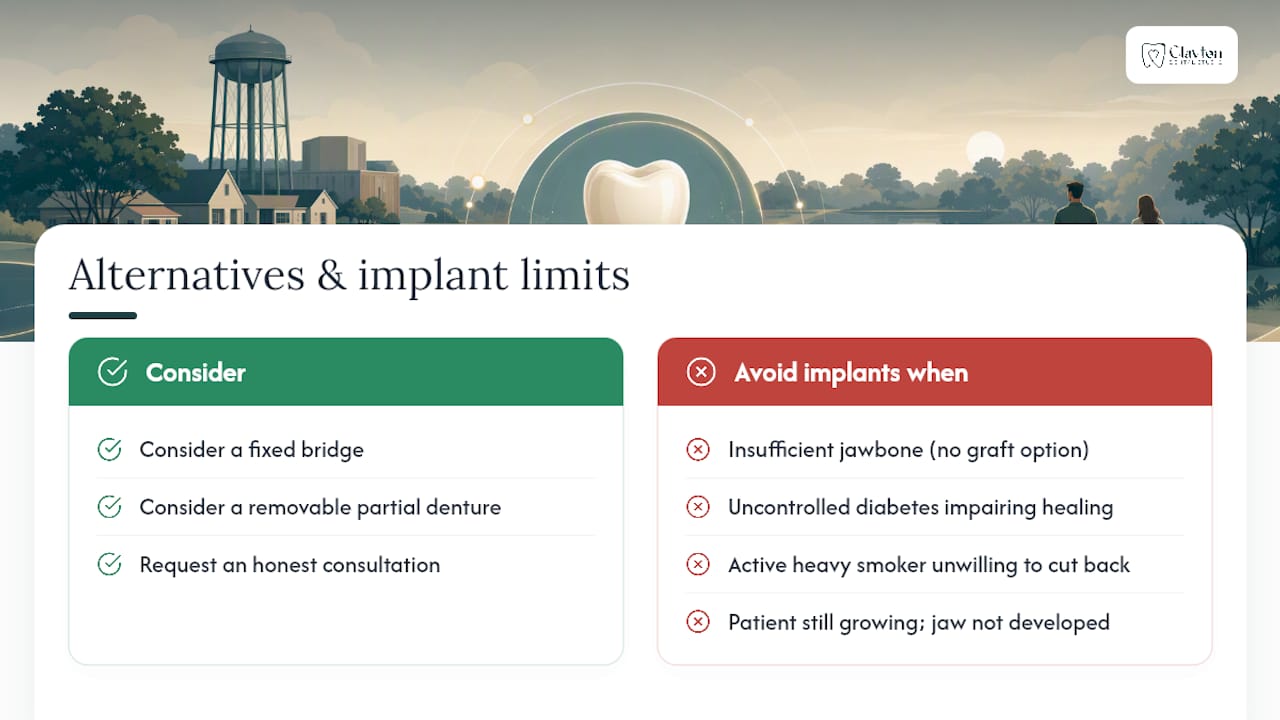
A fixed bridge anchors a replacement tooth to the crowns of the teeth on either side of the gap. It skips the surgical step entirely and can be completed faster, though it requires reshaping two healthy teeth to support it, and it does nothing to preserve the bone underneath the missing tooth.
A removable partial denture replaces one or more teeth without altering neighboring teeth or requiring surgery. It’s usually the least expensive option and the fastest to produce, though it can feel less stable when chewing and needs to be removed for cleaning.
Implants may not be the right fit if you have insufficient jawbone and aren’t a candidate for grafting, if you have uncontrolled diabetes or another condition that impairs healing, if you’re an active heavy smoker unwilling to cut back during the healing window, or if you’re still growing (implants require a fully developed jaw). Patients with certain bleeding disorders or those undergoing radiation therapy to the jaw may also need to explore other paths first. Our missing teeth page walks through how these options compare for different situations.
How Long Single Tooth Implants Actually Last
A well-placed and well-maintained single tooth implant is designed to function for decades, and many patients keep the same implant post for the rest of their lives. The crown itself may need replacement at some point due to normal wear, typically after 10 to 15 years, but the titanium or zirconia post underneath tends to remain stable far longer.
Cleveland Clinic notes that implants function much like natural tooth roots once integration is complete, which is part of why long-term outcomes tend to be favorable when patients keep up with maintenance. Success isn’t guaranteed by the procedure alone, though. It depends heavily on what happens afterward: daily hygiene, regular dental visits, and avoiding tobacco all directly affect how long an implant lasts.
The biggest threat to longevity isn’t the implant hardware failing on its own. It’s peri-implantitis, the gum infection that develops around an implant when plaque builds up and isn’t managed, similar to how periodontal disease damages natural teeth. Catching it early, through the same six-month cleanings you’d schedule for natural teeth, is what separates an implant that lasts 30 years from one that needs revision at year eight.
Post-Operative Care and What Healing Actually Feels Like
The first 24 to 48 hours after implant placement bring the most noticeable swelling and tenderness, usually peaking on day two before gradually improving. Most patients describe it as milder than a tooth extraction, since the surgical site is smaller and more localized.
Expect these post-op basics:
- Bite on gauze for the first hour to control bleeding at the site
- Stick to soft foods (yogurt, soup, scrambled eggs) for the first several days
- Avoid rinsing, spitting forcefully, or using a straw for at least 24 hours, since suction can dislodge healing tissue
- Brush gently around the surgical site while keeping the rest of your mouth’s normal hygiene routine
- Skip strenuous exercise for a few days to avoid increasing blood pressure at the site
Minor bruising on the cheek or jaw near the implant site is common and usually resolves within a week. Contact your dentist if you notice fever, pus, or pain that worsens after day three instead of improving. If you had a temporary crown placed and it comes loose during healing, our guide on a temporary crown that came off walks through what to do before your next visit. Full osseointegration continues quietly in the background for months after the surgical site itself feels back to normal.
Where the Conventional Advice on Implants Falls Short
Most of what’s written about single tooth implants focuses on the surgery itself, and that’s the wrong emphasis. The surgical placement is genuinely the shortest and least eventful part of the entire process. What actually determines whether your implant lasts 10 years or 30 comes down to two things patients rarely hear enough about: whether the bone was properly evaluated before treatment began, and whether daily maintenance happens afterward with the same discipline as caring for a natural tooth.
The other gap we see constantly is patients treating the cost conversation as a single number instead of a staged one. Grafting, imaging, the post, the abutment, and the crown are separate line items with separate timelines, and understanding that upfront prevents the sticker shock that makes people abandon treatment halfway through. If we could change one thing about how this procedure gets discussed publicly, it would be shifting the focus from “how much does surgery hurt” to “what does the next decade of maintenance look like.” That’s the question that actually predicts your outcome.
— Clayton Dental Studio
Ready to Talk Through Your Options? Here’s What to Expect
If you’re weighing a single tooth implant against a bridge or partial denture, the clearest next step is a consultation where we can actually look at your bone structure and gum health instead of guessing from a description. Clayton Dental Studio approaches implant planning the same way we approach every restorative case: with digital imaging first, so you get a treatment plan built around your mouth rather than a generic estimate.
Bring your dental insurance information, a list of current medications, and any recent X-rays or CBCT scans if another provider already took them. Come ready to ask direct questions: how many months of healing to expect, whether grafting is likely, and what the total cost breaks down to by component. Our dental implants page covers what our process looks like in more detail, and you can review our full range of restorative and cosmetic services before your visit. When you’re ready, reach out to schedule a consultation and get a bone assessment scheduled.
This article is general information, not a substitute for advice from a qualified doctor. Consult a qualified healthcare professional about your own circumstances before acting on anything here.
Sources
- Single Tooth Dental Implants - American Academy of Periodontology
- Dental implants: What you should know | FDA
- Dental implant surgery - Mayo Clinic
- Dental Implants - Cleveland Clinic
- Surgical implant protocols (NCBI Bookshelf)
Recommended
Ready to Schedule Your Appointment?
Dr. Kamboj and the Clayton Dental Studio team are here to help. Call us or book online today.