Porcelain dental crowns explained: how they compare with zirconia and metal, how long they last, what the visits involve, and when same-day CEREC makes sense.
Porcelain Dental Crowns: Types, Lifespan and What to Expect
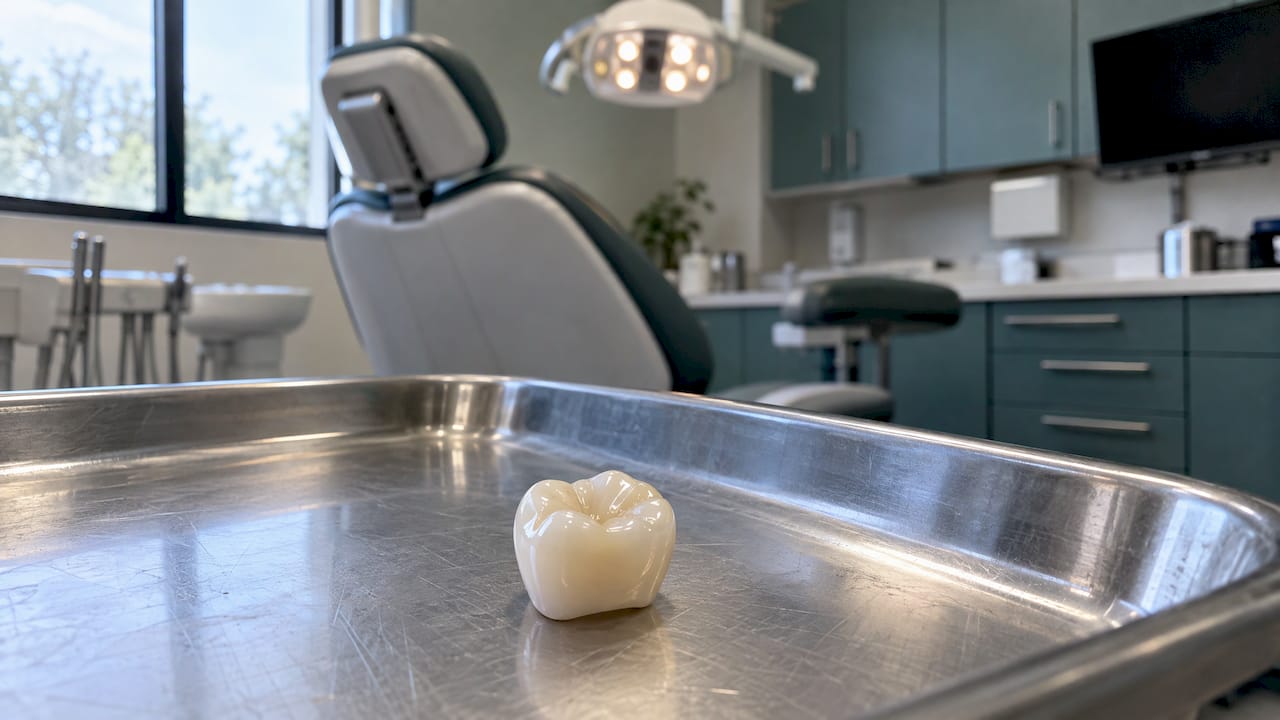
A porcelain crown is a tooth-shaped cap that covers a damaged tooth above the gum line. It is the crown most people choose when appearance matters, because it matches the color of your other teeth. I’m Dr. Kamboj, and at Clayton Dental Studio in Humble, TX, we make porcelain-type crowns in a single visit with CEREC technology, so you can leave with your permanent crown instead of wearing a temporary one for weeks.
Below, you’ll find how porcelain compares with other crown types, how long a crown lasts, what the visits involve, and what to do if a crown chips, loosens or needs replacing.
TL;DR
- Porcelain and ceramic crowns are the closest match to natural enamel, and they suit people with metal allergies.
- Most crowns last at least 5 years and often 15 to 20, depending on your care and habits such as grinding.
- Traditional crowns take two visits with a temporary in between. Same-day CEREC crowns are made while you are in the office.
- The tooth under a crown can still get a cavity, so brushing and flossing matter as much as before.
- A loose, cracked or sharp-feeling crown is worth a prompt call to your dentist.
Table of Contents
- What a porcelain crown is
- Types of tooth crowns compared
- How long porcelain crowns last
- What happens when you get a crown
- Can a tooth decay under a crown?
- Crown repair or replacement
- Is porcelain right for you?
- Same-day crowns in Humble
- Our perspective
- FAQ
- Sources
What a porcelain crown is
The MedlinePlus encyclopedia describes a crown as a cap that replaces the normal tooth above the gum line. It lists porcelain and ceramic crowns among the types that match the color of your other teeth and may be a good choice if you have a metal allergy.
You will see “porcelain” and “ceramic” used almost interchangeably. Cleveland Clinic groups them as all-ceramic or porcelain crowns, and zirconium dioxide (zirconia) is among the most popular ceramic materials. In everyday conversation at the dental chair, a porcelain crown means a tooth-colored, metal-free crown.
When a crown is recommended
MedlinePlus lists the usual reasons: a large cavity, a chipped or broken tooth, a worn or cracked tooth, a stained tooth, or a badly shaped one. A crown is also used to cover a dental implant or anchor a bridge. If the tooth has had a root canal, a crown commonly protects what is left, since the tooth can be weaker afterward. We look at how much natural tooth remains before recommending anything.
Types of tooth crowns compared
The American Dental Association groups indirect restorative materials into noble metal alloys, base metal alloys, ceramics, resin-based composites and metal-ceramics. It also notes that CAD/CAM (computer-designed, machine-milled) technology has widened the all-ceramic options, which have grown popular for their appearance and improving durability.
| Crown type | Look | What to know |
|---|---|---|
| All-porcelain or ceramic | Closest to natural enamel | Metal-free; porcelain can chip, and back teeth see higher fracture rates than front teeth |
| Zirconia | Tooth-colored | A popular ceramic material for strength-demanding teeth |
| Porcelain-fused-to-metal | Tooth-colored surface over a metal base | Long considered the gold standard; the metal framework can limit appearance |
| Gold or metal alloy | Metallic | Very durable; used mostly where looks matter less |
A Canadian review of PFM versus all-ceramic crowns notes that PFM crowns were long the standard for damaged teeth, but their metal framework and opaque layer limit esthetics. All-ceramic crowns made from lithium disilicate, zirconia and other materials have been used for over four decades to solve that.
How to choose
The Journal of the American Dental Association says material choice depends on where the crown sits and how visible it is when you smile, how hard it must chew, the color of neighboring teeth and cost. In practice:
- Front teeth: porcelain or ceramic usually gives the most natural result.
- Molars: strength matters more, so we talk through the material that fits your bite.
- Metal allergy: a metal-free crown is the natural place to start.
- Grinding or clenching: tell us. It affects both material and protection afterward.
Our guide to the best material for dental crowns goes deeper if you want to compare further.
How long porcelain crowns last
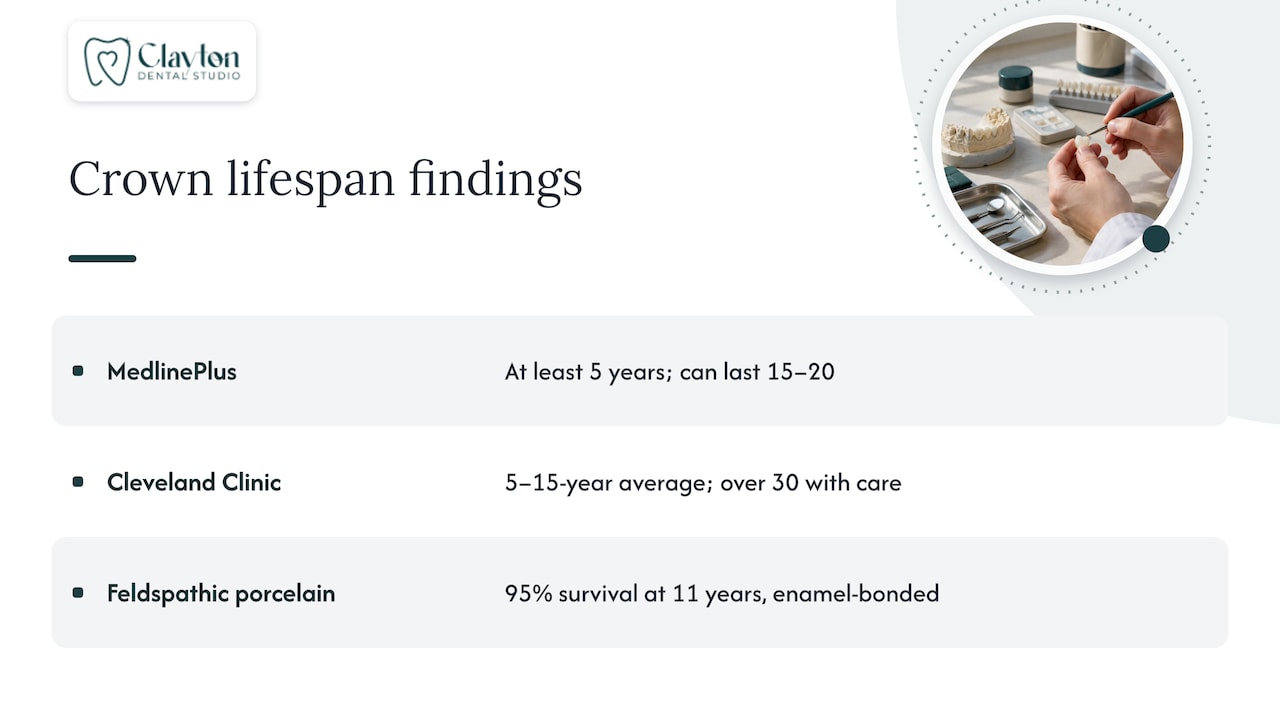
MedlinePlus says most crowns last at least 5 years and can last 15 to 20. Cleveland Clinic gives an average of five to 15 years, and upward of 30 with good care. A peer-reviewed review of dental ceramics reports 95% survival at 11 years for feldspathic porcelain crowns bonded to enamel, which is why we like porcelain where plenty of healthy enamel remains.
The ADA reports that crown fracture is the most frequent complication of all-ceramic materials, and that molars fracture more often than front teeth. That is the reason material choice and bite protection are part of planning, not an afterthought.
Habits that protect a crown
- Brush twice a day with fluoride toothpaste and floss daily.
- Skip ice and hard candy, which can chip porcelain, as MedlinePlus advises.
- If you grind or clench, wear a custom night guard. MedlinePlus recommends a bite splint or mouth guard for this.
- Keep up regular cleanings and exams so small problems are caught early.
For more on timelines, see our posts on how long a crown lasts and crown lifespan.
What happens when you get a crown
According to MedlinePlus, a traditional crown usually takes two visits.
- Prepare the tooth. The dentist numbs the area, removes decay or an old filling, and reshapes the tooth. This is the step many anxious patients worry about. We explain each stage before we start, and you can ask us to pause.
- Take the impression. This is either a mold or a digital scan. A scan means a small camera captures the tooth, with no trays of putty.
- Wear a temporary crown. JADA notes a lab can take up to about 2 weeks to make the permanent crown. The temporary protects the tooth meanwhile.
- Fit the permanent crown. The dentist checks fit and bite, may take an x-ray, and cements it.
With a temporary in place, MedlinePlus advises sliding floss out rather than lifting it, avoiding sticky foods like caramels and gum, and chewing on the other side. Call your dentist for worsening swelling, a bite that feels wrong, a lost temporary or pain that over-the-counter medicine does not relieve. If it comes off, see what to do when a temporary crown comes off.
The same-day option
Think of CEREC as a custom workshop inside the dental office. We scan the prepared tooth digitally, the crown is designed on screen and milled while you wait, and it is fitted in the same appointment. That removes the temporary stage, the second trip and the risk of a temporary coming loose. For a full walkthrough, read our crown procedure steps or the checklist before a same-day crown.
Can a tooth decay under a crown?
Yes. MedlinePlus states the tooth beneath can still get a cavity, which is why daily brushing and flossing continue to matter. It also notes a crown can fall off if the tooth core is too weak, can chip or crack, and the nerve can become sensitive to hot and cold, sometimes needing a root canal.
Cleveland Clinic advises calling your dentist if you notice:
- a loose crown
- bad breath or a bad taste
- cracks or chips
- sharp edges that bother your tongue or gums
A crown that fits well is part of prevention, since a poor fit can trap bacteria and lead to decay.
Crown repair or replacement
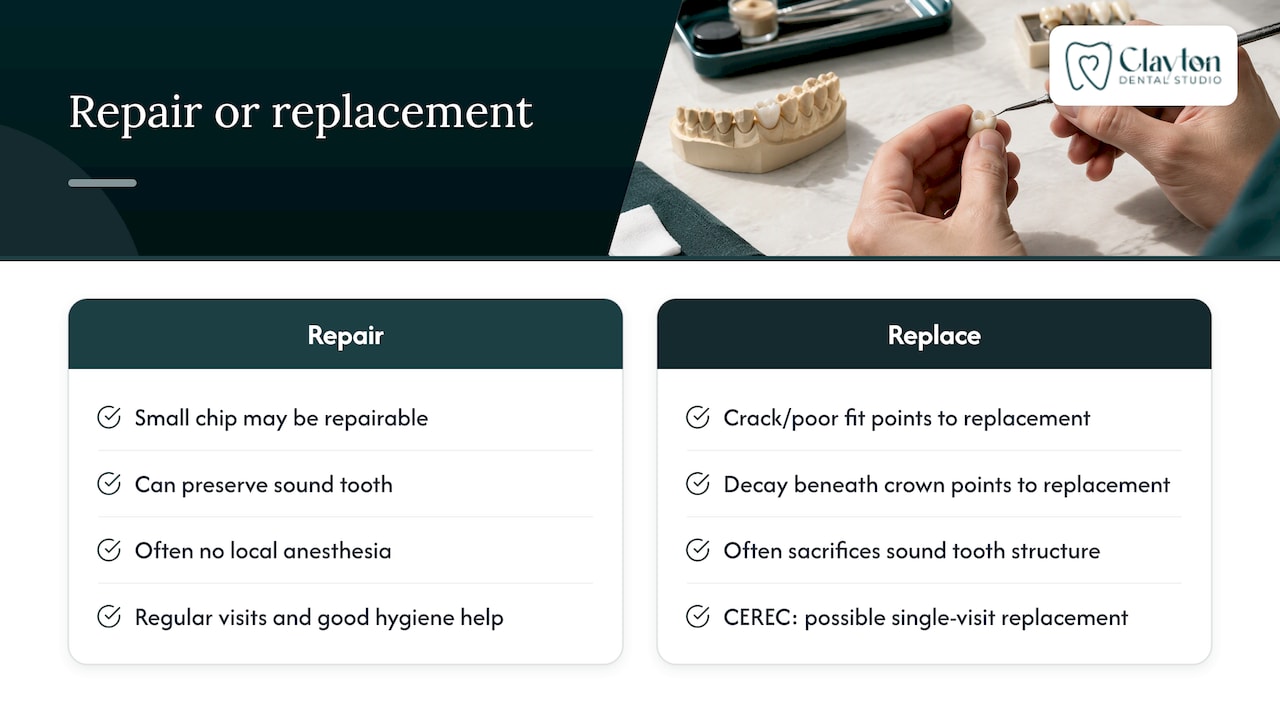
Not every problem means a new crown. A review of reparative dentistry explains that replacing a restoration is often costly and commonly sacrifices sound tooth structure, so repair can be a safe option that preserves it. The authors note that patients who attend regularly and keep up good hygiene are ideal candidates, and that repair can often be done without local anesthesia, which helps patients with dental anxiety.
A small chip may be repairable. A crack, a crown that no longer fits, or decay beneath it usually points to replacement. We examine it and tell you honestly which applies. If the crown has broken, our page on a broken crown covers what to do first. Replacement follows the same steps as a first crown, and it can also be done in a single visit with CEREC.
Is porcelain right for you?
Porcelain is worth considering if you want a natural-looking result, you have a metal allergy, or the tooth is visible when you smile. Be aware that, per MedlinePlus, porcelain can wear the opposing teeth more than metal crowns do, which is one more reason we check your bite and plan around grinding. If you’re weighing crowns against a cosmetic alternative for front teeth, see how veneers are made.
We don’t publish crown prices, because cost depends on the tooth, the material and your insurance. We bill dental insurance for covered treatment and offer flexible financing, and our team can give you an estimate at your visit.
Same-day crowns in Humble
If you have a cracked, broken or heavily filled tooth and want it fixed without a temporary and a second appointment, our same-day CEREC crowns are made in our Humble office with Trios 5 scanning. We keep the setting calm and unhurried, and we explain each step. For toothache or a broken tooth, our emergency dentistry team can see you.
Our perspective
A crown should look like your tooth, feel like your tooth and not take over your schedule. That is why we invested in same-day technology.
Many patients arrive nervous, expecting weeks of temporaries and repeated numbing. A digital scan and an in-house milling unit change that experience, and a spa-like, stress-free office helps with the rest.
We also believe in prevention. A well-fitted porcelain crown, a night guard when you clench, and regular exams give a restored tooth its best chance of lasting. We build a personalized plan for every patient, from children to grandparents, in one practice.
Clayton Dental Studio
FAQ
Are porcelain crowns the same as ceramic crowns?
They overlap. Cleveland Clinic groups them together as all-ceramic or porcelain crowns, and zirconia is one popular ceramic material. Both are tooth-colored and metal-free. Your dentist can tell you which specific material suits the tooth.
Do crowns hurt?
The dentist numbs the area before reshaping the tooth, so the procedure itself should be comfortable. Some sensitivity to hot and cold can follow, as MedlinePlus notes. Tell us if you feel anxious, and we will go at your pace.
Can I get a crown on just a front tooth?
Yes. A crown is made for the individual tooth that needs it, and porcelain is a common choice for front teeth because it blends so closely with the neighboring teeth.
Do I need a crown after a root canal?
Often, yes. A root canal can leave the tooth weaker, and a crown protects it from fracturing. We check how much natural structure remains and recommend what fits your tooth.
Sources
- Dental crowns, MedlinePlus Medical Encyclopedia
- Materials for Indirect Restorations, American Dental Association
- Porcelain-Fused-to-Metal Crowns versus All-ceramic Crowns, NCBI Bookshelf
- Dental ceramics for restoration and metal-veneering, PMC
- Wearing a crown, The Journal of the American Dental Association
- Reparative Dentistry: Possibilities and Limitations, Current Oral Health Reports
Recommended
Ready to Schedule Your Appointment?
Dr. Kamboj and the Clayton Dental Studio team are here to help. Call us or book online today.